




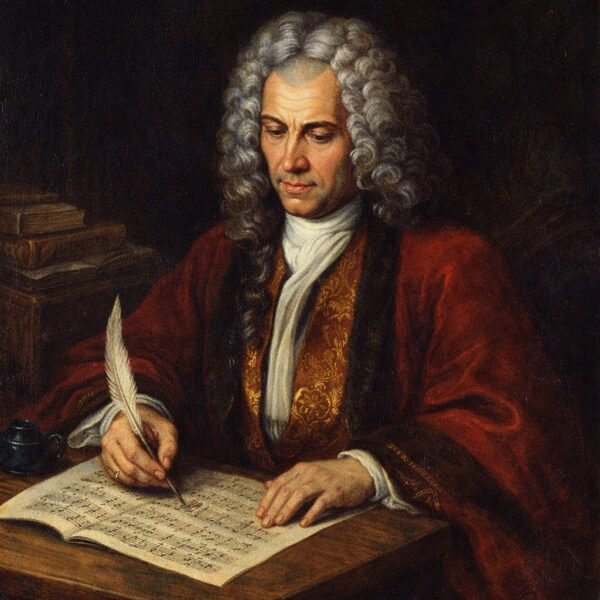
TREATISE ON COUNTERPOINT AND FUGUE (PART 18. FUGUE)
PART XVIII – Historical Origins of the Fugue
XVIII.1 Imitative antecedents in late medieval polyphony
XVIII.2 The Renaissance ricercare as a proto-form of the fugue
XVIII.3 The instrumental canzona and its formal influence
XVIII.4 The evolution of strict imitation
XVIII.5 The emergence of a recognizable subject
XVIII.6 The development of the imitative answer
XVIII.7 The transition from the modal system to tonality
XVIII.8 The gradual standardization of the number of voices
XVIII.9 Differentiating free imitation from the fugue
XVIII.10 The stabilization of the exposition
XVIII.11 The terminological consolidation of “fugue”
XVIII.12 Early liturgical and instrumental contexts
XVIII.13 The historical fixing of the fugue toward the Baroque
XVIII.1 Imitative antecedents in late medieval polyphony
In the polyphony of the late Middle Ages, the first manifestations of imitation between voices began to appear—an element that would become fundamental to the later development of the fugue. Imitation means that one voice repeats or “chases” a melodic motive presented by another, creating an echo-like contrapuntal effect. Medieval theorists even used the term fuga (from Latin fuga, “flight” or “pursuit”) to describe this phenomenon of voices that pursue one another musically. However, in that period imitation was still sporadic and largely confined to special forms; it had not yet become a general organizing principle for polyphonic works.
An early example of strict imitation can be found in the English rota, a type of circular canon. The piece Sumer is icumen in (c. 1250) is emblematic: six voices enter successively with the same melody in canon, generating a tightly interwoven sonic tapestry. Likewise, in Trecento Italy, the caccia emerged—a secular polyphonic form in which two voices sing the same melody displaced in time (a canon at the unison or octave), often over an instrumental accompaniment. These musical “hunts”—frequently with texts that allude ironically to the pursuit of animals or other dynamic scenes—exemplify the late medieval taste for literal imitation: one voice “flees,” and the other “pursues” it by singing exactly the same material a few measures later. Similarly, France had the chace, and courtly repertories occasionally explored canonic puzzles. All of these cases show that the idea of strict contrapuntal imitation was already known in the fourteenth century, though it remained a curiosity within a landscape dominated by other compositional techniques.
It is important to note that, outside these specific canonic compositions, the prevailing medieval polyphony (for instance, the isorhythmic motet of the Ars Nova) did not use imitation as a primary structural device. Voices tended to move relatively independently, superimposing different melodies over a plainsong tenor without a common theme passing from voice to voice. Nevertheless, late medieval experiments with canons and multi-voice pursuits planted the seed of a constructive principle that would grow in relevance: the idea of structuring music through staggered repetition of the same motive in different lines. These imitative antecedents of the late Middle Ages prefigure—on a small scale—the concept of the fugue, in which voices enter successively to present the same theme.
XVIII.2 The Renaissance ricercare as a proto-form of the fugue
During the Renaissance, as instrumental music gained autonomy, contrapuntal forms based on imitation emerged that can be considered proto-forms of the fugue. Chief among them is the ricercare, an instrumental genre widely cultivated in the sixteenth century and the early seventeenth. The Italian term ricercare means “to seek” or “to explore,” suggesting the inquisitive character of these pieces, in which the composer “searches” out elaborate developments from one or more themes. Originally, some ricercares had a more improvisatory or chordal style (derived from the practice of preluding on lute or keyboard to check tuning), but they soon evolved toward strictly imitative compositions, emulating the contrapuntal fabric of vocal motets. In this context, the ricercare became an ideal experimental field for techniques that would later define the fugue.
The imitative ricercare typically presents a single musical theme that is exhaustively developed by all the voices throughout the piece, through successive entries and contrapuntal transformations. Because it lacks a text (unlike vocal motets), the composer can sustain work on the same motive indefinitely without literary constraints, achieving a thematic unity that directly anticipates fugal procedure. For example, in the Italian and Flemish organ traditions of the sixteenth century, it was common for a ricercare to begin with a single voice stating the theme; then the other voices would enter one by one imitating that initial melody—exactly as will later happen in the exposition of a fugue. Venetian composers such as Andrea Gabrieli wrote four-voice ricercares in which a single thematic subject is treated with techniques associated with the future fugue, such as stretto (entries in close pursuit, before the previous voice has finished), augmentation or diminution of the theme (lengthening or shortening note values to present it more slowly or more quickly), and even partial inversions. These works were among the first to produce a discourse built entirely on imitation, foreshadowing the formal rigor the fugue would reach in the Baroque.
The importance of the ricercare as a predecessor of the fugue is evident in the fact that, even in the mid-eighteenth century, Johann Sebastian Bach still used the term: two pieces in Das Musikalische Opfer (1747) are titled Ricercar and are essentially sophisticated fugues. This highlights the historical continuity between the Renaissance ricercare and the Baroque fugue. In short, the ricercare established the concept of a monothematic imitative composition, setting a clear model for how a musical subject could be explored across all voices in an organized way. This proto-form gave Renaissance composers a laboratory in which to refine the art of strict imitative counterpoint—an art that would reach full maturity in the Baroque fugue.
XVIII.3 The instrumental canzona and its formal influence
An instrumental canzona often begins with a fugal section—that is, with an initial theme presented imitatively by the different voices of the ensemble. For example, in Giovanni Gabrieli’s canzonas for brass ensembles at St. Mark’s Basilica in Venice, the opening consists of a thematic fanfare that is imitated across multiple voices, producing a majestic polyphonic effect of call and response among different instrumental choirs. After this imitative opening, the canzona typically proceeds to new sections, each with its own characteristic motive. These contrasting sections could also incorporate imitation: it was common, when introducing a “B” motive in a subsequent section, for the voices to develop it briefly in imitation, though without the extensive elaboration of the first section. Thus, a single canzona could contain several pseudo-fugal episodes (each centered on a different theme), separated by rhythmically marked transitions.
The canzona’s influence on fugal form can be seen in several respects. First, it fostered the idea that a rhythmically defined theme could articulate an initial contrapuntal texture, preparing the ear to recognize successive entries of a subject—an essential notion in the fugue. Second, the canzona’s sectional logic—alternating imitative passages with contrasting material—anticipates the Baroque fugue’s concept of the episode. In mature fugues, although there is one global subject rather than multiple separate themes, episodic material is interspersed to provide variety and to modulate toward new keys; this practice parallels the canzona’s section changes. Finally, the canzona experimented with imitation in varied instrumental contexts: from keyboard pieces (such as Girolamo Frescobaldi’s canzonas, which adapt the model to harpsichord and organ) to early orchestral sonorities. In sum, the canzona provided a flexible formal scheme that fed composers’ imagination regarding the handling of imitative themes and contrasts, contributing to the gestation of the fugue. Indeed, at the beginning of the Baroque, many sonatas—and even overtures—adopted movements labeled “canzona” or “allegro fugato,” direct heirs of this tradition, showing how the canzona paved the formal way for the later consolidation of the fugue.
XVIII.4 The evolution of strict imitation
The refinement of strict imitation (that is, note-for-note imitation, typically in the form of a canon) was an important thread from the late Middle Ages through the Renaissance, and its evolution provided vital technical foundations for the future fugue. In the fifteenth and sixteenth centuries, composers explored the canon not only as a contrapuntal curiosity, but as a means of giving internal unity to compositions. Although most Renaissance polyphony employed free imitation (entries that are similar but not mathematically exact, adapted to harmonic and textual needs), the art of strict canon persisted—and was perfected—in parallel as a compositional discipline.
A notable milestone in the evolution of the canon is Johannes Ockeghem’s Missa Prolationum (c. 1475). In this mass, each pair of voices is linked by canons based on different mensural proportions (prolationes), so that the entire work becomes a tour de force of strict imitation at multiple levels. Ockeghem thus demonstrated that it was possible to sustain entire movements (Kyrie, Gloria, etc.) through complex canonic rules without losing musical coherence. Stylistically, this belongs to the early Renaissance and symbolizes how sophisticated imitative technique had become since simple medieval canons: now not only melodies were imitated, but time and rhythm were manipulated with remarkable ingenuity.
During the sixteenth century, other composers continued to use canons as both structural and symbolic devices. Josquin des Prez, for instance, incorporated canonic sections in some works (as in the motet Qui habitat, where canon can signify spiritual unity). Likewise, in Counter-Reformation sacred music, canons could appear as learned demonstrations and as reflections of theological ideas of order and perfection. In parallel, Renaissance theorists devoted attention to classifying and explaining imitation: Gioseffo Zarlino, in Le istitutioni harmoniche (1558), describes types of fuga and imitazione, using these terms to refer precisely to the entry of voices in canon or in freer pursuit. This theoretical vocabulary indicates that the intellectual conception of imitation was well established: writers analyzed the intervallic and temporal distances suitable for one voice to follow another, and they discussed possible liberties or licenses.
The evolution of strict imitation did not proceed in a single straight line; rather, it enriched compositional possibilities on several fronts. On the one hand, it consolidated a repertoire of canonic techniques (retrograde, inversion, augmentation, etc.) that would later become part of the fugal arsenal. On the other, it forged an aural and structural discipline: learning to write canon sharpened the ability to control simultaneously multiple lines that all derive from a single musical seed. By the end of the Renaissance, although the most common vocal texture was free imitation (sometimes called point imitation, where each new textual phrase is treated imitatively), the underlying knowledge of strict imitation permeated the training of any competent contrapuntist. In short, intensive practice of canon across the fifteenth and sixteenth centuries prepared the ground—technically and intellectually—for the emergence of the fugue: when the time came to build entire pieces around a single subject, composers already had centuries of experimentation in how one melody could rigorously pursue another without losing logic or beauty.
XVIII.5 The emergence of a recognizable subject
A critical step in the gestation of the fugue was the emergence of the “subject” as a central and recognizable musical idea. By subject (or theme) we mean a characteristic melody with a clear rhythmic-melodic identity that serves as the guiding thread of a work through successive reappearances. In medieval music and much of Renaissance music, it was not customary for an entire piece to be based on a single original theme: extended vocal works (masses, motets) generally developed multiple successive motives, each associated with a different textual phrase. When there was thematic unity, it often came from the use of a cantus firmus (a fixed melody, typically plainchant) in long notes in one voice, while the other voices wove varied counterpoints around it; but those added voices did not necessarily repeat the same identifiable theme throughout. By contrast, the conception of a single theme permeating all voices grew stronger as instrumental music and contrapuntal language evolved.
Already in late Renaissance instrumental forms—such as the ricercare and the fantasia—there is an evident intention to build the entire piece from a single generative motive. This motive had to be striking and malleable enough to sustain interest through repeated imitations. Composers at the end of the sixteenth century began to pay special attention to the design of such subjects: a strong thematic phrase had a clear melodic contour, sometimes a distinctive initial leap followed by stepwise motion, or a peculiar rhythm that aided aural memorability. For example, in many ricercares of the period, the composer opens with a brief melody with a marked rhythmic profile; when that melody returns in another voice, a trained listener can recognize it as the “same idea” transposed or re-situated. This recognition was new: it meant the piece offered a kind of guide or leitmotif that listeners could identify as it passed among the voices.
The notion of a recognizable subject was reinforced in early Baroque music theory. Writings from the early seventeenth century already employ terms such as soggetto or tema to refer to the principal motive that “spines” an imitative piece. It was understood that this soggetto should be clearly stated and then “answered” or repeated in the other voices. Even in vocal contexts, some late madrigals and motets show an almost monothematic treatment, where an important musical idea returns several times to unify the composition. This tendency anticipates fugal thinking: in the Baroque fugue, the subject becomes the primary element, the seed from which all development grows. The emergence of the subject as a structural entity also implied a shift in the composer’s perspective: it is no longer merely a matter of writing beautiful polyphony, but of conceiving a thematic germ with developmental potential. That requires large-scale thinking and planning when and where the theme will reappear—skills cultivated at the end of the Renaissance and brought to full fruition in fugal practice.
In sum, the rise of the recognizable subject marks the moment when imitation ceases to be merely a local device and becomes the core of a form. A well-defined subject acts as the composition’s identifiable “face,” supporting aural coherence and preparing the ground for systematic elaboration. Without this crystallization of the subject concept, the fugue—understood as a construction around a single theme that is stated, developed, and reiterated—would not have been possible. By the end of the sixteenth century, the foundations were in place: composers already possessed subjects that were self-aware, ready to “flee” through the voices.
XVIII.6 The development of the imitative answer
As the idea of a principal subject became firmly established in imitative polyphony, increasing importance was attached to the way in which the other voices respond to the initial entry of that subject. In fugal terminology, the answer is the second presentation of the subject, stated by another voice at a different tonal level. The historical development of the imitative answer essentially reflects the transition from a more instinctive or modal form of imitation to one governed by tonal principles.
In the High Renaissance, within the modal system, there was no rigid and universal rule governing the interval at which the second voice should enter. Often the following voice repeated the motive at the upper fifth of the original entry (or its inversion at the lower fourth), because the fifth was a strong consonant interval within the mode and largely preserved the sonority of the theme. For example, if in a Renaissance motet a voice initiated a point of imitation in the Dorian mode on D, another voice might imitate the motive beginning on A (a fifth above), since A also belonged to the modal context and maintained stable harmonic relations with D. This practice, however, was not uniform: in some cases the answer might occur at the unison, the fourth, or the octave, depending on the desired effect and on the specific pitches of the subject. The essential point is that, in the modal era, imitation was relatively flexible and primarily concerned with avoiding dissonance or emphasizing certain degrees of the mode, rather than conforming to a predetermined tonal scheme.
As the early Baroque approached and tonality began to take shape, the response to the subject’s entry started to be regulated more strictly. In a tonal framework (major–minor), the tonic–dominant relationship became fundamental: music gravitates around the first scale degree (the tonic) and the fifth scale degree (the dominant) as harmonic poles. Consequently, it became conventional for the second voice to answer at the fifth above the subject, effectively placing the theme in the key of the dominant. This practice ensures that, after the answer, the music can readily return to the original tonic, creating balance and coherence. However, a practical problem soon emerged: if the subject contains certain prominent intervallic relationships—such as beginning on the tonic and then leaping to the dominant early on—a literal transposition up a fifth could push the answer too strongly into the dominant key, potentially destabilizing the tonal center. To address this, composers developed the tonal answer: a subtle adaptation of the subject in the answer, in which one or two intervals are adjusted to preserve the tonal framework.
In simple terms, the tonal answer alters the subject during its transposition, typically by adjusting the most sensitive scale degrees. For instance, if a subject in C major begins on the note G (the fifth degree) and then descends to C, a strictly literal answer at the fifth would begin on D (the fifth degree of the dominant key, G major) and descend to G, which could cause the music to settle prematurely in G rather than returning to C. The composer therefore modifies the answer so that it begins on C (a fourth above the original G) and descends to F or G as appropriate, thereby avoiding an overemphasis on the dominant. These slight modifications—unthinkable within older modal theory but essential to tonal logic—became increasingly systematized toward the end of the seventeenth century. A conceptual distinction was established between the real answer (an exact transposition of the subject, note for note, usually at the fifth) and the tonal answer (a modified transposition designed to respect tonal balance).
The development of the imitative answer thus reflects both a shift in musical mentality and the adaptation of imitative technique to new rules. In fully developed Baroque fugues, the alternation between subject and answer in the exposition is a cornerstone of the form: the first voice presents the subject in the tonic, the second responds in the dominant (either real or tonal, as required), and subsequent voices continue the pattern. This dialogic structure gives the fugue its initial stability and sense of symmetry. Historically, achieving this level of regularity required experimentation and the gradual codification of which alterations were acceptable without betraying the melodic identity of the subject. Once this balance was achieved, the imitative answer became a defining element: no longer a mere repetition by another voice, but a carefully calibrated component within an emerging tonal system. In this way, the refinement of the answer during the transition to the Baroque was a decisive step in transforming Renaissance imitation into the fugue as we know it.
XVIII.7 The transition from the modal system to tonality
The transition from the medieval–Renaissance modal system to the Baroque tonal system represented a paradigm shift in musical organization, and the fugue was both a consequence and a beneficiary of this change. In modal music, inherited from the eight ecclesiastical modes (Dorian, Phrygian, Lydian, Mixolydian, and their respective plagal forms), compositions were structured around specific scales with defined finals (finalis) and a more flexible hierarchy of degrees. Renaissance polyphonic works often remained anchored in their initial mode throughout the entire piece, or modulated only very narrowly to closely related modes. The notion of a central key was not rigid: although cadential formulas on the finalis existed, modal music tolerated ambiguities and transitions that did not follow a uniform pattern of fifth relationships.
At the beginning of the seventeenth century, this landscape began to change radically. The emerging major–minor tonal system introduced the idea that each piece is in a specific key (C major, D minor, etc.), within which harmonic functions are clearly defined. As a result, even in contrapuntal music, every dissonance and modulation acquired meaning in relation to the tonic and dominant of that key. For imitative technique, this had several implications. First, as noted above, the primary interval of imitation became the perfect fifth, because it directly connects the subject to the dominant, the second most important tonal center after the tonic. Thus, successive voice entries in the exposition of a tonal fugue almost invariably follow a tonic–dominant pattern, in contrast to the greater modal freedom of earlier practice.
Second, tonality allowed—and indeed encouraged—greater modulatory mobility within a composition. In the Renaissance, maintaining modal coherence limited how far voices could stray from the original finalis; in the Baroque fugue, by contrast, it is almost obligatory that after the exposition in the home key, the music modulates to related keys (the dominant, the relative major or minor, the relative of the dominant, and so forth) during the episodes. This sequence of planned modulations is a defining feature of the mature fugue and a direct product of tonal thinking. A Renaissance ricercare, even when imitative, tended to hover within its modal sphere, generating variety primarily through contrapuntal means rather than harmonic movement; a Baroque fugue, by contrast, creates tension and interest through harmonic excursions, with episodes and middle entries carrying the subject into new keys before preparing the eventual return to the tonic.
The modal–tonal transition did not occur overnight but unfolded gradually over several decades. Music from the late sixteenth and early seventeenth centuries shows a coexistence of modal flavor and emerging tonal schemes. The works of Girolamo Frescobaldi (1583–1643) vividly illustrate this stylistic ambiguity: his Ricercari and Canzoni sometimes bear indications of “tone” that blend modal and tonal concepts. Frescobaldi still uses vocabulary associated with fuga in a modal context—such as in his Ricercar con obligo di cantare la Quinta parte senza tocarla (1615), a ricercar with a canon at the fifth that is not literally played—yet the harmonic direction of his music increasingly features cadences in related tonal areas that resemble tonal modulation. In the following generation, composers such as Dieterich Buxtehude (1637–1707) in northern Europe were already writing preludes and fugues with a clearly defined main key (for example, a Fuga in C major) and a series of passing modulations that ultimately return to that key. By the mid-seventeenth century, therefore, composers were treating the fugue in decidedly tonal terms.
For the consolidation of the fugue, the full adoption of the tonal system was a prerequisite that gave the form its definitive shape. Tonality provided structural clarity (an unambiguous point of departure and return in the tonic), directionality (tension toward the dominant and resolution back to the tonic), and broad yet ordered modulatory possibilities. The Baroque fugue capitalized on all of this: it could articulate firmly grounded expositions, trace a middle section that travels through related keys, and finally return the subject to the home key for a satisfying conclusion. For this reason, the fugue, as defined in classical theory and practice, is essentially a tonal phenomenon. Its roots lie in modal polyphony, but it required the fertile ground of tonality to bloom into its fullest formal expression.
XVIII.8 The gradual standardization of the number of voices
Another crucial factor in the evolution toward the classical fugue was the progressive standardization of the number of voices participating in the imitative texture. Throughout the Middle Ages and the Renaissance, great variety existed in the size of vocal and instrumental ensembles and, consequently, in the number of contrapuntal lines employed. Works could be written for two, three, four, five, six, or even more voices, depending on occasion and available resources. Early canonic imitations often involved only two voices (as in medieval canons or Renaissance didactic bicinia), while large-scale sacred compositions of the late Renaissance could employ eight, twelve, or more voices (as in Venetian polychoral motets), though strict imitation was not always their primary concern. In the context of sustained fugal discourse, however, composers gradually converged on more consistent and balanced vocal templates, discovering that certain configurations were especially effective for contrapuntal clarity and interest.
Renaissance practice had already suggested that four voices offered an optimal balance of richness and transparency. The classic SATB texture (soprano, alto, tenor, bass) became a standard in vocal music and was readily transferred to instrumental works written “in parts.” Within a four-voice texture, imitation can be distributed symmetrically, and there is sufficient registral space to avoid excessive overlap. It is therefore unsurprising that many sixteenth-century ricercares and fantasias were conceived for four voices. Three-voice textures were also common, especially in English consort music for viols or in keyboard exercises: three independent lines allow for complete counterpoint (with implied triads) while maintaining a relatively clear texture. By contrast, two-voice fugues were—and would remain—rare, since with only two lines it is difficult to sustain prolonged interest without additional harmonic support; such pieces tend to serve pedagogical purposes or function as brief, specialized movements. At the other extreme, fugues for five or more voices present formidable challenges: with each additional voice, the initial exposition lengthens, individual entries become harder to perceive, and the risk of accidental dissonance or thematic obscurity increases during development.
Over the course of the Baroque period, it gradually became the norm for a typical fugue to have three or four voices. This standardization was not imposed by formal decree but emerged organically through common practice and the guidance of treatises. In keyboard collections of fugues, works with more than four voices are extremely rare. Johann Sebastian Bach, in The Well-Tempered Clavier, predominantly writes fugues for three or four voices; only exceptionally does he offer fugues for two voices (such as the brief E minor fugue in Book I, a notable rarity) or for five voices (such as the monumental E-flat major fugue from Book I, often nicknamed “St. Anne,” which stands as an extraordinary case). This distribution indicates that even the greatest master of the fugue regarded three and four voices as the optimal domain of the form, reserving extreme textures for special occasions.
The preference for three or four voices rests on both sonic and pedagogical grounds. Sonically, this number of lines allows for the deployment of invertible counterpoint (for example, a countersubject that can appear both above and below the subject) and other devices without producing irresolvable dissonances, while still ensuring that the subject remains clearly audible at each entry. Pedagogically, the counterpoint theories of the late seventeenth and early eighteenth centuries could systematically explain the relationships among three or four voices—something that would be impractical for eight or more. Indeed, the so-called “school fugue” (or strict fugue) taught by Baroque theorists was typically conceived in three or four voices as a model.
In summary, by the early and middle Baroque periods, an implicit canon had been established regarding the ideal number of voices for a fugue. This fixation strengthened the form by providing composers with clear conventions: they knew how many subject entries to plan in the exposition, how dense the texture would be, and how to design a subject capable of functioning in that context. The fugue thus acquired a habitual template—a contrapuntal trio or quartet—that contributed to its recognition as a distinct genre. Although notable fugues exist outside this pattern (double-choir fugues, massive choral fugues in oratorios, academic experiments in six, seven, or eight voices), the overwhelming majority of classical fugues adhere to the three- or four-voice norm forged historically in the transition from the Renaissance to the Baroque.
XVIII.9 Differentiating free imitation from the fugue
As the fugue gradually assumed its own identity, it began to be conceptually distinguished from free imitation as a compositional technique used within other forms. This distinction was crucial for understanding the fugue not merely as a procedure, but as an autonomous musical form with its own rules and purposes. In the Renaissance, “to make a fuga” could simply mean to write an imitative passage; it did not necessarily imply that the entire work was a fugue in the modern sense. For example, a motet by Josquin may contain several points of imitation: each time a new textual phrase begins, the voices enter successively with a motive derived from that phrase, creating a fugato-like episode. After a few measures, the imitation ends, the text advances, and a new motive appears, again treated imitatively, and so on. This method—sometimes called point imitation—is “fugal” in a local sense but does not constitute a unified fugue, because there is no single subject that governs the entire composition, nor a global structure conceived around it.
With Baroque consolidation, the term fugue came to designate specifically an entire composition (or an independent section) whose organizing principle is the systematic exploitation of a single theme through strict imitation. A clear line was thus drawn between the general use of imitation as a stylistic resource—ubiquitous in polyphony of all periods—and the fugue as a form and genre. A contemporary of Bach might speak of writing in stile fugato to refer to the inclusion of imitative passages within a sonata or vocal movement, while understanding that this did not constitute a complete fugue, but rather a localized application of the technique. Even in later Classicism, composers such as Mozart or Beethoven would incorporate fugato episodes in masses or symphonies, clearly distinguishing them from independent fugues.
This distinction was made explicit in the musical treatises of the period. The term fughetta came into use to designate small fugues or fugal sections within larger works, differentiating them from the “true” or strict fugue. Some theorists spoke of fuga ricercata (when all academic rules were followed) as opposed to fuga libera or freer styles of imitative counterpoint. In practice, the difference lies in completeness and rigor: a true fugue systematically presents the subject in all voices (the exposition), then alternates episodes and reentries of the subject while maintaining it as a continuous guiding thread, and typically concludes by reaffirming the subject in the tonic. By contrast, a piece employing free imitation may begin with imitative entries but then diverge toward other ideas or homophonic textures, without consistently maintaining the subject.
Recognizing this distinction allowed the fugue to be canonized as the highest expression of imitative writing. Not every imitative passage was confused with a fugue; instead, the fugue acquired a distinct status. For example, in Baroque sacred repertory, alla breve choruses with successive entries (such as a fugued “Gloria” or “Et resurrexit”) were understood as fugal choruses within a mass or oratorio, but they might later shift to homophonic textures to emphasize certain words—thereby moving away from strict fugue. A well-known example is the opening Kyrie of Bach’s Mass in B minor: it begins with strict imitation of a subject in all voices (a fugue), but because of the extended text, it passes through less strict sections; one might describe it as a large-scale fugal construction rather than a pure fugue, though the boundary is subtle.
Ultimately, by the end of the seventeenth century, the musical community understood that contrapuntal imitation was a broad language, while the fugue was a specialized form within that language. This understanding led to more focused compositions: when an author titled a piece Fuga, listeners knew what to expect—a sustained display of imitative counterpoint with a recurring subject—distinct from a toccata, motet, or sonata that merely contained imitative passages. The differentiation between free imitation and fugue thus marked the full emancipation of the fugue as a formal entity, giving it a clearly defined profile among other types of composition.
XVIII.10 The stabilization of the exposition
The exposition is the opening section of a fugue in which each voice, in turn, presents the subject (and its corresponding answer). The crystallization of the exposition as an obligatory and norm-governed phase of the fugue occurred gradually over the course of the seventeenth century. In earlier forms—ricercares, canzonas, and fantasias—it was already common for pieces to begin with staggered entries of the voices in imitation. However, the number of voices involved and the order of their entries could vary according to the composer’s convenience; in the sixteenth century and early seventeenth century there was no formal written theory prescribing this process, beyond the general expectation that all voices should eventually participate in the imitation of the opening motive to provide cohesion.
With the emergence of the Baroque fugue, the expectation became standardized that, in the opening measures, all voices would be systematically deployed. In a four-voice fugue, for example, established practice—derived from the observation of countless works—is that one voice begins alone with the subject in the principal key; the second voice then enters with the answer (normally in the dominant) while the first continues with accompanying material (sometimes a countersubject); next, the third voice enters with the subject again (returning to the tonic), and finally the fourth voice enters with the last answer in the dominant. This sequence constitutes the complete exposition. Once the final voice has stated the theme, the fugue typically moves into another phase, such as an episode or a modulatory development. What now appears highly logical was in fact the result of a long process of stabilization: composers adopted an opening structure that proved musically effective in ensuring that the subject was clearly presented and absorbed in all voices.
By the mid-seventeenth century, the works of composers such as Frescobaldi, Froberger, and Pachelbel already exhibit fairly regular fugal expositions. In Frescobaldi’s Canzoni (published in 1635), each piece begins with a theme announced successively by the four voices of the keyboard texture, functioning as an exposition even if the piece later takes other directions. In the preludes and fugues of Johann Pachelbel (c. 1680–1690), the fugal section clearly opens with all voices presenting the subject; Pachelbel even composed dozens of short fugues on the Magnificat for organ, in which each fugue has a clearly defined exposition before proceeding to modulation. In Italian pedagogical environments, masters of counterpoint such as Giuseppe Ottavio Pitoni taught their students how to plan successive voice entries when beginning a fugue in stile antico. All of this indicates that the concept of a fixed exposition was firmly established before the eighteenth-century theoretical treatises that would later codify it in writing.
The stabilization of the exposition gave the fugue a recognizable and repeatable opening framework, benefiting both composition and listening. Audiences learned to hear the structure: first identifying the subject alone, then anticipating its answer in another voice, and so forth, following the order of entries. At the same time, the composer had a guiding model: the subject had to be conceived with its superposition against answers and possible countersubjects in mind from the very beginning. This discipline in initial conception contributed enormously to the solidity of Baroque fugues. Even in cases where a voice omits its entry in the exposition for artistic reasons—such as rare organ fugues by Bach in which the pedal enters later—such omissions are deliberate deviations from a well-known norm.
In short, during the early Baroque the fugue acquired a regular formal layout in its opening measures, distinguishing it from the freer imitative practices of the Renaissance. The exposition became the “signature” of the fugue: a clearly polyphonic, methodical opening that signals to the listener that a fugal treatment is underway. Once the exposition was solidified as an independent section (by the early eighteenth century), the fugue was endowed with a characteristic beginning upon which composers could innovate in later developments, having first fulfilled the ritual of complete thematic presentation.
XVIII.11 The terminological consolidation of the fugue
Alongside technical and formal transformations, the very term fugue evolved in meaning and became increasingly precise over time, eventually consolidating into the specific sense we use today. This terminological consolidation reflects the fact that the form itself had reached maturity and recognition.
In the late Middle Ages, as noted earlier, fuga (Latin) or its vernacular equivalents were used generically to refer to any musical pursuit between voices. Fourteenth-century theorists such as Jacobus of Liège used the Latin word fuga when describing canons and rounds, because it literally implied that one voice “fled” and another followed. In this context, there was no concept of the fugue as an autonomous piece; it was simply a resource within works or a type of canonic composition. Terms such as caccia in Italian or chace in French conveyed a similar idea of imitative pursuit without implying a rigid structural format beyond canon.
During the Renaissance, the word fuga continued to be used in theoretical treatises, but with a broad meaning tied to imitative counterpoint in general. Gioseffo Zarlino, for example, speaks of fuga and imitazione almost interchangeably, referring to the technique by which one voice follows another by repeating its motive. Likewise, English theorists such as Thomas Morley (late sixteenth century) use the term fugue when explaining how to compose imitation in the parts of a madrigal or motet. In practice, some Renaissance manuscripts even label certain canonic sections as fuga. Crucially, however, fuga did not yet designate a specific genre: around 1600 one would not typically find a work titled simply “Fugue in G major,” but rather Ricercar, Capriccio, or Motet a 4, with fugued sections within.
True terminological consolidation occurred during the seventeenth century. As the form acquired a distinct profile, musicians began to apply the term fugue to entire pieces constructed according to these principles. This process ran parallel to pedagogical development: Baroque chapel masters taught composition by assigning fugue exercises, now understood as a specific format. The term also began to appear in published titles. For instance, the German organist Andreas Hammerschmidt published collections of Fugen on Lutheran chorales in 1656, and by the end of the century Johann Krieger included several Fugen in his keyboard collections. In Italy, Francesco Gasparini’s treatise L’armonico pratico al cimbalo (1708) devotes chapters to Della Fuga, specifying how to compose them—clear evidence that the term was fully assimilated. Even in sacred vocal music, composers began to indicate segments as Allegro (fuga) to denote a fugued passage.
By the early eighteenth century, the terminology was firmly fixed: fugue unequivocally referred to the mature imitative contrapuntal form. Johann Sebastian Bach and his contemporaries used the word naturally. Bach titled many of his works Fuga (every piece in The Well-Tempered Clavier includes one; in The Musical Offering he uses Ricercar as a historical synonym; in The Art of Fugue he avoids individual titles but exhaustively treats the concept). Meanwhile, theoretical literature reached a formal peak with Johann Joseph Fux’s Gradus ad Parnassum (1725), which, though written in Renaissance-style dialogue, codified many principles of fugue (especially in the fifth species of counterpoint). Fux and his contemporaries established the vocabulary—subject, answer, countersubject, exposition, stretto, and so forth—that would become universal in music theory.
In sum, the word fugue traveled from being a loose descriptor of any imitative pursuit in medieval polyphony to the proper name of a highly defined form in the Baroque. This terminological consolidation is significant because it shows that the musical community reached a consensus about what a fugue was. From the eighteenth century onward, to say “fugue” implied a concrete set of structural and stylistic expectations. The common language of composers, theorists, and listeners thus absorbed the fugue as a distinct category, reflecting the culmination of its historical development.
XVIII.12 Early liturgical and instrumental contexts
The historical origins of the fugue cannot be understood without considering the contexts in which the imitative techniques that shaped it emerged and were practiced—chiefly the liturgical vocal/instrumental context and the secular instrumental context of the fifteenth to seventeenth centuries. Both environments acted as breeding grounds for imitative polyphony, albeit with different motivations and outcomes, ultimately complementing each other in the formation of the fugue.
In the liturgical context, the Church fostered the development of polyphony from the Middle Ages onward, first in syllabic and homophonic forms (organum), and later in more florid textures. Already in the fourteenth-century Ars Nova, motets and masses were composed with complex polyphonic textures, though imitation was not yet the primary focus. During the Renaissance, however—especially under the influence of the contenance angloise (the English style of smooth harmonies introduced by Dunstable) and the work of composers such as Guillaume Dufay and Josquin des Prez—sacred music increasingly embraced imitative technique. In Renaissance masses and motets it became common for each textual phrase to be introduced by an imitative entry: the voices enter successively with the same melodic succession, creating points of imitation that articulate the musical structure. This approach enhanced textual clarity (as each phrase unfolded sequentially across the voices) while also providing motivic unity. Thus, sixteenth-century sung liturgy became a natural laboratory for perfecting imitation. Composers serving chapels and churches developed great skill in weaving voices around one or more common motives. Although this practice did not yet produce integral fugues, it established imitation as the normal language of sacred music.
The liturgy also provided a crucial instrument for fugal practice: the organ. In churches, organists frequently improvised or played instrumental pieces between sections of the service or in place of sung portions. From this practice arose the organ ricercare (and related forms such as the tiento in Spain or the fantasia in England), often based on fragments of plainchant or other liturgical themes. These pieces, performed in cathedral acoustics, had to interweave voices clearly in order to fill the sacred space intelligibly. Organist-composers—Claudio Merulo, Antonio de Cabezón, Jan Pieterszoon Sweelinck, among others—cultivated works in which a theme (often derived from a chorale or Gregorian chant) was developed in strict imitative style. Frescobaldi’s Fiori musicali (1635), for example, includes ricercares “after the Credo” and canzonas “after the Epistle” to be played during the Mass; these are essentially early fugues on sacred motives. In this way, the liturgy provided both the thematic material and the performance setting for sustained imitative counterpoint, training organists in principles that would crystallize in the fugue.
In the secular instrumental context, imitation also found fertile ground, but with greater thematic freedom and without the obligation to serve a text or ritual. Renaissance courts valued musical erudition, and collections of instrumental chamber music emerged (for lute, viol consorts, or domestic keyboard) in which composers experimented with abstract forms. Instrumental fantasies and capriccios, for instance, allowed for the display of contrapuntal imagination without the formal constraints of vocal music. Many of these pieces are clearly imitative: they introduce a theme and work it through several voices, though often with more freedom than the strict religious ricercare. A telling example is the English viol consort fantasia (Byrd, Gibbons, Lawes): some begin with fugued sections on a noble theme that circulates through the parts, then move to contrasting episodes and later return with new contrapuntal treatments. While not “fugues” in the later sense, they clearly contain the germ of the circulating subject. In Italy, Frescobaldi’s capricci sometimes combine intense imitation with rhythmic or homophonic sections, demonstrating a desire to explore every possible texture of instrumental polyphony.
An important element of the secular–instrumental context was musical pedagogy in academies and courts. Learning counterpoint was essential, and students were routinely assigned imitative exercises that were essentially proto-fugues. An apprentice might be given a cantus and asked to write a three-voice fugue over it, which in practice amounted to a short ricercare. Many such exercises circulated in manuscript and were eventually published as small didactic pieces. These practices ensured that strict imitation was not confined to church use but became part of the training of any well-rounded composer.
In sum, liturgical contexts supplied both thematic material (sacred chants inspiring subjects) and a performance environment (churches with organs and choirs) ideally suited to sustained imitative polyphony, while secular instrumental contexts offered creative freedom and intellectual impetus to push imitation to new limits. Their conjunction was decisive: from the church came discipline and solemnity, from the chamber came invention and theoretical systematization. Out of this union arose the first recognizable fugues at the end of the seventeenth century, whether as elaborate keyboard fantasies or as fugued movements within instrumental sonatas and suites.
XVIII.13 The historical fixing of the fugue toward the Baroque
By the Baroque period, roughly between 1680 and 1750, the fugue was historically fixed as the culminating form of imitative counterpoint. Several indicators attest to this: the ubiquity of fugues in the output of major composers, the publication of collections devoted entirely to fugues, the formalization of its teaching in treatises, and the aesthetic perception of the fugue as a symbol of musical perfection.
In the final decades of the seventeenth century, the fugue appeared in multiple spheres. In Germany, organists such as Dieterich Buxtehude composed organ preludes that included virtuosic fugue sections, or wrote standalone fugues on chorale themes for Lutheran services (chorale fugues). In Italy, the Roman tradition (with figures such as Bernardo Pasquini and Giuseppe Pitoni) maintained the strict fugue (stile antico) in both sacred and secular contexts, training students through rigorous fugal exercises. In France, although organ music tended toward a more decorative character, fugues were still composed (for example, the fugue grave within organ suites), and Italian influence introduced fugues into opera overtures and imported sonatas.
This period also witnessed key publications that consolidated the form. Johann Caspar Kerll published his Modulatio Organica (1689), containing eight fugues on the Magnificat in different tones; Johann Jakob Froberger, somewhat earlier, left manuscript ricercares and capriccios that function as proto-fugues; Andreas Hammerschmidt and later Johann Pachelbel disseminated simple chorale fugues for less experienced organists. All of this points to the fugue becoming part of the standard repertory: music printers offered works explicitly titled Fuga, recognizing them as a known and valued entity.
Definitive fixation came with the generation of Johann Sebastian Bach (born 1685) and his contemporaries. Bach, absorbing influences from across Europe, elevated the fugue to unprecedented levels of complexity and beauty. His two books of The Well-Tempered Clavier (1722 and 1744), each containing twenty-four fugues paired with preludes, are often regarded as the summa of the Baroque fugue. In them, Bach explores every imaginable possibility—from short, playful fugues to elaborate constructions with multiple countersubjects, dense stretti, and devices such as thematic inversion. The very conception of these volumes, systematically traversing all major and minor keys, demonstrates Bach’s conviction that the fugue was worthy of exhaustive artistic exploration. His choral fugues and large-scale vocal fugues in masses and oratorios (such as the Cum Sancto Spiritu in the Mass in B minor or the fugued Amen in the St Matthew Passion) further show the form’s application in monumental vocal-symphonic contexts.
Alongside Bach, other late Baroque composers attest to the fugue’s ubiquity and apotheosis. George Frideric Handel, in his English oratorios of the 1730s and 1740s, includes majestic fugued choruses that combine theatrical drama with contrapuntal severity (for example, “He trusted in God” in Messiah). In instrumental music, late concertos by Antonio Vivaldi occasionally feature fugued movements, and early symphonists such as Giovanni Battista Sammartini still incorporated fugues in overture finales. These examples demonstrate how deeply the fugue permeated Baroque compositional practice, from chamber music to opera and liturgy.
Another sign of historical fixation is pedagogical codification. Fux’s Gradus ad Parnassum presents the fugue as the culmination of contrapuntal training, while Johann Mattheson’s Der vollkommene Capellmeister (1739) describes the fugue as an indispensable part of a composer’s craft, offering advice on handling subjects and modulations. When a form reaches the point of being analyzed and taught in such detail, it has clearly attained canonical status.
By the late Baroque, the fugue also carried a special aura: it embodied technical mastery and expressive depth. In an era that regarded counterpoint as the pinnacle of musical art, the fugue reigned supreme. Although not every piece was a fugue—and indeed, by the late eighteenth century the galant and Classical styles relegated the fugue to a more secondary role—the mark was indelible. The Baroque period gave the fugue a standard form so well defined that it would survive stylistic change. Even when it fell out of fashion, it continued to be used in academic contexts and as a dramatic resource; Mozart and Beethoven famously reintroduced fugues in key works to convey gravity and intellectual weight.
In conclusion, by the Baroque era the fugue was firmly established in all respects: technique (subject, tonal answer, countersubject, episode, stretto, etc.), form (exposition, modulatory development, return to the tonic), terminology, and prestige. From modest medieval canons and Renaissance experiments, the fugue had traveled a long path to become the supreme embodiment of imitative counterpoint. Its historical fixation in the Baroque ensured that, beyond changing styles, the fugue would remain enshrined as one of the great forms of Western music, studied and admired to the present day.
