



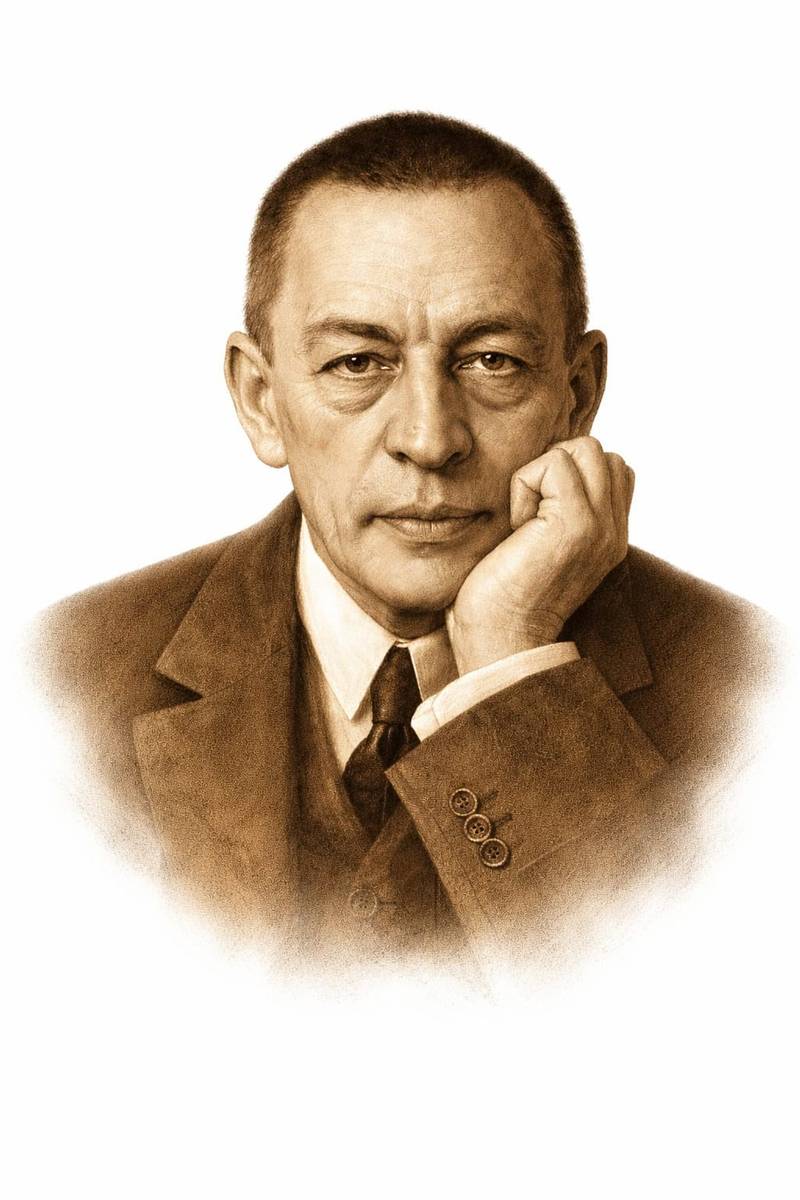
SERGUEI VASILIEVICH RAJMANINOV (English)
Serguéi Vasílievich Rajmáninov was born on April 1, 1873, in Semyónovo, Novgorod Province, within the Russian Empire. He belonged to a family with a musical tradition, which enabled early contact with the piano and an initial education oriented toward musical art. His formal training began in Saint Petersburg during the 1880s and continued at the Moscow Conservatory, one of Russia’s most prestigious musical institutions. There, he studied piano with Nikolai Zverev and composition with Sergei Taneyev and Anton Arensky, consolidating a rigorous pianistic technique and a structurally solid compositional style. In 1892, he graduated with honors in composition, presenting the opera Aleko as his final work; its premiere marked his early recognition within Russian musical circles. From this initial stage, Serguéi Vasílievich Rajmáninov showed a clear affinity for expansive lyricism and harmonic density, integrating late-Romantic influences with verifiable Russian traditions, which allowed the rapid consolidation of his musical language within the fin-de-siècle landscape.
Creative crisis, recovery, and artistic maturity
After the failure of Symphony No. 1 in 1897, Rachmaninoff went through a period of creative blockage widely documented in correspondence and contemporary accounts. As a result, he significantly reduced his compositional activity for several years. Between 1900 and 1901, he received treatment from the physician Nikolai Dahl, a process that facilitated his emotional and creative recovery. The direct outcome was the Piano Concerto No. 2, premiered in 1901 with great success, a work that consolidated his international prestige and restored his artistic confidence. From that point onward, he entered a phase of full creative maturity, composing fundamental works such as the Piano Sonata No. 2, the Preludes Op. 23 and Op. 32, and the Symphony No. 2, scores that demonstrate formal balance, melodic expansion, and architectural control. During this period, Serguéi Vasílievich Rajmáninov also distinguished himself as an orchestral conductor and concert pianist, with professional activity in Russia and Western Europe.
Serguei Vasilievich Rajmaninov and definitive exile
The Russian Revolution of 1917 brought about an irreversible change in Rachmaninoff’s personal and artistic life. That same year, he left Russia with his family, with no possibility of return. From 1918, he settled primarily in the United States, where he prioritized his career as a pianist to support his family financially, undertaking extensive international tours between 1918 and 1942. As a consequence of this intense performing activity, his compositional output decreased markedly. Nevertheless, he composed essential works such as the Rhapsody on a Theme of Paganini in 1934, as well as Symphony No. 3 and the Symphonic Dances in 1940, the latter considered his final work. In these late compositions, Serguéi Vasílievich Rajmáninov developed a synthesis between Romantic tradition and modern structural clarity, displaying a carefully measured expressive economy.
Historical legacy, pianistic style, and cultural significance
Rachmaninoff died on March 28, 1943, in Beverly Hills, California, just days before turning seventy, and was buried at Kensico Cemetery in New York, according to official records. His legacy rests on three dimensions: composer, pianist, and conductor. As a pianist, he possessed an exceptional technique, extensively demonstrated in historical recordings, characterized by structural clarity, sonic control, and expressive breadth. From a compositional standpoint, he maintained a coherent late-Romantic aesthetic, without fully embracing the avant-garde movements of the twentieth century. Even so, his music retains full relevance thanks to its formal solidity and emotional depth. Within the international pianistic repertoire, Serguéi Vasílievich Rajmáninov occupies a central and undisputed position, as his works continue to be performed regularly on the world’s leading stages, consolidating him as one of the pillars of the modern piano tradition worldwide.