




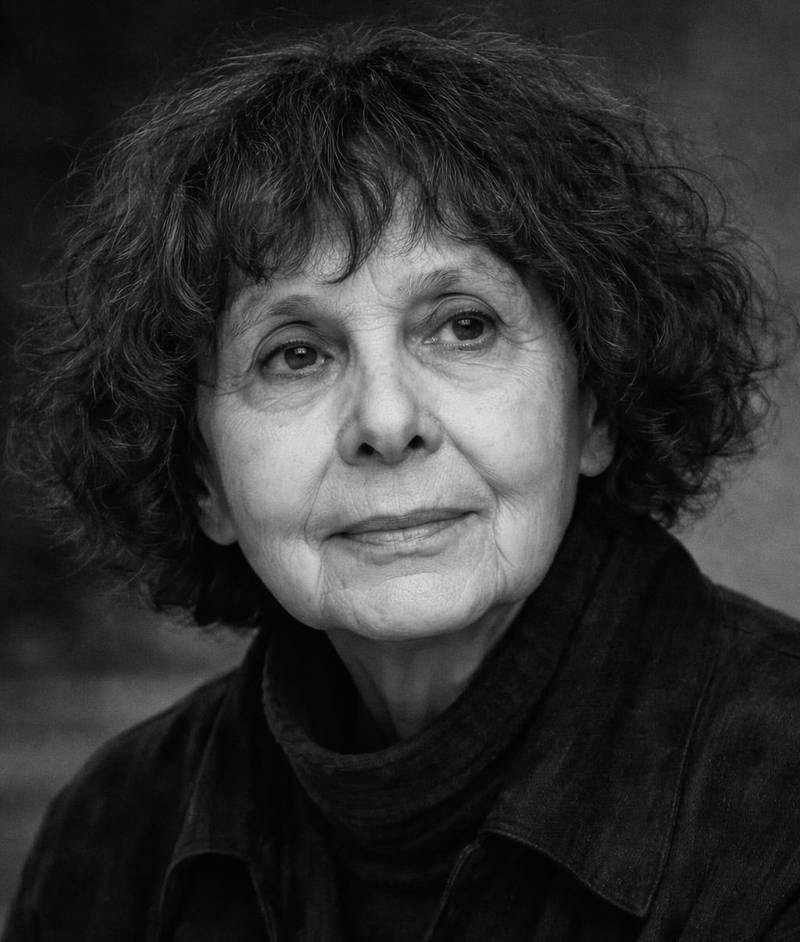
SOFIYA GUBAIDULINA (English)
Sofiya Gubaidúlina was born on October 24, 1931, in Chistopol, then part of the Tatar Autonomous Soviet Socialist Republic of the Soviet Union, today the Russian Federation. She grew up in a multicultural environment, shaped by Russian and Tatar influences that decisively marked her musical sensibility. From childhood, she studied piano and composition, showing an early inclination toward sonic exploration. She later entered the Kazan Conservatory, where she graduated in 1954, acquiring a solid technical foundation. She subsequently continued her studies at the Moscow Conservatory, where she pursued composition until 1959 and completed postgraduate studies under Vissarion Shebalin. After completing this academic training, she remained active as a composer from 1963 onward, developing an independent musical outlook that was considered unconventional by Soviet cultural authorities. Nevertheless, Dmitri Shostakovich recognized her talent and explicitly encouraged her to follow her own creative path.
Aesthetic Formation and Spiritual Quest of Sofiya Gubaidúlina
From the 1960s onward, the composer deepened a conscious spiritual quest, which became the conceptual core of her output. Consequently, her music explores symbols, numerical relationships, and extreme contrasts as structural elements. Sofiya Gubaidúlina conceived composition as an ethical and transcendent act, not merely a formal one. For this reason, she employed nonlinear structures, tensions between sound and silence, and unconventional instrumentation to expand the timbral spectrum. During the 1970s, she faced official restrictions within the Soviet system; however, she continued composing for film and alternative projects, strengthening her aesthetic independenceand creative resilience.
Sofiya Gubaidúlina and International Recognition
International recognition consolidated toward the end of the twentieth century. The premiere of Offertorium in 1980, a concerto for violin and orchestra, marked a decisive turning point in her global projection. From then on, the music of Sofiya Gubaidúlina began to be regularly programmed at major festivals and leading symphonic seasons. After the dissolution of the Soviet Union, she settled in Germany in 1992, establishing her residence near Hamburg. From this period onward, her catalogue expanded with major symphonic, chamber, and vocal works, including Stimmen… Verstummen…, The Canticle of the Sun, and Seven Words. Each work confirms a deep aesthetic coherence, grounded in symbolic contrasts and rigorous formal decisions.
Musical Language and Technical Contributions of Sofiya Gubaidúlina
The composer’s musical language is characterized by extreme dynamic contrasts, the use of glissandi, microintervals, and dense textures, and a structural spiritual dimension, rather than a decorative one. Accordingly, formal decisions respond to precise internal meanings. Moreover, Sofiya Gubaidúlina employed proportional relationships and mathematical principles as expressive supports, without turning them into abstract ends. Her writing demands a high level of interpretive commitment, transforming the performer into a mediator between sound and meaning, through intense listening and sustained concentration.
Awards, Distinctions, and Final Years of Sofiya Gubaidúlina
Throughout her life, she received numerous international honors, including the Praemium Imperiale Award in 1998 and the Golden Lion for Lifetime Achievement from the Venice Biennale in 2013. She also received honorary doctoratesfrom several European universities, confirming her lasting impact on the music of the twentieth and twenty-first centuries. In her final years, she continued composing with remarkable intensity; her late output maintains conceptual clarity and expressive strength. Sofiya Gubaidúlina passed away on March 13, 2025, at the age of 93, leaving a fundamental legacy.
Historical Legacy and Continuing Relevance
The composer’s legacy transcends styles and schools. Her work demonstrates that contemporary music can be profound, rigorous, and communicative without renouncing complexity. For this reason, her catalogue continues to be studied in conservatories and universities, and her scores are regularly performed on international stages. In summary, Sofiya Gubaidúlina represents a key figure in modern musical thought, whose life was dedicated to the search for meaning through sound.
