




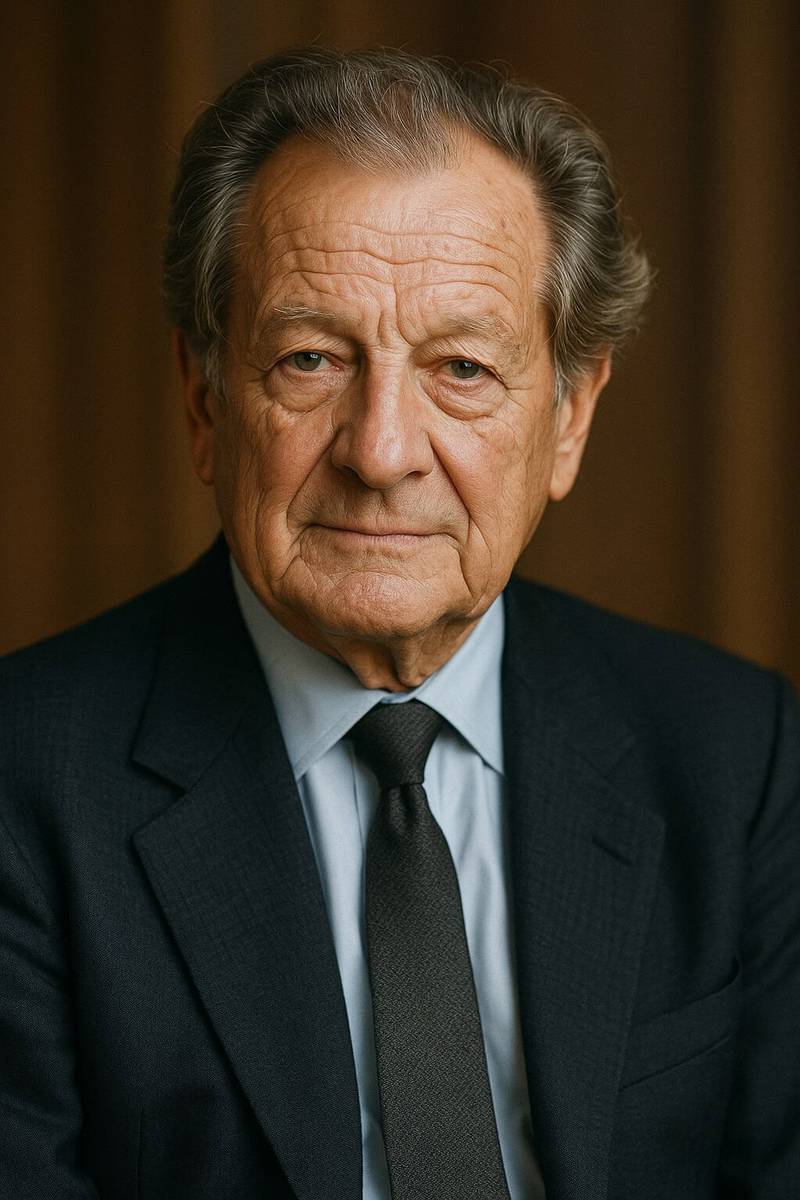
SIR NEVILLE MARRINER (English)
Sir Neville Marriner was born on 15 April 1924 in Lincoln, England, into a disciplined, modest household that valued education and responsibility. From an early age, he demonstrated exceptional musical sensitivity and intellectual focus, gravitating toward the violin and ensemble performance. He studied at the Royal College of Music in London, where he developed a solid technical foundation and a refined sense of musical structure. However, his studies were interrupted by World War II, during which he served in the Royal Navy. After the war, he returned to music with renewed artistic maturity, refining his violin technique and interpretive discipline. These formative experiences shaped his later approach to leadership, balance, and stylistic clarity as a conductor.
SIR NEVILLE MARRINER and the Academy of St Martin in the Fields
In 1958, Sir Neville Marriner founded the Academy of St Martin in the Fields in London, initially as a conductorless chamber ensemble. The group quickly distinguished itself through clarity, elegance, and refined ensemble precision. Over time, Marriner assumed a guiding role, shaping the orchestra’s artistic identity with disciplined rehearsal methods and stylistic coherence. The ensemble gained international recognition for its interpretations of Baroque and Classical repertoire, especially works by Mozart, Haydn, Bach, and Handel. Through transparent textures, controlled vibrato, and rhythmic vitality, the orchestra became a global reference for modern interpretations grounded in historical awareness without rigid dogma.
Recording Legacy and Global Influence
Over several decades, Sir Neville Marriner built one of the most extensive discographies in classical music history, recording more than 600 albums. His recordings are widely regarded as benchmarks for structural balance, stylistic restraint, and musical clarity. He collaborated with major labels including Decca, Philips, EMI, and Chandos, ensuring worldwide distribution and lasting influence. A defining moment in his public recognition came with the soundtrack to Amadeus (1984), which won an Academy Award and introduced classical music to millions beyond traditional audiences. This project highlighted his ability to combine scholarly integrity with broad accessibility, reinforcing his role as a cultural ambassador for orchestral music.
SIR NEVILLE MARRINER as an International Conductor
Beyond his London-based work, Sir Neville Marriner held prominent conducting positions with leading orchestras worldwide. He served as Music Director of the Los Angeles Chamber Orchestra, the Minnesota Orchestra, and the Stuttgart Radio Symphony Orchestra, among others. As a guest conductor, he appeared extensively across Europe, Asia, and the Americas. His rehearsal style emphasized efficiency, musical logic, and stylistic awareness, fostering mutual respect rather than authoritarian control. Musicians consistently valued his leadership for its clarity, intellectual rigor, and calm authority, which encouraged cohesive ensemble performance at the highest level.
Honors, Style, and Musical Philosophy
In 1985, he received a knighthood in recognition of his exceptional services to music. His conducting philosophy prioritized textual fidelity, classical proportion, and expressive moderation, avoiding exaggerated gestures while preserving warmth and emotional depth. Elegance, balance, and structural insight defined his interpretations, allowing performances to remain fresh and relevant over time. His artistic approach demonstrated that restraint and expressivity are not opposites but complementary forces in great musical interpretation.
SIR NEVILLE MARRINER’s Final Years and Enduring Legacy
Sir Neville Marriner continued conducting actively into his late eighties, maintaining intellectual sharpness and artistic authority. He passed away on 2 October 2016 in London, leaving behind a legacy of recordings, performances, and educational influence that continues to shape modern orchestral practice. Today, his interpretations remain essential references for performers and scholars alike. Ultimately, Sir Neville Marriner exemplified how disciplined artistry, humility, and clarity can define a lifetime of musical excellence.
