




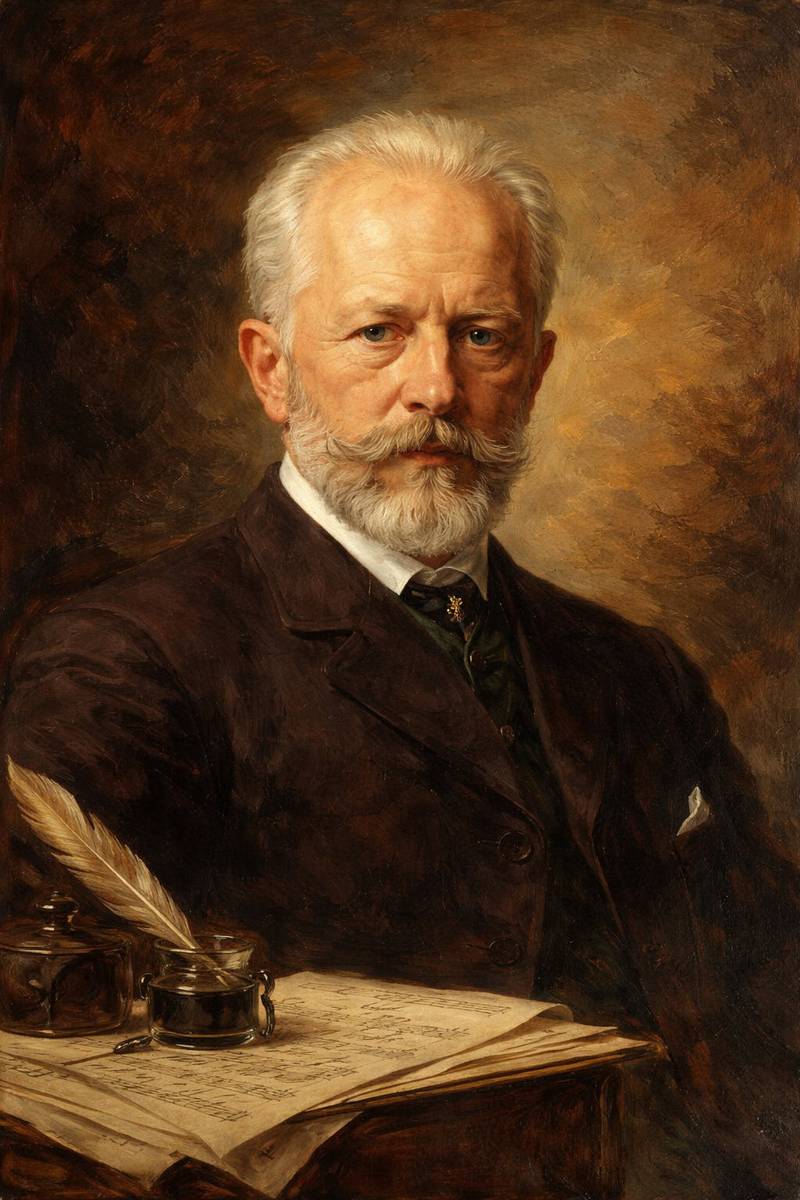
PIOTR ILICH CHAIKOVSKI (English)
Piotr Ilich Chaikovski was born on 7 May 1840 in Votkinsk, within the Russian Empire. He demonstrated an early inclination toward music during childhood. However, his initial education followed the expectations of Russian society, which favored civil service careers. Consequently, he entered the Imperial School of Jurisprudence in Saint Petersburg. This early path delayed, but did not suppress, his artistic vocation. After completing legal studies, he briefly worked as a government clerk before pursuing music professionally.
Piotr Ilich Chaikovski and Academic Musical Training
In 1862, Piotr Ilich Chaikovski enrolled in the newly founded Saint Petersburg Conservatory, marking a decisive shift in his life. The conservatory represented the first institutional framework for advanced musical education in Russia. There, he studied harmony, counterpoint, fugue, and orchestration within a structured academic system. His training occurred under the institutional leadership of Anton Rubinstein, a central figure in Russian musical education. As a result, he developed technical discipline grounded in Western compositional models. In 1866, he accepted a teaching position at the Moscow Conservatory, beginning his professional consolidation.
Piotr Ilich Chaikovski: Musical Style and Artistic Identity
The music of Piotr Ilich Chaikovski is defined by emotional intensity, melodic clarity, and refined harmonic language. Unlike members of nationalist circles, he employed Western formal structures, integrating them with Russian expressive character. Moreover, his works emphasize psychological drama, aligning with late Romantic aesthetics. Therefore, his compositions communicate directly with listeners across cultural boundaries. Emotional transparency and formal control coexist within his musical voice, establishing his international recognition during his lifetime.
Piotr Ilich Chaikovski and Major Compositional Works
Among the most significant works of Piotr Ilich Chaikovski are his six symphonies, particularly the Symphony No. 6 “Pathétique”, premiered in 1893. Additionally, he composed the Piano Concerto No. 1 in 1875, which became a cornerstone of the concert repertoire. His contribution to ballet proved transformative through Swan Lake (1877), The Sleeping Beauty (1890), and The Nutcracker (1892). These works expanded the expressive role of orchestral music within ballet narratives, shaping modern ballet tradition.
Piotr Ilich Chaikovski: Opera, Vocal Music, and Personal Life
Opera occupied a central place in the output of Piotr Ilich Chaikovski, especially Eugene Onegin (1879) and The Queen of Spades (1890). These operas demonstrate sophisticated dramatic construction and psychological depth. In parallel, he composed numerous songs and choral works that reflect careful text setting. His personal life included significant emotional strain. His marriage in 1877 was brief and destabilizing. Later, financial support from Nadezhda von Meck enabled creative independence through extensive correspondence, though they never met.
Piotr Ilich Chaikovski: Final Years, Death, and Legacy
During his final years, Piotr Ilich Chaikovski achieved substantial international recognition. He conducted his works throughout Europe and the United States, reinforcing his global stature. He died on 6 November 1893 in Saint Petersburg at the age of 53. Historical debate continues regarding the precise cause of death. Nevertheless, his influence remains enduring. His music shaped late Romantic symphonic development and remains central to modern concert life. Piotr Ilich Chaikovski represents a lasting synthesis of formal structure and emotional expression, securing his position within Western musical history.
