




MUSIC OF ANCIENT CIVILIZATIONS
Music of Ancient Greece (c. 9th century BCE – 4th century CE)
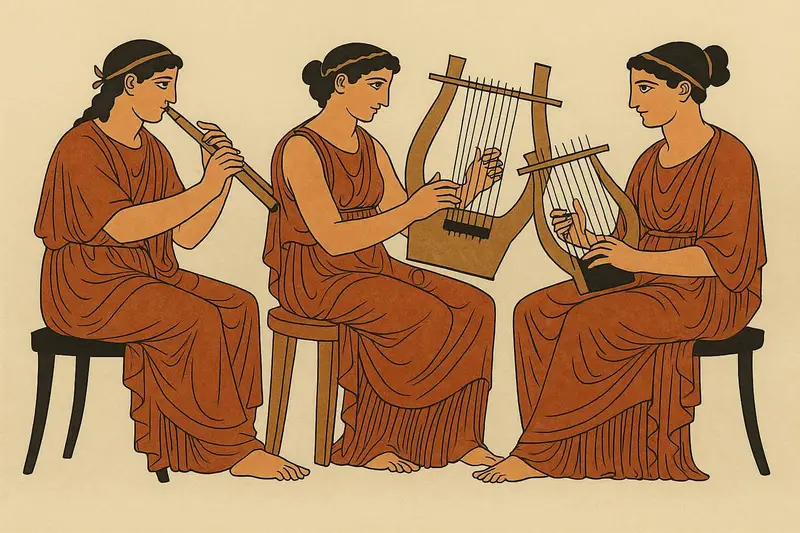
Ancient Greek music represents the most influential musical tradition prior to the Middle Ages. Greek thinkers established fundamental principles that shaped Western music for centuries. Among their major contributions were:
- Advanced musical theory, including modal systems such as Dorian, Phrygian, and Lydian.
- Mathematical concepts of sound, developed notably by Pythagoras (c. 570–495 BCE), who demonstrated numerical relationships between musical intervals.
- Ethical theory of music, which connected musical modes to moral character and human behavior.
- Alphabetic musical notation, one of the earliest systematic methods for writing music.
The only composer whose works survive in partial form is Mesomedes of Crete (2nd century CE).
Music accompanied epic recitation, religious rituals, and theatrical performances, serving both artistic and social functions.
Music of Ancient Rome (c. 3rd century BCE – 476 CE)
Roman music largely inherited Greek musical traditions and adapted them to Roman cultural contexts. Common instruments included:
- cornu, tuba, lituus, tibiae, and cymbals.
Music was primarily used in military ceremonies, public spectacles, theatrical productions, and festive events.
Although Rome did not develop a sophisticated theoretical system comparable to Greece, it disseminated musical practices throughout its empire, later influencing early Christian liturgical traditions.
Music of Ancient Egypt (c. 3000 BCE – 30 BCE)
Ancient Egyptian music is extensively documented through reliefs, wall paintings, and papyri. The most common instruments were:
- arched harps,
- double flutes,
- sistrums,
- lyres.
Music played a central role in religious ceremonies, court life, and funerary rituals. Despite its clear social importance, no usable musical notation has survived, making precise reconstruction impossible.
Music of Mesopotamia (Sumerians, Akkadians, Babylonians, Assyrians)
Mesopotamia preserves some of the oldest musical sources in human history. Key evidence includes:
- The Hurrian tablet (Hymn to Nikkal), dated to approximately 1400 BCE, regarded as the oldest known written melody.
- Use of lyres, harps, and drums.
- Strong connections between music, religious ritual, and epic poetry.
Cuneiform tablets reveal early concepts of tuning systems and intervallic organization.
Music of Ancient Israel (c. 1200 BCE – 1st century CE)
Biblical texts provide detailed references to a tradition centered on Hebrew psalmody. This musical culture directly influenced:
- later Jewish liturgical music,
- early Christian chant practices, which eventually formed the foundation of medieval plainchant.
Instruments included psalteries, harps, trumpets, and the shofar.
Early Christian Music (1st–5th centuries CE)
Before medieval formalization, early Christian communities practiced:
- adapted Hebrew psalms,
- simple hymns, either melismatic or syllabic,
- chants without fixed notation,
- orally transmitted melodies.
These practices formed the direct bridge to Gregorian chant, and therefore to medieval music.
Connections Between Antiquity and Medieval Music
- Greek modes evolved into medieval ecclesiastical modes.
- Hebrew chant shaped early Christian liturgical singing.
- Roman expansion unified ritual musical practices across Europe.
- Ancient oral traditions gradually gave way to medieval neumatic notation.
- Ancient instruments evolved into medieval counterparts (lyre → fiddle, aulos → double flutes).
Before medieval music emerged, complex musical traditions flourished across Greek, Roman, Egyptian, Mesopotamian, and Israelite civilizations. These cultures established the theoretical, ritual, and aesthetic foundations of Western music.
Modern interdisciplinary scholarship confirms with high reliability that medieval musical systems developed directly from these ancient traditions, preserving their concepts while transforming their forms.
