




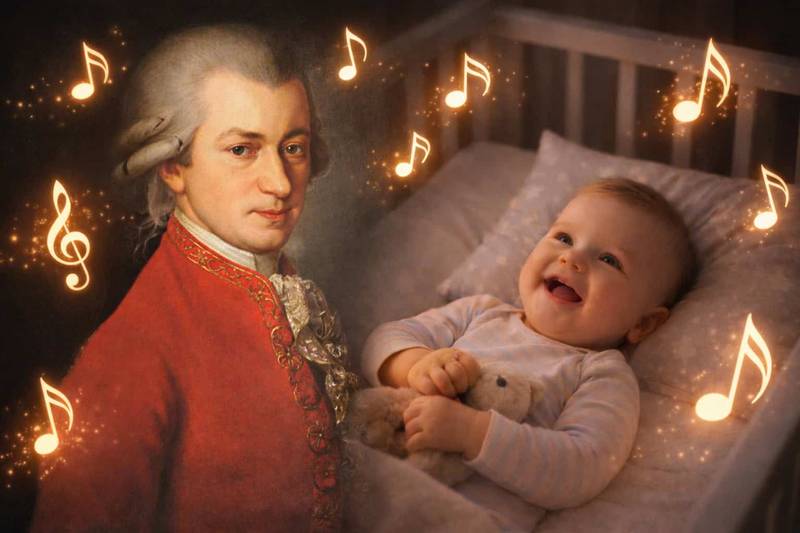
MOZART’S MUSIC FOR BABIES
Mozart’s music for babies is based on a repertoire created by Wolfgang Amadeus Mozart between 1761 and 1791. Mozart was born on January 27, 1756, in Salzburg and died on December 5, 1791, in Vienna. During his lifetime, he composed works intended for courtly, pedagogical, and domestic contexts. However, there is no historical documentation indicating a specific intention to compose music aimed at babies. Consequently, the contemporary use of his repertoire in early childhood reflects modern reinterpretations, not the composer’s original purposes. Nevertheless, the Mozartian corpus presents clear and stable formal features, useful for early listening environments, provided that undocumented claims are avoided.
Relevant musical characteristics in Mozart’s music for babies
From an analytical perspective, Mozart’s music for babies is usually selected for its formal clarity, metrical regularity, and tonal balance. These qualities are evident in minuets, adagios, and slow movements of sonatas and symphonies. Moreover, the frequent homophonic texture facilitates a stable auditory perception. On the other hand, classical functional harmony, with predictable cadences, supports basic auditory comprehension. Nevertheless, these observations describe objective musical properties, not guaranteed cognitive effects. It is essential to distinguish between musicological analysis and unverified psychological extrapolations. Thus, the selection of pieces responds to musical criteria, not to presumed universal benefits.
Modern reception and dissemination of Mozart’s music for babies
By the late twentieth century, a broad commercial dissemination emerged under the label Mozart’s music for babies, especially from the 1990s onward. This phenomenon coincided with media debates surrounding the so-called “Mozart effect.” However, historical musicology and subsequent empirical research did not confirm permanent benefits in children’s intellectual development attributable exclusively to Mozart. Consequently, academic rigor requires acknowledging that this popularization stems from contemporary editorial and pedagogical strategies, not from historical evidence from the eighteenth century. Therefore, the value of the repertoire lies in its intrinsic musical quality and in guided listening practices.
Pedagogical criteria for the responsible use of Mozart’s music for babies
A responsible use of Mozart’s music for babies should be based on historical contextualization, moderate sound levels, and adult accompaniment. Documentary sources indicate that Mozart conceived music as a social and educational art, particularly in his pedagogical keyboard works. However, he did not design early stimulation programs. Consequently, it is recommended to use short excerpts, moderate tempos, and controlled volumes. Furthermore, listening should be integrated into human interaction, avoiding prolonged passive playback. This approach respects both historical evidence and contemporary educational principles.
Musicological value and conceptual limits
From a musicological standpoint, Mozart’s music for babies functions as a modern cultural category, useful for describing early listening practices. Nevertheless, it does not constitute a historical genre nor a documented authorial intention. Critical editions, family correspondence, and eighteenth-century concert records confirm the general artistic purpose of the repertoire. Therefore, any serious analysis must acknowledge clear conceptual limits. Mozart’s music provides formal order, balance, and beauty, universal aesthetic values, without the need for unproven neuroscientific attributions.
In summary, Mozart’s music for babies can be analyzed rigorously only if verifiable historical facts are separated from modern constructions. Mozart composed within the Viennese Classical tradition, during fully documented dates, without specific infant audiences in mind. His music, carefully selected, may be integrated into early listening environments due to its structural clarity. Ultimately, respect for historical context ensures informed use, avoiding myths and strengthening musical appreciation from the earliest years.
