




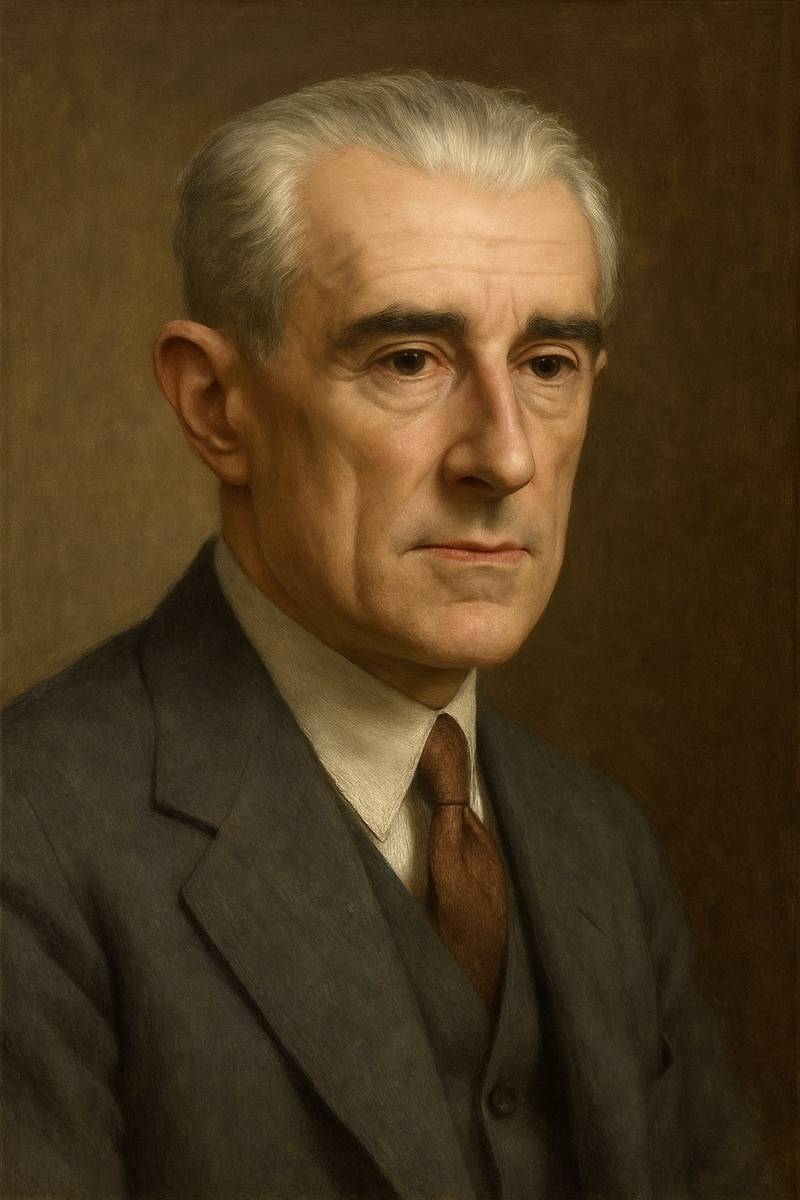
MAURICE RAVEL (English)
MAURICE RAVEL was born on March 7, 1875, in Ciboure, France, near the Spanish border. His multicultural environment shaped a refined artistic sensibility early. His father, an engineer, encouraged curiosity, while his mother introduced Basque and Spanish folk traditions. Therefore, rhythmic color and precision appeared early in his musical imagination. In 1889, he entered the Paris Conservatoire, studying piano and composition. Although often criticized by academic authorities, MAURICE RAVEL refined a distinctive, meticulous voice. Consequently, clarity, balance, and structural elegance defined his emerging style. He admired Mozart and Couperin, yet pursued modern harmonic exploration.
MAURICE RAVEL and Artistic Identity
MAURICE RAVEL never aligned strictly with Impressionism, despite frequent comparisons to Debussy. Instead, he pursued technical perfection and emotional restraint. His music emphasizes orchestral color, formal control, and precise rhythm. As a result, critics recognized him as an innovator with classical discipline. Between 1900 and 1905, repeated failures to win the Prix de Rome frustrated him. However, public debate strengthened his reputation as an independent artist. Thus, MAURICE RAVEL emerged as a symbol of creative resistance within French music.
Major Works of MAURICE RAVEL
Among his early masterpieces, “Pavane pour une infante défunte” (1899) gained lasting popularity. Later, the ballet “Daphnis et Chloé” (1912) demonstrated extraordinary orchestral mastery. Its textures reveal lush harmony and architectural coherence. In 1928, MAURICE RAVEL composed “Boléro,” his most famous work. Built on repetition, the piece relies on orchestral crescendo rather than thematic development. Consequently, it became one of the most performed works in classical music history. Other significant compositions include “La Valse” (1920) and “Rapsodie espagnole” (1908). These works reflect his fascination with dance, motion, and controlled intensity.
MAURICE RAVEL During War and Later Years
During World War I, MAURICE RAVEL served as a military truck driver between 1915 and 1917. The experience affected his health and emotional outlook. After the war, his music adopted sharper edges and darker undertones. In the 1930s, neurological illness limited his compositional ability. Despite declining health, his artistic reputation continued to grow internationally. He underwent brain surgery in 1937, which proved unsuccessful.
Legacy of MAURICE RAVEL
MAURICE RAVEL died on December 28, 1937, in Paris, France. His legacy remains central to twentieth-century music. Today, composers admire his precision, innovation, and timeless craftsmanship. Ultimately, MAURICE RAVEL stands as a master of balance between intellect and emotion. His works continue inspiring performers, scholars, and audiences worldwide.
