




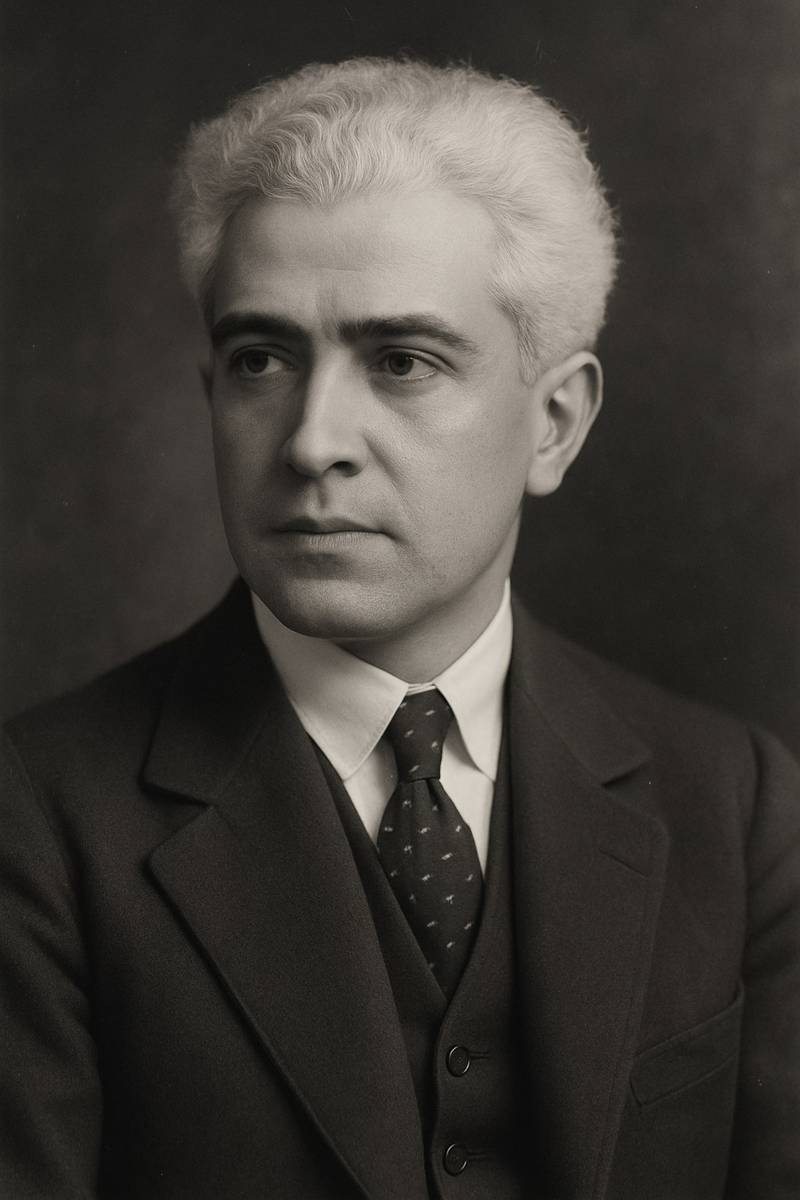
MANUEL M. PONCE (English)
Manuel M. Ponce was born on December 8, 1882, in Fresnillo, Zacatecas, Mexico, into a family deeply connected to music. From early childhood, he demonstrated remarkable musical sensitivity, especially at the piano. His first formal studies took place in Aguascalientes, where he developed strong technical discipline in harmony and composition. These formative years shaped his artistic character and refined his expressive instincts.
Later, he moved to Mexico City to study at the National Conservatory of Music, where he strengthened his academic foundations. Seeking broader artistic horizons, he continued his education in Europe, including Bologna and Paris. In France, he studied with Paul Dukas, absorbing modern harmonic language and refined orchestration. Consequently, his musical identity evolved through a synthesis of European technique and Mexican cultural roots.
Manuel M. Ponce and the Rise of Musical Nationalism
During the early twentieth century, Manuel M. Ponce emerged as a central figure in Mexican musical nationalism. In 1912, he delivered a landmark lecture defending the artistic value of Mexican folk music. This moment transformed academic attitudes toward popular traditions and redefined their cultural significance. His ideas challenged prevailing aesthetic hierarchies within Mexican musical institutions.
Rather than merely quoting folk melodies, he reimagined them within classical forms such as songs, sonatas, and orchestral works. As a result, his music preserved authenticity while achieving structural sophistication. Moreover, his vision influenced cultural debates during the post-revolutionary era. Therefore, his work laid the foundation for a modern national art music tradition in Mexico.
Creative Output and Artistic Language of Manuel M. Ponce
The creative output of Manuel M. Ponce encompasses piano music, orchestral works, art songs, and guitar compositions. He composed more than 200 songs, many inspired by Mexican and Spanish poetry. Among these, “Estrellita” achieved international recognition due to its direct emotional clarity and lyrical simplicity. This song remains one of the most performed Mexican art songs worldwide.
Equally significant were his contributions to the classical guitar repertoire, developed through collaboration with Andrés Segovia. These works elevated the guitar to new artistic status in concert performance. Stylistically, his music combines romantic lyricism, impressionist color, and formal balance. Nevertheless, clarity and expressive restraint consistently define his mature voice.
Pedagogy, Scholarship, and Cultural Thought
In addition to composing, Manuel M. Ponce played a vital role as an educator and musical thinker. He taught at the National Conservatory of Music, influencing several generations of Mexican musicians. His pedagogical approach emphasized the integration of academic rigor with national identity. This philosophy reinforced artistic responsibility and cultural awareness.
Furthermore, he authored essays on music history and aesthetics, contributing to the emergence of Mexican musicology. Through scholarly writing, he promoted the study and preservation of national musical heritage. Consequently, his influence extended beyond composition into education, research, and cultural policy, shaping Mexico’s musical institutions.
Legacy of Manuel M. Ponce and Historical Significance
Manuel M. Ponce died on April 24, 1948, in Mexico City, leaving an enduring artistic legacy. He is widely recognized as a pioneer of academic musical nationalism in Mexico. His work represents a refined synthesis of folk tradition, European training, and modern artistic sensibility.
Today, his compositions remain central to conservatory curricula and international concert programs. Scholars continue to examine his contributions to twentieth-century music. In conclusion, Manuel M. Ponce occupies a central position in Mexican cultural history. His legacy endures as a bridge between national identity and universal artistic expression.
