




THE MAIN PERIODS OF CLASSICAL MUSIC
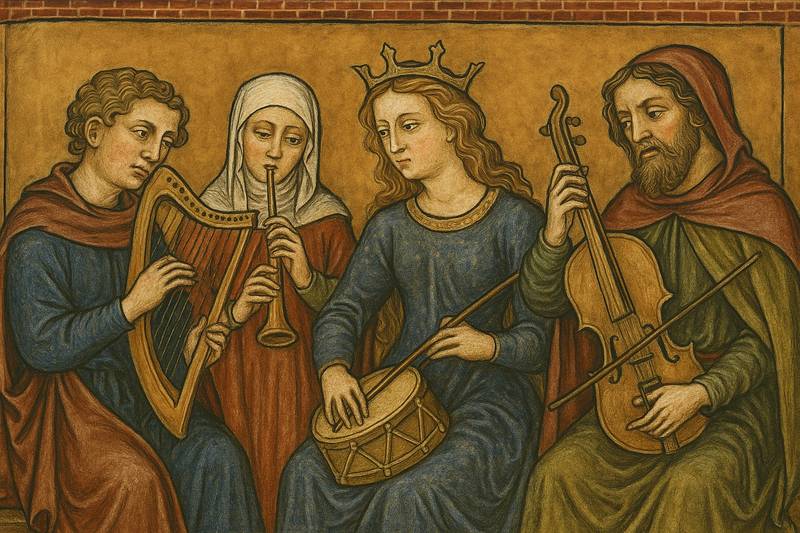
The main periods of classical music begin with Medieval music, emerging after the fall of the Western Roman Empire around 476 CE. During this era, sacred traditions dominated musical creation. Gregorian chant, formalized between the 9th and 10th centuries, became the foundation of Western liturgical music. As a result, monophonic textures emphasized spiritual clarity and textual intelligibility. Gradually, early polyphony appeared at Notre Dame in Paris during the 12th century, marking a structural transformation. Therefore, rhythmic notation and modal organization established the earliest theoretical systems.
Renaissance Balance and Humanism (c. 1400–1600)
During the Renaissance, music reflect humanist ideals inspired by classical antiquity. Composers such as Josquin des Prez (c.1450–1521) developed imitative polyphony, creating balanced textures and expressive clarity. Consequently, sacred and secular music flourished equally across Europe. The invention of music printing by Ottaviano Petrucci in 1501 accelerated stylistic unity. Moreover, harmony became smoother through controlled dissonance. Thus, Renaissance music reinforced proportional beauty and vocal expressiveness.
The Main Periods of Classical Music: Baroque Innovation and Expression (c. 1600–1750)
The Baroque period represents one of the most transformative stages. Beginning around 1600, composers sought emotional intensity and dramatic contrast. Opera emerged in Florence circa 1600, blending music, theater, and poetry. Meanwhile, Johann Sebastian Bach (1685–1750) perfected counterpoint, while George Frideric Handel (1685–1759) expanded large-scale vocal forms. As a result, basso continuo and functional harmony became central. Therefore, the Baroque era solidified tonal organization, shaping future developments.
Classical Clarity and Form (c. 1750–1820)
The Classical period emphasizes balance, transparency, and formal clarity within the main periods of classical music. Around 1750, musical language simplified, favoring homophonic textures. Joseph Haydn (1732–1809) standardized the symphony and string quartet, while Wolfgang Amadeus Mozart (1756–1791) perfected melodic elegance. Later, Ludwig van Beethoven (1770–1827) expanded structural boundaries. Consequently, sonata form became the dominant organizational model. Thus, rational structure and expressive restraint defined this central stage.
The Main Periods of Classical Music: Romantic Expansion and Individualism (c. 1820–1900)
The Romantic era transformed the main periods of classical music through emotional depth and personal expression. After 1820, composers emphasized individuality, nationalism, and expanded harmonic language. Franz Schubert (1797–1828) elevated the art song, while Frédéric Chopin (1810–1849) redefined piano expression. Additionally, orchestras grew significantly in size. Therefore, tone poems and programmatic music flourished. Romanticism prioritized subjective experience, marking a profound emotional evolution.
Late Romanticism and Transition (c. 1880–1910)
Late Romanticism represents a transitional phase. Composers such as Richard Wagner (1813–1883) pushed tonal harmony toward chromatic extremes. Meanwhile, Gustav Mahler (1860–1911) expanded symphonic scale and philosophical depth. Consequently, traditional tonality faced structural tension. Therefore, this period bridges Romantic expressiveness and modern experimentation. It prepares the aesthetic shift that defines the next chapter of the main periods of classical music.
The Main Periods of Classical Music: Modernism and New Languages (c. 1900–1975)
Modernism redefined the main periods of classical music through innovation and rupture. Beginning around 1900, composers rejected Romantic excess. Claude Debussy (1862–1918) explored impressionistic color, while Arnold Schoenberg (1874–1951) developed atonality and twelve-tone technique in the 1920s. As a result, rhythm, timbre, and form gained autonomy. Moreover, composers like Stravinsky challenged traditional pulse. Thus, Modernism fragmented musical language within the main periods of classical music.
Contemporary Diversity (c. 1975–Present)
The contemporary era reflects pluralism. After 1975, composers embraced stylistic coexistence. Minimalism, led by Steve Reich (born 1936) and Philip Glass (born 1937), emphasized repetition and clarity. Meanwhile, film music expanded classical techniques into global media. Therefore, boundaries between genres softened. Contemporary music values accessibility and innovation equally. Consequently, this period completes the evolving narrative of the main periods of classical music.
The Main Periods of Classical Music: Historical Continuity and Impact
Overall, the main periods of classical music demonstrate a continuous dialogue between tradition and innovation. Each era responds to social, philosophical, and technological change. From Medieval chant to contemporary minimalism, structural principles evolve without losing historical roots. Therefore, understanding the main periods of classical music clarifies how Western musical language developed coherently across centuries. This historical continuity explains their enduring educational, cultural, and artistic relevance worldwide.
