




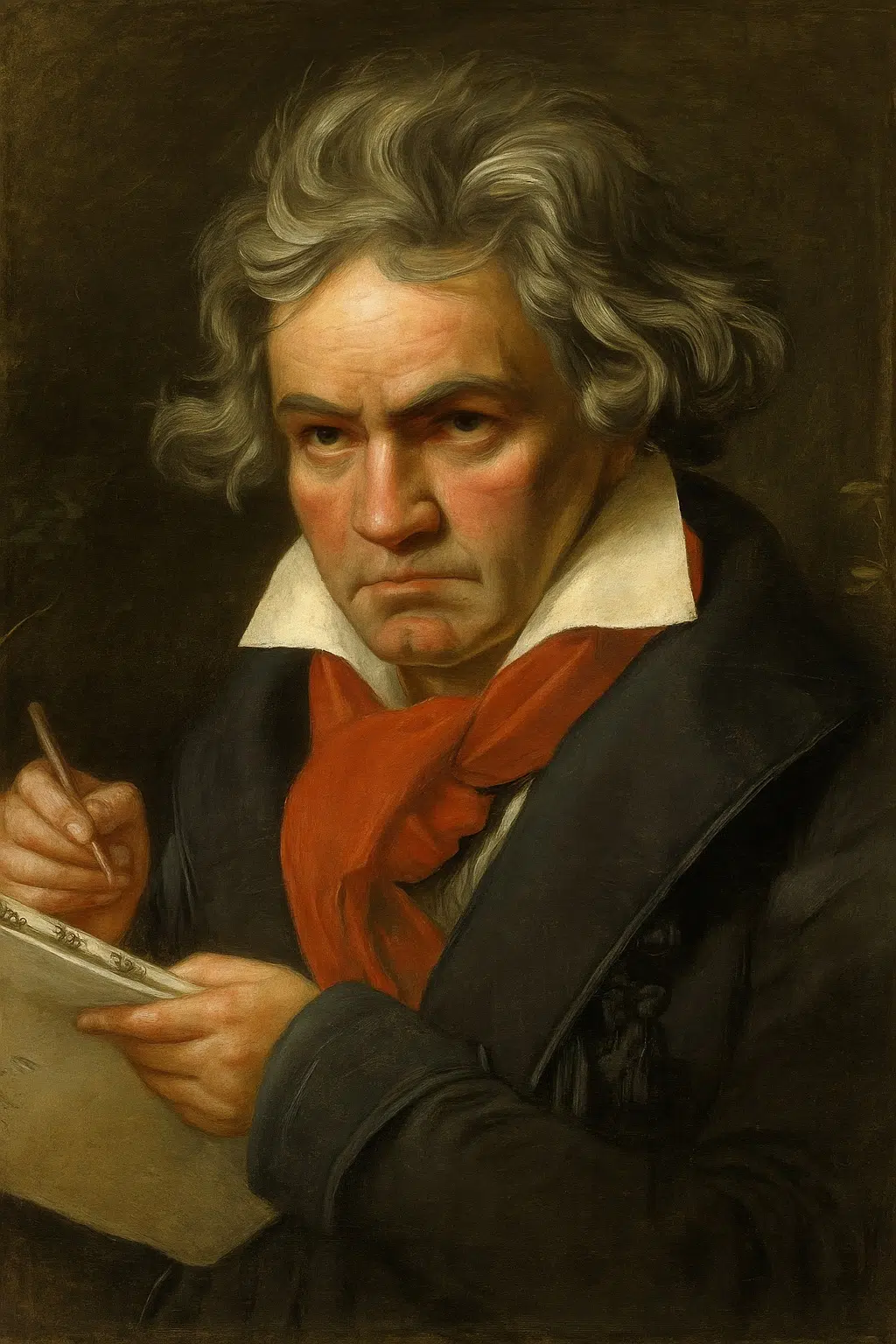
LUDWIG VAN BEETHOVEN (English)
LUDWIG VAN BEETHOVEN was born on December 16, 1770, in Bonn, within the Holy Roman Empire. He grew up in a musically active family facing constant financial difficulties. His father, Johann van Beethoven, served as a court singer and initiated his son’s musical education early. Although the training was strict, it instilled discipline and resilience. From childhood, Beethoven demonstrated remarkable talent for piano and improvisation. He studied with Christian Gottlob Neefe, who introduced him to Bach’s works. In 1783, he published his first keyboard compositions, revealing clear artistic promise.
LUDWIG VAN BEETHOVEN and His Viennese Formation
In 1792, LUDWIG VAN BEETHOVEN moved permanently to Vienna, Europe’s most influential musical center. There, he studied composition with Joseph Haydn, while also learning from Salieri and Albrechtsberger. He quickly gained recognition as a brilliant piano virtuoso, admired for expressive power. Consequently, aristocratic patrons supported his career. During this phase, he composed sonatas and chamber works rooted in Classical tradition. However, his music already displayed dramatic tension and emotional depth, signaling a distinct personal voice.
LUDWIG VAN BEETHOVEN: Personal Crisis and Artistic Transformation
Around 1798, Beethoven began experiencing progressive hearing loss, which deeply affected his emotional life. The condition caused isolation and inner turmoil. In 1802, he wrote the Heiligenstadt Testament, expressing despair yet reaffirming artistic purpose. Despite suffering, he chose creative perseverance. This turning point launched his heroic period. The Third Symphony “Eroica” expanded symphonic scale and meaning. As a result, Beethoven permanently transformed musical expression.
LUDWIG VAN BEETHOVEN and the Expansion of Musical Language
Between 1804 and 1814, Beethoven composed works of unprecedented ambition. The Fifth and Sixth Symphonies explored struggle, fate, and nature. He also wrote the Piano Concerto No. 5 “Emperor” and the opera Fidelio. These compositions reinforced his historical importance. Although his hearing continued to decline, his imagination intensified. Music became a space of inner freedom and moral strength. He expanded thematic development and emotional range, laying foundations for Romanticism.
Late Works and Inner Vision
After 1815, Beethoven became almost completely deaf. Nevertheless, his creativity reached extraordinary spiritual depth. The late piano sonatas and string quartets challenged formal conventions and harmonic language. These works anticipated future musical developments. In 1824, he premiered the Ninth Symphony, introducing chorus and soloists into symphonic form. The Ode to Joy expressed universal ideals of humanity and brotherhood, redefining musical possibility.
LUDWIG VAN BEETHOVEN and His Universal Legacy
LUDWIG VAN BEETHOVEN died on March 26, 1827, in Vienna, at fifty-six years old. Thousands attended his funeral, reflecting immense cultural impact. He stands as a bridge between Classicism and Romanticism. Moreover, he defended the artistic independence of the composer. His works continue shaping global performance standards. His life united struggle, innovation, and human dignity. Beethoven remains a central figure in Western music history.
