




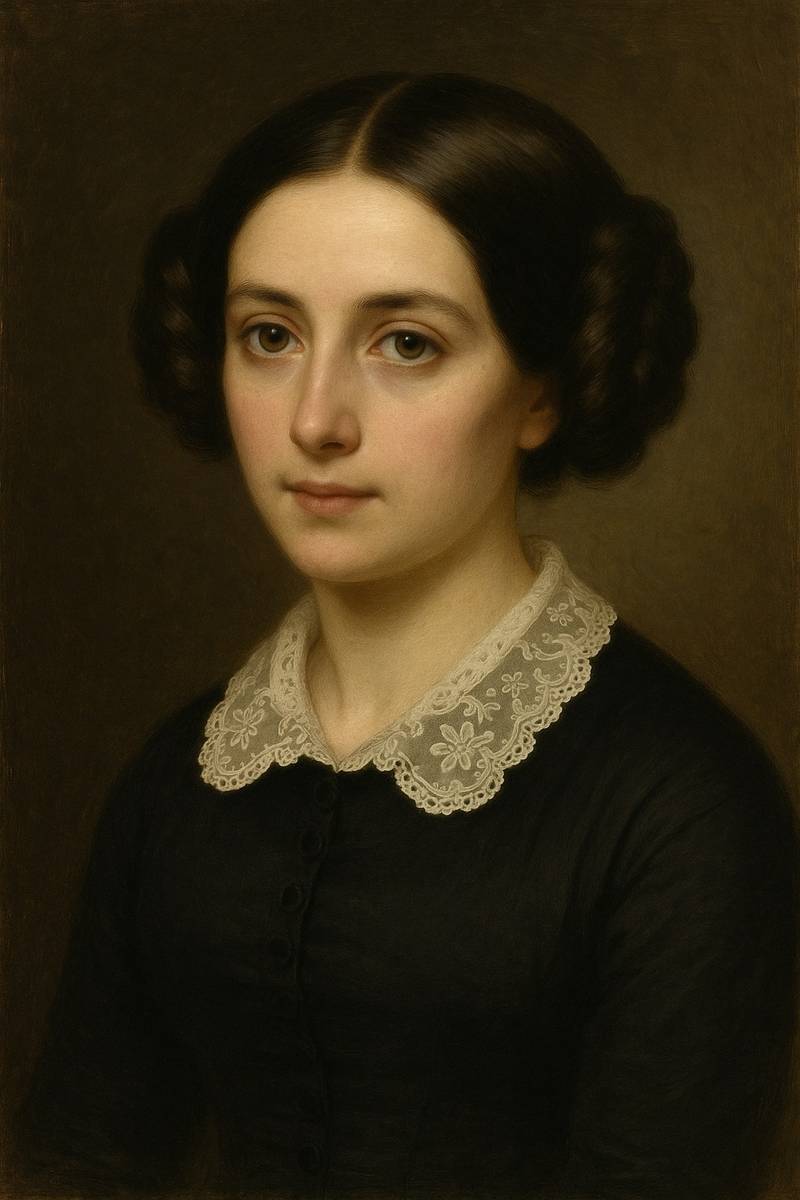
LOUISE FARRENC (English)
LOUISE FARRENC was born on May 31, 1804, in Paris, France, into a family closely connected to the arts. From childhood, she displayed exceptional musical sensitivity and intellectual discipline. As a result, her cultural environment strongly influenced her artistic development and long-term vision.
She began formal piano studies with Cécile Soria, a former student of Muzio Clementi. Later, she studied composition privately with Anton Reicha, an influential Classical theorist. Through this rigorous education, she achieved mastery of counterpoint, harmonic logic, and formal balance.
At that time, institutional composition training was largely denied to women. Nevertheless, LOUISE FARRENC continued advanced studies independently, demonstrating determination and technical ambition. Consequently, her early works already reflected structural confidence and stylistic maturity.
Professional Career and Artistic Consolidation
In 1821, she married flutist and music publisher Aristide Farrenc, who became an essential professional collaborator. Together, they founded Éditions Farrenc, a publishing house devoted to high-quality classical repertoire. Therefore, her music gained increased visibility in Parisian artistic circles.
During the 1830s, Farrenc established herself as a respected pianist, composer, and pedagogue. Her works were frequently performed and praised for expressive restraint and architectural strength. Moreover, her professional reputation extended beyond France.
In 1842, she achieved a historic milestone by becoming Professor of Piano at the Paris Conservatoire. She held this prestigious post for over thirty years. Thus, she became one of the most influential female educators of the nineteenth century.
LOUISE FARRENC and Artistic Recognition
Despite her accomplishments, she initially received lower pay than male colleagues. However, she firmly defended professional equality through sustained excellence. Eventually, she secured equal salary, establishing a lasting institutional precedent.
This achievement confirmed her authority within one of Europe’s most conservative musical institutions. Furthermore, LOUISE FARRENC demonstrated that women could excel in roles traditionally reserved for men. Her success directly challenged entrenched gender norms.
Beyond pedagogy, she earned recognition as a serious composer capable of large-scale forms. Consequently, she expanded creative possibilities for women within the Romantic tradition.
Musical Language and Compositional Style
Her music is defined by formal clarity, disciplined craftsmanship, and expressive balance. It reflects Classical influences from Haydn, Mozart, and Beethoven, combined with Romantic lyricism. Therefore, emotional depth coexists with structural coherence.
She composed three symphonies, extensive chamber works, and refined piano pieces. These genres demanded technical authority and intellectual control. Her command of counterpoint ensured stability even in moments of heightened expression.
Because of this synthesis, Farrenc occupies a distinctive place within French Romanticism. Her style avoids excess, favoring proportion, motivic development, and elegant orchestration.
LOUISE FARRENC as Scholar and Editor
Beyond composition, she made a lasting scholarly contribution. Between 1861 and 1876, she co-edited “Le Trésor des pianistes”, a monumental anthology of keyboard music spanning the Renaissance to the nineteenth century.
This publication became an essential pedagogical reference throughout Europe. Consequently, her historical vision strengthened her intellectual legacy. It also reinforced her authority in piano education and musicology.
Through this editorial work, LOUISE FARRENC preserved significant repertoire while shaping modern keyboard pedagogy. Her scholarly rigor matched her compositional discipline.
Final Years and Enduring Legacy
She died on September 15, 1875, in Paris, leaving a substantial and coherent body of work. After her death, much of her music disappeared from concert programs, largely due to gender bias.
However, since the late twentieth century, her compositions have been rediscovered and widely performed. Today, recordings and research continue restoring her historical significance. As a result, her reputation continues to grow.
Her legacy represents artistic excellence, intellectual integrity, and cultural resilience. In conclusion, her life demonstrates that disciplined talent transcends social limitations when guided by vision, rigor, and perseverance.
