




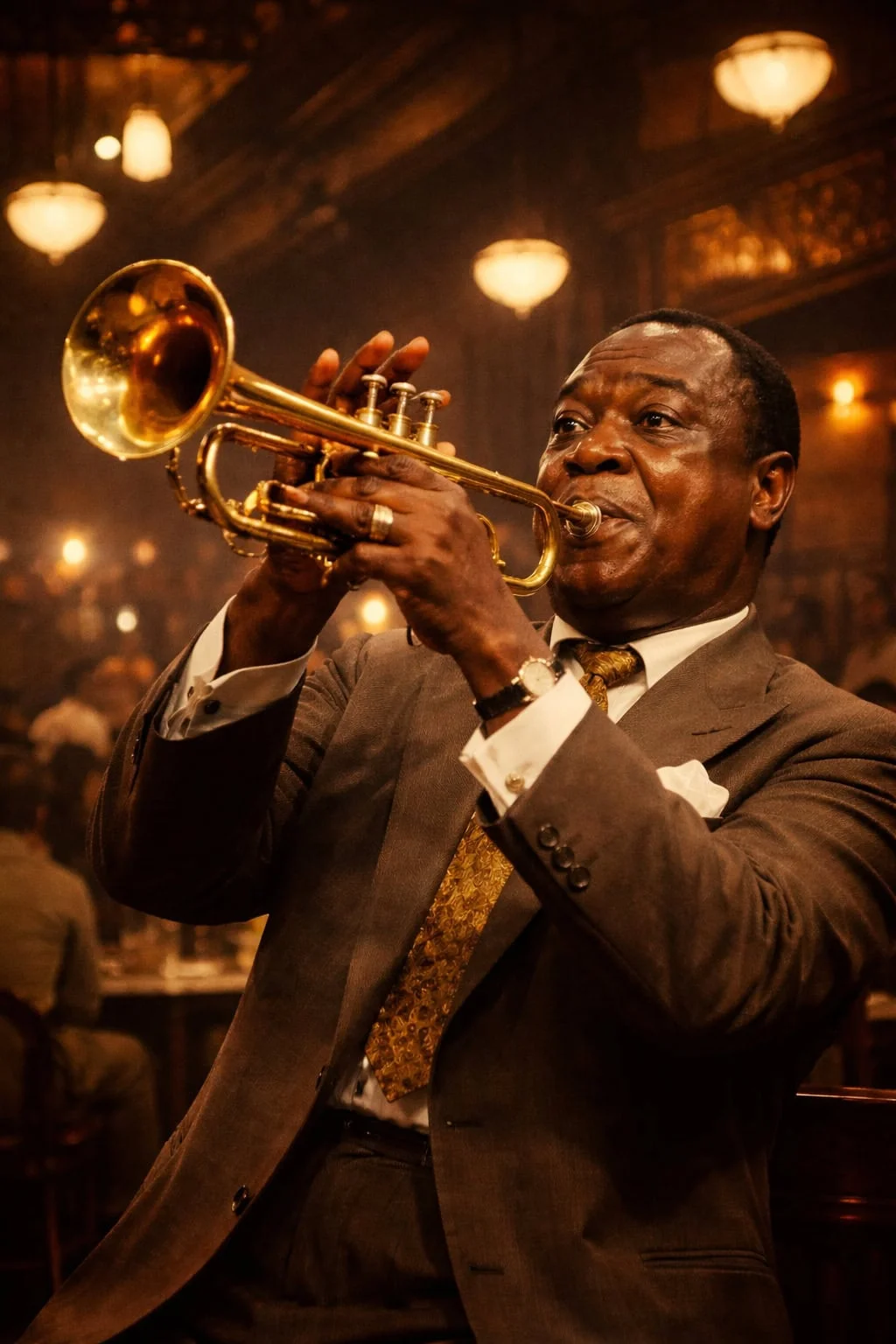
LOUIS ARMSTRONG (English)
Louis Armstrong was a decisive figure in the history of jazz and twentieth-century popular music. He was born on August 4, 1901, in New Orleans, and died on July 6, 1971, in New York City. His legacy transformed instrumental performance, singing, and the global cultural reach of jazz. Moreover, he redefined the role of the soloist within modern musical ensembles.
From an analytical perspective, Louis Armstrong represents the transition from collective jazz to solo-centered jazz. He also consolidated an aesthetic grounded in improvisation, rhythmic expressiveness, and the performer’s personal identity. For this reason, his influence remains present across multiple musical genres.
Historical context of Louis Armstrong and New Orleans
Louis Armstrong grew up in an environment shaped by racial segregation and structural poverty in the American South. In the early twentieth century, New Orleans functioned as a unique cultural melting pot, where African, European, and Caribbean traditions converged.
During his adolescence, Armstrong entered the Colored Waif’s Home for Boys in 1913, where he received basic musical training. This experience proved decisive for his artistic future. He later worked with local bands before joining King Oliver’s orchestra in Chicago in 1922.
This period marked the beginning of his professional projection. It also reflected the migration of jazz from New Orleans to industrial urban centers in the North. Louis Armstrong thus became a key agent of cultural expansion.
Louis Armstrong and the revolution of modern jazz
Between 1925 and 1928, Armstrong recorded with his Hot Five and Hot Seven groups. These sessions represent a historical turning point. In them, the soloist assumed absolute prominence over the ensemble.
Louis Armstrong developed an improvisational language based on melody rather than solely on rhythmic variation. This approach directly influenced later musicians such as Charlie Parker and Dizzy Gillespie. He also established technical standards for the modern trumpet.
His sense of swing redefined the relationship between rhythm and phrasing. In addition, he introduced a narrative approach to every solo. As a result, Louis Armstrong transformed improvisation into a coherent and personal musical discourse.
Voice, style, and cultural legacy of Louis Armstrong
The voice of Louis Armstrong constitutes another fundamental contribution. His raspy timbre broke with traditional vocal ideals. From the 1930s onward, he popularized scat singing as a central expressive resource.
This vocal style emphasized rhythmic freedom and spontaneous creativity. It also reinforced the connection between voice and instrument. Louis Armstrong demonstrated that technical imperfection could become a defining artistic identity.
Culturally, Armstrong served as an international ambassador for jazz. During the Cold War, he undertook government-sponsored tours, mainly between 1955 and 1965. Through these tours, jazz became consolidated as a symbol of cultural freedom.
Historical impact of Louis Armstrong on global music
The impact of Louis Armstrong goes beyond jazz. His approach influenced blues, rhythm and blues, and early rock. He also redefined the figure of the African American musician within the global music industry.
His recording of “What a Wonderful World” in 1967 solidified his popular reach. This work demonstrated his communicative power beyond instrumental virtuosity. It also revealed a deeply humanistic dimension of his art.
From a historical perspective, Louis Armstrong articulated music, identity, and collective emotion. His legacy remains a mandatory reference in contemporary musicological studies. For this reason, his figure continues to be analyzed, reinterpreted, and celebrated.
Louis Armstrong was not only an exceptional performer. He was an architect of modern musical language. His life reflects the social, aesthetic, and cultural processes of the twentieth century.
In summary, his contribution is grounded in technical innovation, individual expression, and the global projection of jazz. Louis Armstrong established an artistic model that remains relevant today. Therefore, his legacy retains unquestionable historical significance.
