




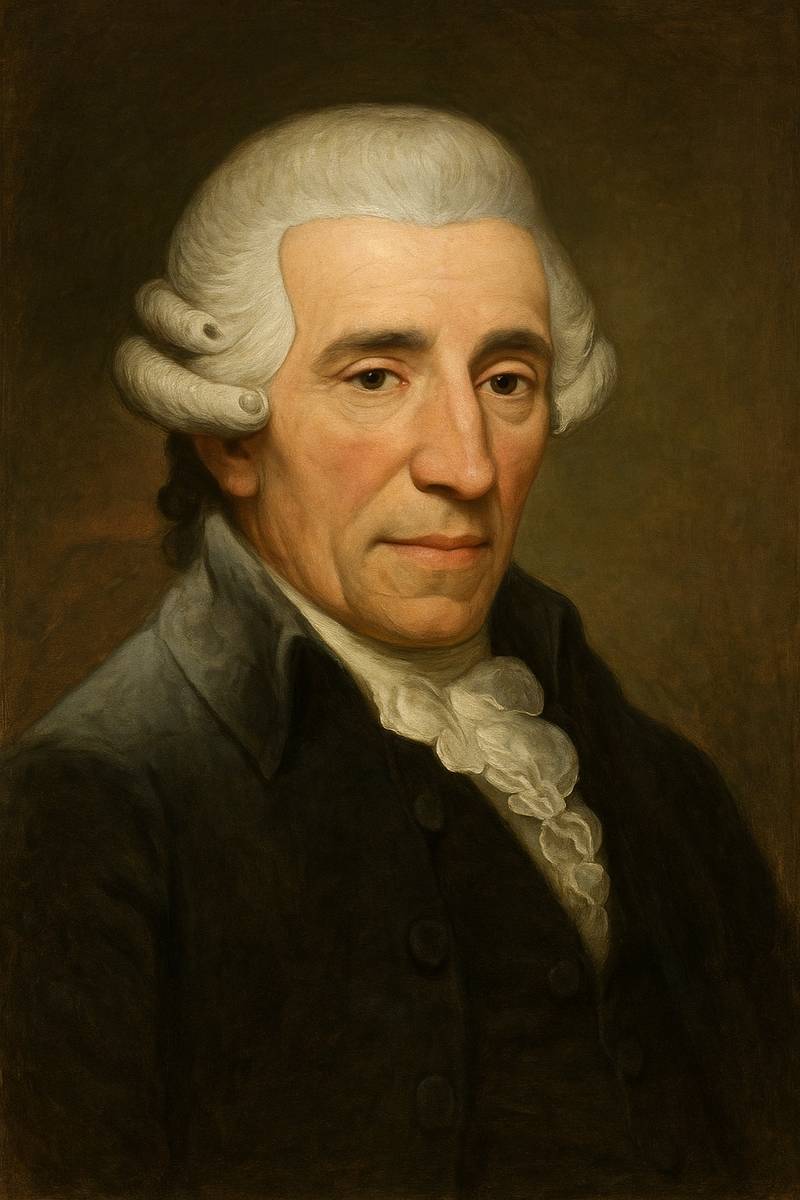
JOSEPH HAYDN (English)
Joseph Haydn was born on March 31, 1732, in Rohrau, Austria, near the Hungarian border. His family background was modest, yet culturally active. Early folk traditions influenced his rhythmic clarity and melodic simplicity. Therefore, music shaped his identity before formal schooling began. At eight years old, he entered St. Stephen’s Cathedral Choir in Vienna. There, he received training in singing, violin, and basic composition. However, his voice changed, and dismissal followed in 1749. Consequently, independence defined his youth. He survived through teaching and performance while studying theory independently. He relied heavily on Johann Joseph Fux’s Gradus ad Parnassum, which reinforced counterpoint discipline. As a result, structural balance became central to his musical thinking. These formative years established technical resilience and creative autonomy.
Joseph Haydn: Service at the Esterházy Court
In 1761, Joseph Haydn entered employment with the influential Esterházy family, marking a professional turning point. Initially appointed Vice-Kapellmeister, he later assumed full leadership. His responsibilities included composing, rehearsing, and directing music for court events. Therefore, long-term patronage ensured artistic stability. Isolation at the Esterházy estates limited external influence. Accordingly, originality replaced imitation. Between 1760 and 1790, Haydn produced most of his symphonies and string quartets. During this period, formal consistency matured. The four-movement symphony gained standardization. Thus, orchestral architecture became clearer and more balanced. His constant experimentation refined thematic development and tonal planning. This environment transformed private service into creative advantage.
Joseph Haydn: Classical Style and Lasting Innovation
Joseph Haydn earned recognition as the Father of the Symphony and the Father of the String Quartet. His approach emphasized motivic unity rather than decorative excess. Consequently, clarity and coherence defined Classical style. Humor and surprise enriched intellectual rigor. He employed unexpected pauses, rhythmic shifts, and harmonic turns. Therefore, listeners remained engaged and attentive. His music balanced emotional restraint with expressive warmth. Importantly, his innovations influenced contemporaries profoundly. Mozart admired his craftsmanship and emotional control. Beethoven briefly studied with him in Vienna. As a result, Haydn’s techniques shaped successive generations. His compositional logic became a cornerstone of Western musical form.
Joseph Haydn: International Fame and the London Years
After Prince Nikolaus Esterházy died in 1790, Joseph Haydn gained artistic freedom. He traveled to London twice, between 1791 and 1795. These visits brought unprecedented public success. Large audiences embraced his music enthusiastically. He composed the celebrated London Symphonies, expanding orchestral color and dynamic contrast. Accordingly, symphonic music reached broader social classes. Public concerts replaced exclusive aristocratic settings. Financial independence followed, reinforcing his international reputation. Enlightenment ideals of reason and balance resonated within his works. Thus, his music aligned with cultural transformation across Europe.
Joseph Haydn: Sacred Masterworks and Final Legacy
In his later years, sacred composition dominated Haydn’s output. The oratorios The Creation (1798) and The Seasons (1801) merged theology, nature, and Enlightenment optimism. These works displayed monumental structure and expressive clarity. Therefore, spiritual reflection coexisted with rational design. Their success confirmed his universal appeal. Haydn spent his final years in Vienna, honored and respected. He died on May 31, 1809, during Napoleonic occupation. However, his influence endured beyond political turmoil. Through balance, innovation, and humanity, Joseph Haydn defined Classical music foundations. His legacy remains essential to Western art music history.
