




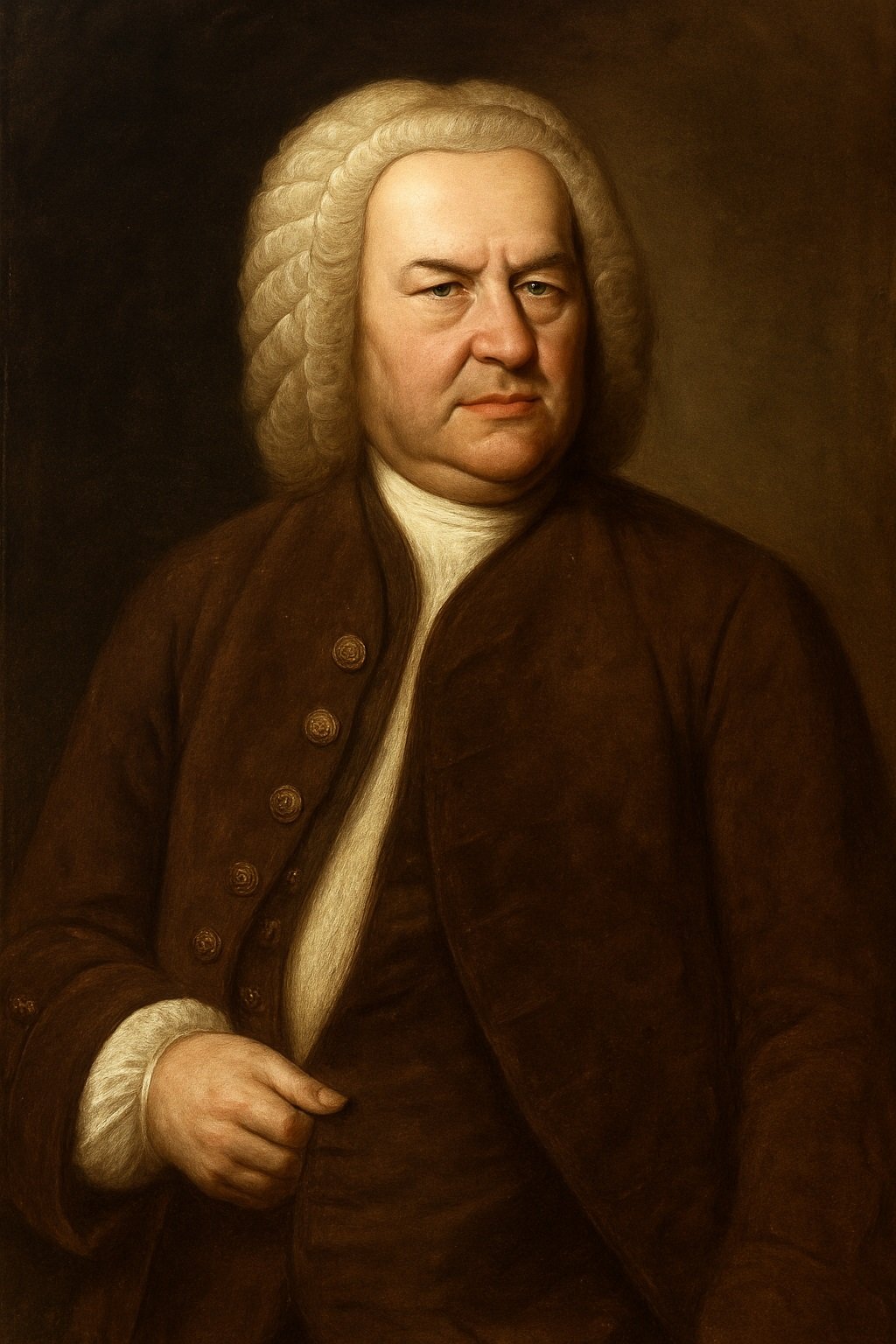
JOHANN SEBASTIAN BACH (English)
Johann Sebastian Bach was born on March 31, 1685, in Eisenach, Germany, into a distoried musical family. His early exposure to music shaped his artistic foundation. Moreover, his father taught him violin and harpsichord, while his brother expanded his skills through additional training. These experiences formed the core principles that later defined his mature style. After becoming an orphan at ten, he moved to Ohrdruf, where he continued his studies. Through discipline and curiosity, he developed the ability to integrate complex counterpoint with expressive clarity.
Musical Growth and Career of Johann Sebastian Bach
During 1703, Johann Sebastian Bach accepted his first professional role in Weimar. Soon after, he moved to Arnstadt, where he refined his organ performance. Additionally, he worked in Mühlhausen in 1707, producing sacred works with strong structural balance. His marriage that same year to Maria Barbara Bach enriched his personal life and influenced several compositions. Later, from 1708 to 1717, he returned to Weimar and created important organ pieces, including Toccata and Fugue in D minor. This period showed his mastery of baroque expression and innovative harmonies.
In 1717, he became Kapellmeister in Köthen. Here, he composed the Brandenburg Concertos, written in 1721, which remain central to the orchestral repertoire. His Köthen years highlighted a focus on secular music, elegant forms, and refined textures. Consequently, he gained recognition among European courts.
Leipzig Mastery and Legacy of Johann Sebastian Bach
In 1723, Johann Sebastian Bach was appointed Thomaskantor in Leipzig. This important position allowed him to shape sacred music for decades. Furthermore, he created the St. John Passion in 1724 and the St. Matthew Passion in 1727, both regarded as monumental works of spiritual depth. He also produced the Mass in B minor, completed around 1749, which scholars consider a synthesis of his mature technique.
While working in Leipzig, he educated young musicians and maintained high musical standards. His family grew, and several children became accomplished composers. During these years, he developed The Well-Tempered Clavier, which transformed keyboard pedagogy. His ability to unify melody, harmony, and structure demonstrated exceptional intellectual discipline.
By 1740, he explored scientific tuning, instrumental design, and rigorous contrapuntal procedures. His final project, The Art of Fugue, left an enduring statement of abstract musical thought. Although his eyesight failed in 1750, he continued composing until his death on July 28, 1750.
Enduring Influence of Johann Sebastian Bach
Today, Johann Sebastian Bach is recognized as a foundation of Western music. His works influence conductors, composers, and performers worldwide. Additionally, his compositions remain essential in education, demonstrating craftsmanship and emotional insight. Because of this legacy, he stands as a timeless figure whose innovations still inspire modern creativity and cultural appreciation.
