




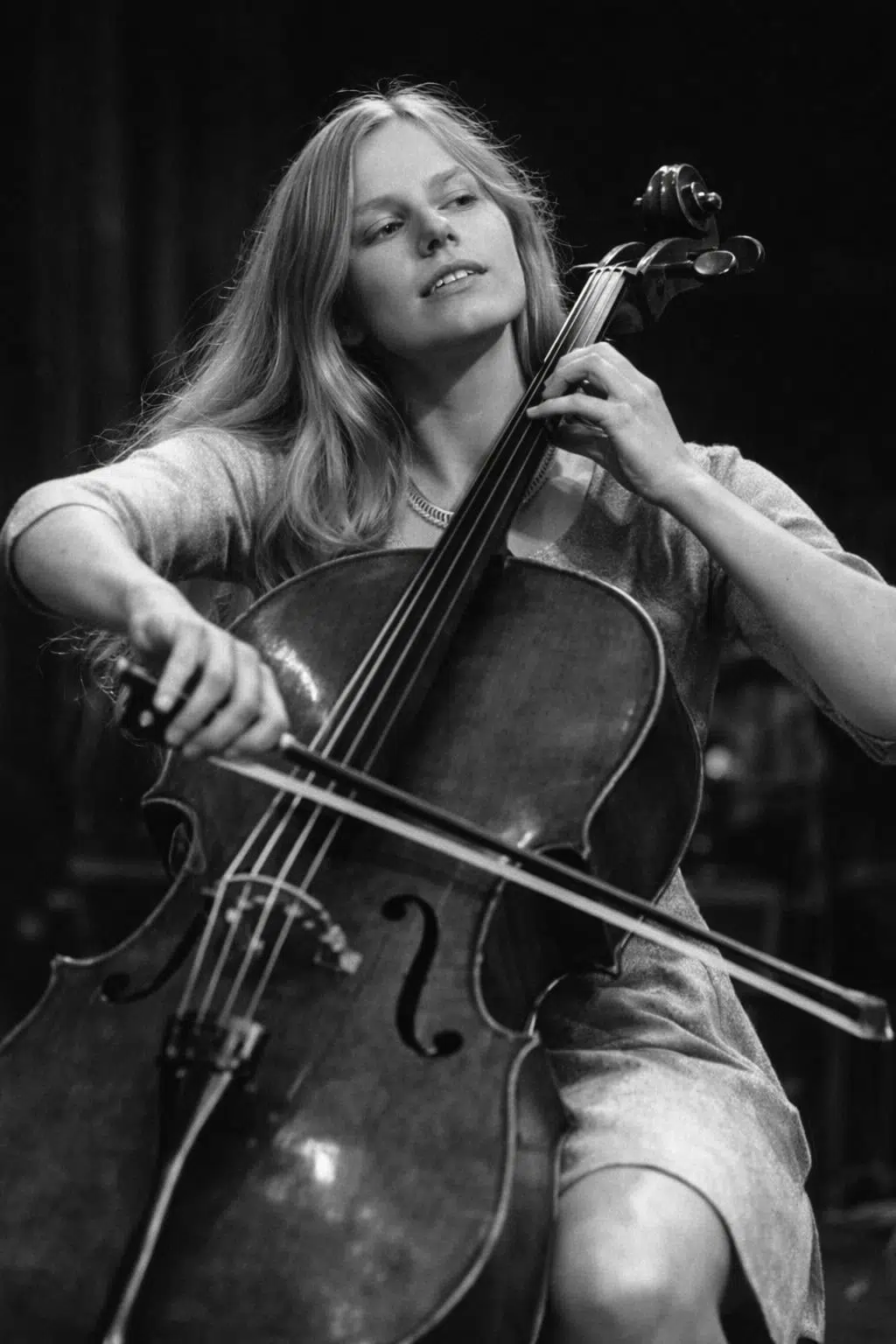
JAQUELINE DU PRÉ (English)
Jacqueline du Pré was born on January 26, 1945, in Oxford, England. From childhood, she displayed extraordinary musical abilities, documented in pedagogical records and youth concerts during the 1950s. At the age of five, she began formal cello studies, initiating an exceptionally early artistic development. From her earliest years, she stood out for a physical and highly expressive relationship with the instrument, a defining trait of her entire career. As a result, her name became early associated with a new conception of instrumental virtuosity.
Academic Training
Jacqueline du Pré’s musical training was consolidated under the guidance of some of the most important teachers of the twentieth century. She initially studied with William Pleeth in London, whose influence was decisive for her technique and musicality. She later expanded her studies with Pablo Casals, Paul Tortelier, and Mstislav Rostropovich. Thanks to this international training, Jacqueline du Pré developed a solid, flexible, and deeply expressive technique, together with a clear structural understanding of the Classical and Romantic repertoire. This academic foundation explains the interpretative maturity she demonstrated from a very early age.
Jacqueline du Pré and International Recognition
Her debut took place in 1961, when she performed Edward Elgar’s Cello Concerto in E minor. However, her international recognition came in 1965 with the historic recording of this work conducted by Sir John Barbirolli. This recording became a worldwide discographic reference and firmly established her international prestige. From that point onward, Jacqueline du Pré was invited to the leading concert halls of Europe and the Americas, performing with top-tier orchestras. Her stage presence was distinguished by emotional intensity, physical energy, and expressive honesty.
Interpretative Style of Jacqueline du Pré
Jacqueline du Pré’s style was characterized by a powerful, warm, and directly communicative sound. Unlike more restrained approaches, her interpretations sought an immediate human experience. For this reason, her readings of works by Elgar, Schumann, and Dvořák marked a turning point in cello interpretation. Critics and musicologists agree that Jacqueline du Pré redefined the relationship between performer and audience, prioritizing total emotional commitment over expressive neutrality.
Personal Life and Artistic Context
In 1967, Jacqueline du Pré married the pianist and conductor Daniel Barenboim. Together, they formed a significant artistic partnership within the musical landscape of the twentieth century. They shared the stage with musicians such as Itzhak Perlman and Pinchas Zukerman, within a historically documented artistic environment. Nevertheless, Jacqueline du Pré’s artistic identity always remained clearly defined and autonomous, regardless of her collaborations.
Illness, Retirement, and Death of Jacqueline du Pré
In 1973, she was diagnosed with multiple sclerosis, a progressive neurological disease that gradually limited her concert activity. As a consequence, she was forced to withdraw from the stage, bringing an exceptionally brief public career to an end. She died on October 19, 1987, in London, at the age of forty-two. Despite the short duration of her career, her artistic impact remains fully alive.
Historical Legacy
Today, Jacqueline du Pré is recognized as a central figure in the history of the cello. Her interpretations continue to be studied in conservatories and universities. Moreover, her expressive approach still influences contemporary instrumental pedagogy. In summary, Jacqueline du Pré represents artistic authenticity, musical rigor, and emotional commitment.
