




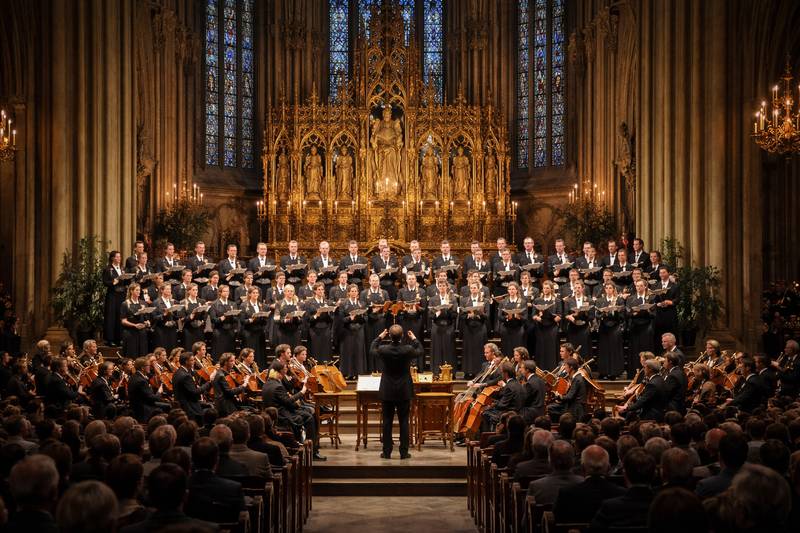
HÄNDEL’S MESSIAH
George Frideric Händel composed Messiah in 1741, during a period of intense creative activity in London. The autograph manuscript preserves precise dates that place the writing between August 22 and September 14, 1741. This information aligns with the consensus of historical musicology and is supported by preserved primary sources. The chronology shows no significant discrepancies within the specialized literature.
Time of composition and creative context (Händel’s Messiah)
The musical composition of Messiah was completed in twenty-four days, as indicated by the composer’s own annotations in the score. This working pace corresponds to other documented periods of high productivity in his career. The fact fits coherently within his usual compositional practice, without recourse to external narrative elements or later idealizations.
Libretto and biblical sources of Messiah
The text was assembled by Charles Jennens, an eighteenth-century English intellectual, as evidenced by his surviving correspondence. The libretto draws exclusively on passages from the 1611 King James Bible, selected and organized without external doctrinal additions. This textual choice defines the contemplative character of the oratorio and explains its distance from religious opera. The coherence between text and music reinforces the conceptual unity of Messiah.
Musical and theological structure (Händel’s Messiah)
Messiah is organized in three parts, following a progressive biblical trajectory. The first addresses messianic prophecies and the Nativity. The second focuses on the Passion, the Resurrection, and Redemption, concluding with the Hallelujah Chorus. The third reflects on the resurrection of the dead and eternal life. This arrangement responds to a clear and sustained theological logic, without staged dramatic action.
Musical language of Messiah
The musical language belongs to the late Baroque, with a clear functional differentiation between recitatives, arias, and choruses. Händel employs secco recitative for direct textual exposition and accompagnato recitative at moments of greater expressive density. The arias, mostly in da capo form, allow musical reflection on the text. The choruses alternate counterpoint and homophony, according to the expressive needs of the biblical discourse.
Premiere and early performances
The premiere of Messiah took place on April 13, 1742, in Dublin, at Neal’s Music Hall on Fishamble Street. Contemporary announcements indicate that the performance had a charitable purpose and a favorable reception. From 1743 onward, the work was presented in London, where Händel himself made instrumental and vocal adjustments. These adaptations reflect a flexible practice typical of the eighteenth century.
Historical reception and performance tradition (Händel’s Messiah)
During the eighteenth century, Messiah became associated with charitable concerts, especially in England and Ireland. In the nineteenth century, the work was incorporated into the tradition of large choral performances, particularly within the British context. Despite these interpretive changes, the essential musical content remained stable thanks to the preservation of sources and later critical editions.
Musicological value and continuing relevance
From the perspective of contemporary musicology, Messiah is regarded as a model of the biblical oratorio for its balance between text and music. The work rests on solid historical sources and on a coherent textual transmission.
