



GREEK MODES
Historically, the modern term “mode” does not fully coincide with the original Greek concepts (harmoniai and, in later contexts, tonoi). Therefore, Greek Modes should not be understood as fixed diatonic scales or harmonic systems. Their primary function was melodic and ethical, not tonal in the modern sense. This distinction is widely accepted in contemporary musicology.
Greek Modes: verified historical sources
Ancient sources on Greek Modes are fragmentary but conceptually consistent.
- Plato (427–347 BCE), in The Republic and The Laws, discusses modes from an educational and moral perspective.
- Aristotle (384–322 BCE), in Politics, analyzes the emotional effects of music and confirms the concept of musical ethos.
- Aristoxenus of Tarentum (4th century BCE), in Elements of Harmonics, provides the most detailed technical framework for ancient melodic organization.
None of these sources preserve complete musical notation. Therefore, any sonic reconstruction must be understood as a theoretical interpretation, not as an exact reproduction.
Greek Modes: theoretical structure and musical organization
From a technical standpoint, Greek Modes were organized through tetrachords, intervals spanning a perfect fourth. Aristoxenus describes how these tetrachords could be configured according to three intervallic genera:
diatonic, chromatic, and enharmonic.
This structure confirms that Greek Modes were not rigid scales. A single mode could present perceptible variants without losing its conceptual identity. Organization relied on ambitus, points of repose, and melodic direction, not on harmonic hierarchies.
Greek Modes: ethical and educational function
The principle of musical ethos is firmly documented. Plato argues that certain modes promote discipline and virtue, while others encourage relaxation or emotional excess. Aristotle reinforces this view by describing music’s ability to generate specific affective dispositions.
It is important to clarify that these assertions belong to the philosophical and pedagogical domain, not to experimental acoustic theory. Nevertheless, their internal coherence and textual recurrence grant them significant historical value.
Musical use of Greek Modes
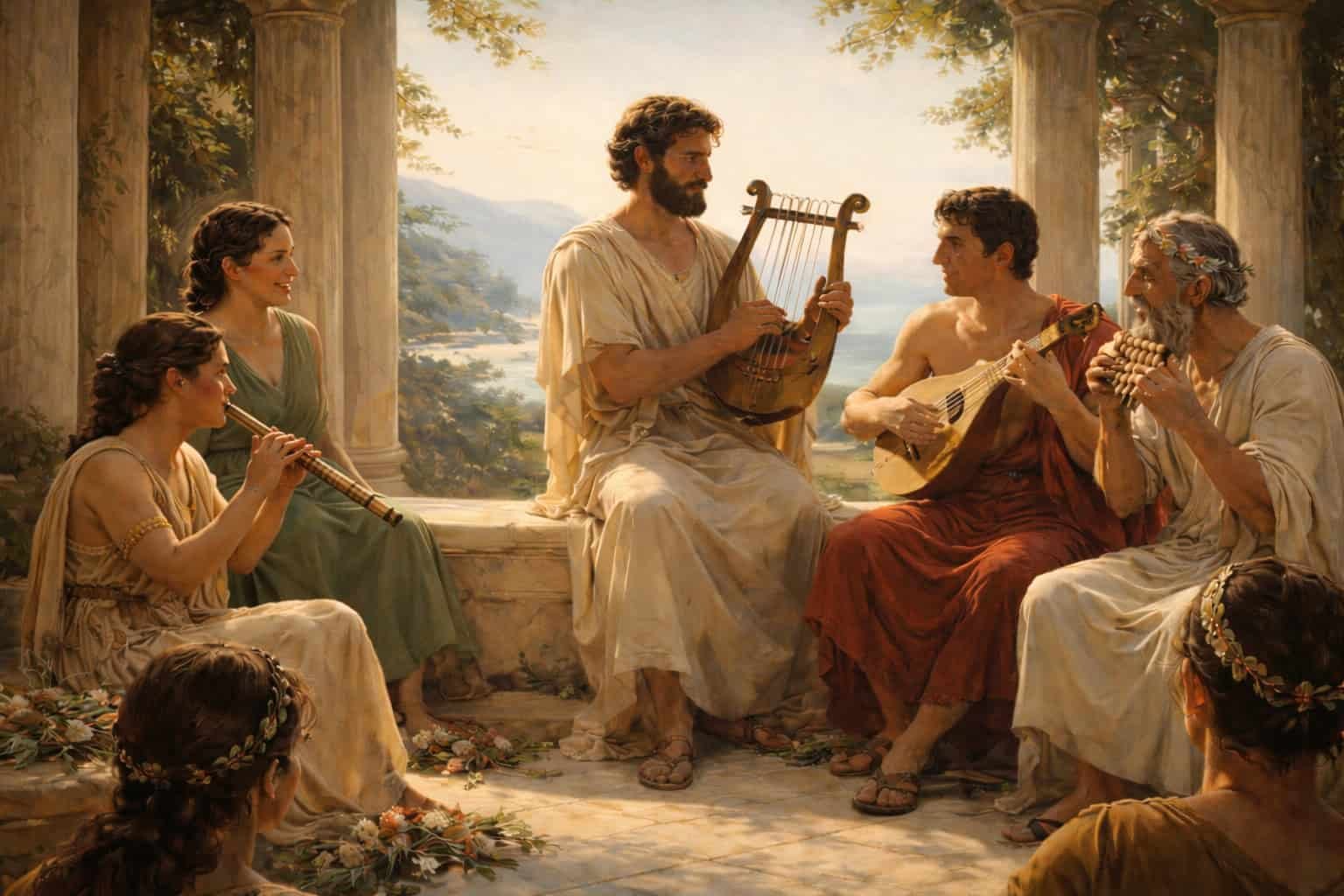
Ancient sources confirm that Greek Modes were employed as stable melodic frameworks, especially in vocal contexts linked to poetry, drama, and ritual. There is no evidence of harmonic progressions or tonal modulation in the modern sense.
The choice of a mode depended on its overall expressive character, which remained consistent throughout performance. This practice aligns with the Greek conception of music as an extension of language and rhetoric.
Musical characteristics attributed to each principal mode
The following characteristics are based exclusively on documented ethical–aesthetic attributions, not on precise acoustic descriptions:
- Dorian mode: Associated with firmness, balance, and self-control. Plato considers it suitable for civic education.
- Phrygian mode: Linked to excitement and enthusiasm. Aristotle notes its capacity to produce emotional exaltation.
- Lydian mode: Connected with softness and relaxation. Plato criticizes it for lacking moral severity.
- Mixolydian mode: Associated with lament and emotional gravity in the Platonic context.
These descriptions reflect cultural perceptions, not scales that can be reconstructed with absolute certainty.
Ionian, Aeolian, and Locrian: historical status
The Ionian mode is explicitly mentioned by Plato, although always in a critical context. Its identification with the modern major scale lacks historical support.
The Aeolian mode and Locrian mode do not possess the same level of documentation in fourth-century BCE classical theory. Their systematization occurs mainly in later theoretical traditions, particularly during Late Antiquity and the Middle Ages. Contemporary musicology recognizes this difference in status as an established fact.
Greek Modes and musical alterations
There is no historical evidence that Greek Modes employed sharps or flats in the modern sense. Ancient notation did not function with accidental alterations equivalent to the tonal system.
Pitch variation occurred through internal division of the tetrachord, especially in the chromatic and enharmonic genera. These divisions include intervals that cannot be precisely represented using modern Western notation.
Therefore, any translation of Greek Modes into scales with sharps and flats must be considered a contemporary pedagogical tool, not a documented ancient practice.
Transmission and historical reinterpretation
During Late Antiquity, Boethius (c. 480–524 CE) transmitted Greek musical theory to the Latin world. This process decisively influenced the formation of the medieval modal system. However, this transmission involved reinterpretations that altered the original meaning of Greek Modes.
Twentieth-century musicology has clearly distinguished between ancient Greek theory and later modal systems.
Academic synthesis
Greek Modes must be understood as melodic and ethical categories, not as tonal scales or harmonic systems. Their study relies on verifiable philosophical and theoretical sources that are necessarily limited. Respecting these limitations is essential to maintaining academic rigor.
When understood in their authentic context, Greek Modes represent one of the fundamental pillars of Western musical thought, with a high degree of historical reliability.
Contemporary didactic reinterpretation of Greek Modes
In Ancient Greece, Greek Modes were not conceived as fixed diatonic scales.
However, modern music theory frequently explains them as diatonic scales derived from a major scale to facilitate practical understanding.
What follows is therefore a contemporary pedagogical reinterpretation, not a literal historical description.
Ionian mode as a diatonic scale
The Ionian mode corresponds to the modern major scale.
Interval structure:
Whole – Whole – Half – Whole – Whole – Whole – Half
Example in C:
C – D – E – F – G – A – B – C
Alterations:
No sharps or flats in C.
In other keys, it adopts the accidentals of the corresponding major scale.
Modern pedagogical character:
Stable, bright, and conclusive.
Dorian mode as a diatonic scale
The Dorian mode is obtained by starting the major scale on its second degree.
Interval structure:
Whole – Half – Whole – Whole – Whole – Half – Whole
Example in D (derived from C major):
D – E – F – G – A – B – C – D
Alterations:
Minor third relative to Ionian, with a major sixth.
Modern pedagogical character:
Balance between tension and stability; widely used in jazz and modal music.
Phrygian mode as a diatonic scale
The Phrygian mode begins on the third degree of the major scale.
Interval structure:
Half – Whole – Whole – Whole – Half – Whole – Whole
Example in E (derived from C major):
E – F – G – A – B – C – D – E
Alterations:
Minor second relative to the major scale.
Modern pedagogical character:
Tense and dark; frequent in flamenco and metal.
Lydian mode as a diatonic scale
The Lydian mode starts on the fourth degree of the major scale.
Interval structure:
Whole – Whole – Whole – Half – Whole – Whole – Half
Example in F (derived from C major):
F – G – A – B – C – D – E – F
Alterations:
Augmented fourth (B natural instead of B♭).
Modern pedagogical character:
Expansive and bright.
Mixolydian mode as a diatonic scale
The Mixolydian mode begins on the fifth degree of the major scale.
Interval structure:
Whole – Whole – Half – Whole – Whole – Half – Whole
Example in G (derived from C major):
G – A – B – C – D – E – F – G
Alterations:
Minor seventh relative to the major scale.
Modern pedagogical character:
Open sonority; common in blues and rock.
Aeolian mode as a diatonic scale
The Aeolian mode corresponds to the natural minor scale.
Interval structure:
Whole – Half – Whole – Whole – Half – Whole – Whole
Example in A (derived from C major):
A – B – C – D – E – F – G – A
Alterations:
Minor third, sixth, and seventh.
Modern pedagogical character:
Introspective and melancholic.
Locrian mode as a diatonic scale
The Locrian mode begins on the seventh degree of the major scale.
Interval structure:
Half – Whole – Whole – Half – Whole – Whole – Whole
Example in B (derived from C major):
B – C – D – E – F – G – A – B
Alterations:
Diminished fifth, plus minor second, third, sixth, and seventh.
Modern pedagogical character:
Highly unstable; rare in tonal practice.
Comparative summary
| Mode | Characteristic alteration |
|---|---|
| Ionian | None |
| Dorian | Minor 3rd |
| Phrygian | Minor 2nd |
| Lydian | Augmented 4th |
| Mixolydian | Minor 7th |
| Aeolian | Minor 3rd, 6th, and 7th |
| Locrian | Minor 2nd and diminished 5th |
Explaining Greek Modes as diatonic scales is useful for modern musical practice but historically inaccurate.
This approach must be understood as a contemporary didactic tool, not as original Greek theory.
