




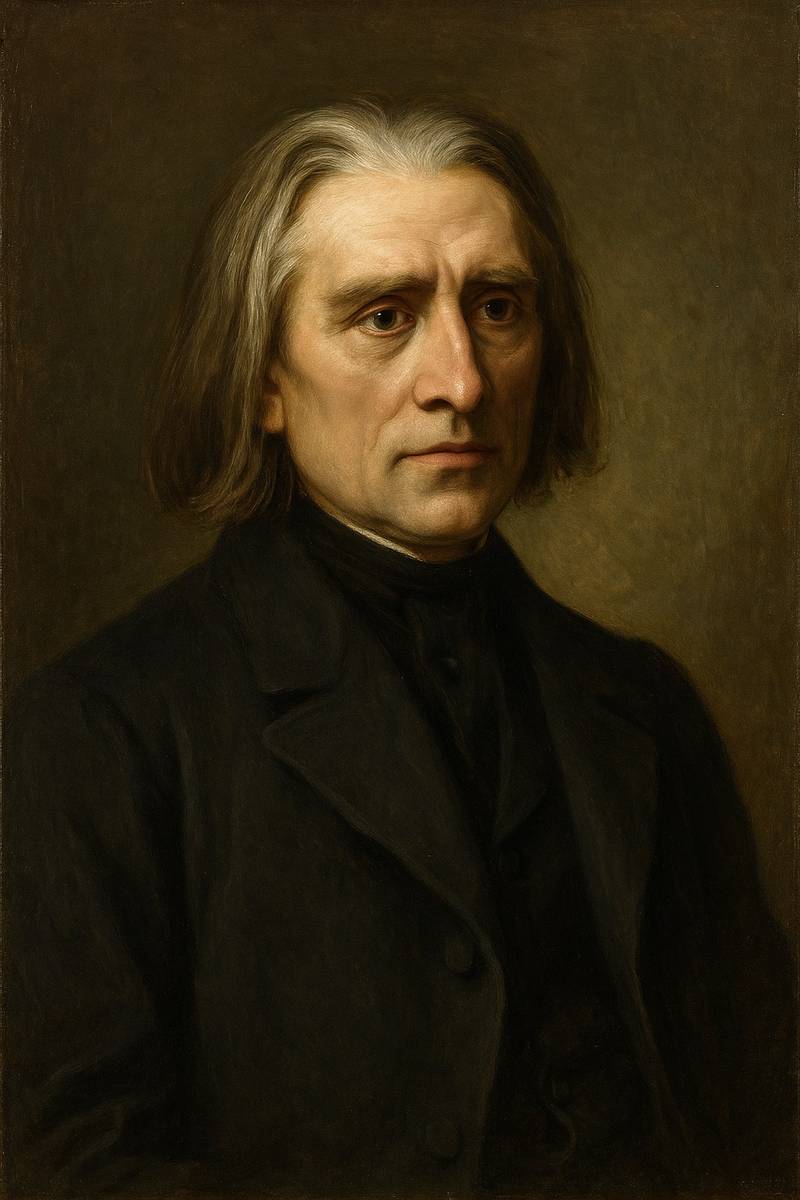
FRANZ LISTZ (English)
Franz Listz was born on October 22, 1811, in Raiding, then part of the Austrian Empire. His father, Ádám Liszt, worked for the Esterházy court and provided early musical guidance. From childhood, Franz Listz demonstrated extraordinary pianistic talent, exceptional memory, and rare artistic sensitivity. At the age of six, he performed publicly, astonishing audiences with clarity and control. Therefore, local patrons quickly recognized a prodigious musician whose abilities suggested a future of historic importance. In 1821, Franz Listz moved to Vienna to study with Carl Czerny and Antonio Salieri, where he developed technical discipline, stylistic awareness, and structural understanding. Although rejected by the Paris Conservatoire for age reasons, he pursued private studies intensively. Consequently, this challenge strengthened his independence and artistic determination.
Franz Listz and the Rise of a Piano Virtuoso
During the 1830s, Franz Listz became the most celebrated pianist in Europe. His performances transformed the concert experience through dramatic presence and expressive freedom. Moreover, he established the solo piano recital as an independent concert format. Audiences reacted with overwhelming enthusiasm, a phenomenon later called Lisztomania, which reflected the emotional intensity of his performances. Franz Listz expanded piano technique through wide gestures, powerful sonority, and emotional intensity, redefining the physical and expressive limits of the instrument. As a result, his extensive tours across France, Germany, Italy, and Russia enhanced his international fame. Thus, he shaped the modern concept of virtuosity admired worldwide.
Franz Listz: Romantic Innovation and Composition
Franz Listz played a central role in nineteenth-century Romantic music, seeking to unite sound with poetry, philosophy, and imagination. He believed music could communicate ideas beyond pure form. Most notably, he created the symphonic poem, a revolutionary orchestral form that allowed music to express literary and dramatic narratives directly. Works such as Les Préludes and Mazeppa reveal bold orchestration and thematic transformation. Additionally, his Transcendental Études reshaped piano literature through technical ambition and expressive depth. Franz Listz combined virtuosic brilliance with intellectual purpose. Therefore, he profoundly influenced composers including Wagner, Debussy, and Richard Strauss.
Franz Listz and His Pedagogical Legacy
In 1848, Franz Listz settled in Weimar, beginning a new creative phase focused on mentorship and cultural leadership. He gradually withdrew from touring to dedicate himself to conducting, composing, and teaching. Importantly, he offered free instruction to gifted students from across Europe, reflecting his commitment to artistic development. Among his pupils were Hans von Bülow and Carl Tausig, who later spread his interpretive ideals. Franz Listz promoted a teaching philosophy centered on interpretive freedom and artistic individuality. He rejected mechanical repetition in favor of musical meaning and stylistic awareness. Furthermore, he emphasized the study of Bach, Beethoven, and Schubert, strengthening European pianism for generations.
Franz Listz: Spiritual Transformation and Late Style
From the 1860s, Franz Listz experienced a profound spiritual transformation that reshaped his artistic priorities. In 1865, he received minor orders within the Roman Catholic Church, an event that deeply affected his late musical language. His compositions became increasingly introspective, restrained, and experimental. Works such as Via Crucis and Nuages gris anticipate twentieth-century modernism through dissonance, silence, and fragmented forms. Franz Listz challenged Romantic conventions by exploring new expressive paths. Although initially misunderstood, these works are now recognized as visionary and historically significant.
Franz Listz: Cultural Impact and Historical Importance
Franz Listz died on July 31, 1886, in Bayreuth, Germany. His legacy extends beyond piano performance into composition, education, and cultural leadership. He actively supported emerging composers and promoted innovative musical ideas, helping shape the future of European music. Franz Listz redefined the identity of the Romantic artist by uniting virtuosity, intellectual depth, and spiritual exploration within a single artistic vision. His contributions continue to influence conservatories, scholars, and concert stages worldwide. For these reasons, Franz Listz remains a foundational figure in Western music history.
In summary, Franz Listz transformed piano technique, concert culture, and musical thought. He bridged Classical traditions with Romantic expression and early modern experimentation. Moreover, his artistic courage expanded the expressive boundaries of music. Consequently, the enduring legacy of Franz Listz continues to inspire musicians and audiences around the world.
