




CLASSICAL MUSIC
Classical Music describes a broad body of musical traditions developed mainly in Europe between the eleventh and twentieth centuries. This tradition emerged within religious institutions and European courts, where music served spiritual, ceremonial, and educational purposes. Initially, during the Middle Ages, liturgical chant dominated, especially Gregorian chant, which established modal foundations and an oral tradition later preserved through written notation.
Over time, the Renaissance encouraged complex polyphony, balance, and a refined relationship between text and sound. Subsequently, the Baroque period introduced counterpoint, opera, and new instrumental forms, alongside harmonic foundations that shaped later styles.
Later, the Classical period consolidated principles of formal clarity, proportion, and structural balance, establishing lasting compositional models. The Romantic era then expanded emotional expression, orchestral color, and artistic subjectivity. Finally, the twentieth and twenty-first centuries embraced stylistic plurality and experimentation, confirming that Classical Music is not a single genre but a diverse, deep, and continually evolving historical tradition.
Musical Language, Notation, and Forms in Classical Music
This academic repertoire is constructed through detailed musical notation, which preserves works and enables precise interpretation. Such writing communicates rhythm, pitch, articulation, and dynamics accurately. Moreover, the musical language relies on tonal systems, harmonic development, and rigorous formal organization.
Among the most representative forms are the sonata, symphony, concerto, and string quartet. These structures emphasize formal balance and logical musical discourse. Additionally, works develop thematic ideas through variation, contrast, and modulation.
Interpretation, therefore, requires stylistic understanding and conscious technical mastery. Each historical period demands specific approaches to articulation, tempo, and expression. As a result, this language encourages deep analysis, active listening, and structured musical thinking, essential for understanding its artistic complexity.
Classical Music and Instrumental Sound
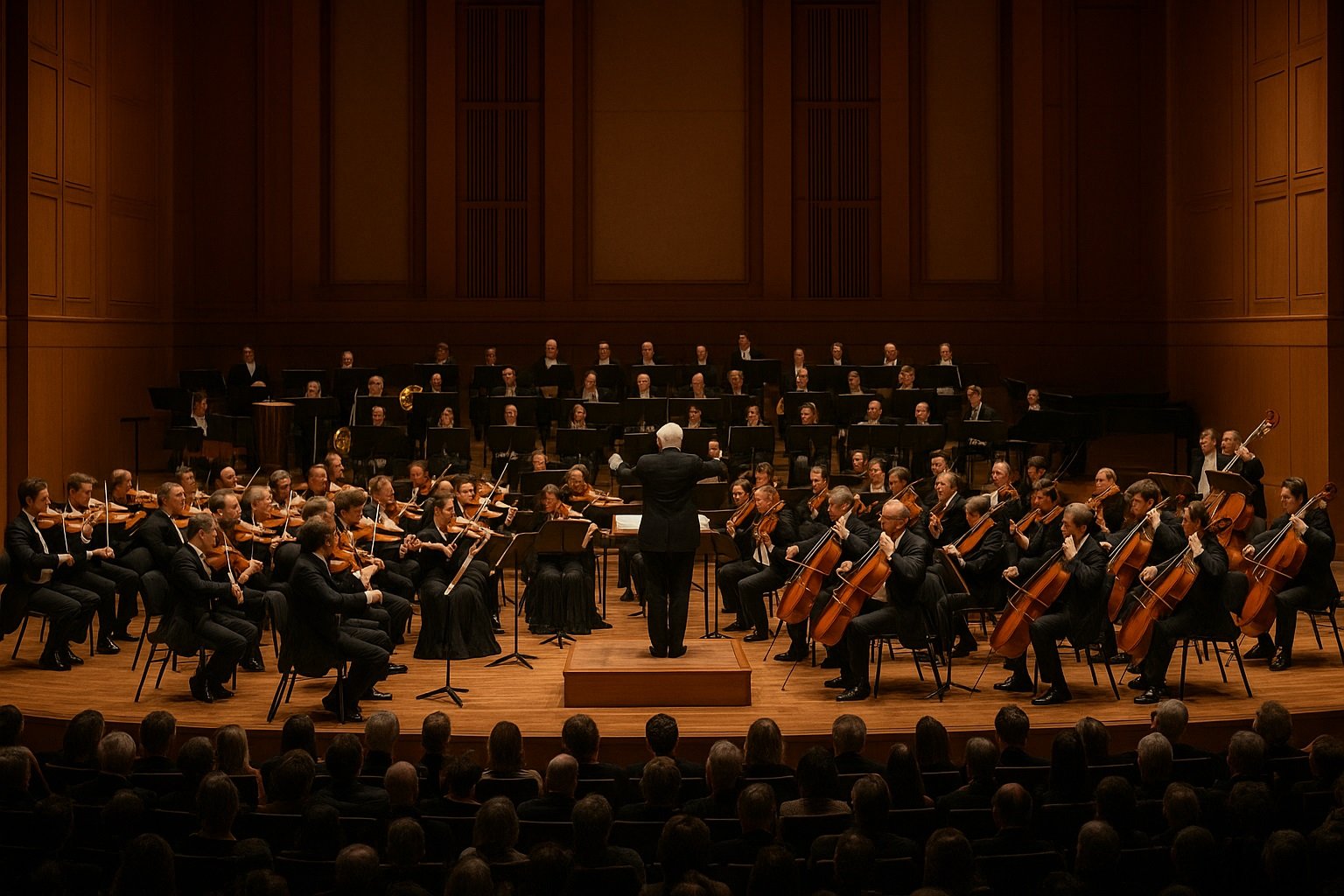
Classical Music employs symphony orchestras, chamber ensembles, and solo formats, significantly expanding expressive possibilities. Instruments are organized into clearly defined families: strings, woodwinds, brass, and percussion. This organization ensures timbral balance and sonic clarity.
Furthermore, its language includes functional harmony, polyphonic and monophonic textures, and wide dynamic contrasts. These features create emotional depth and expressive richness. The symphony orchestra plays a central role by combining color, power, and interpretive subtlety.
Vocal music also integrates text and sound through opera, oratorio, and lied, blending narrative, emotion, and compositional technique. Therefore, the classical sound language offers a complex aesthetic experience, where form and expression remain carefully balanced.
Cultural Importance, Education, and the Present Day
Classical Music has profoundly influenced musical traditions worldwide. Its impact extends into arts education, academic research, and global cultural development. Numerous studies indicate that its study enhances memory, concentration, and aesthetic sensitivity.
Moreover, this repertoire remains present in concerts, festivals, audiovisual media, and interdisciplinary projects. Today, new generations reinterpret its works through contemporary perspectives while maintaining historical respect and creative innovation. Digital recordings and online platforms have broadened access for diverse audiences.
Additionally, conservatories, orchestras, and cultural institutions preserve its legacy through specialized training and continuous dissemination. In summary, this tradition combines educational value, academic rigor, and technological adaptability. For these reasons, Classical Music maintains global relevance and future projection, grounded in knowledge, artistic discipline, and enduring cultural significance.
