




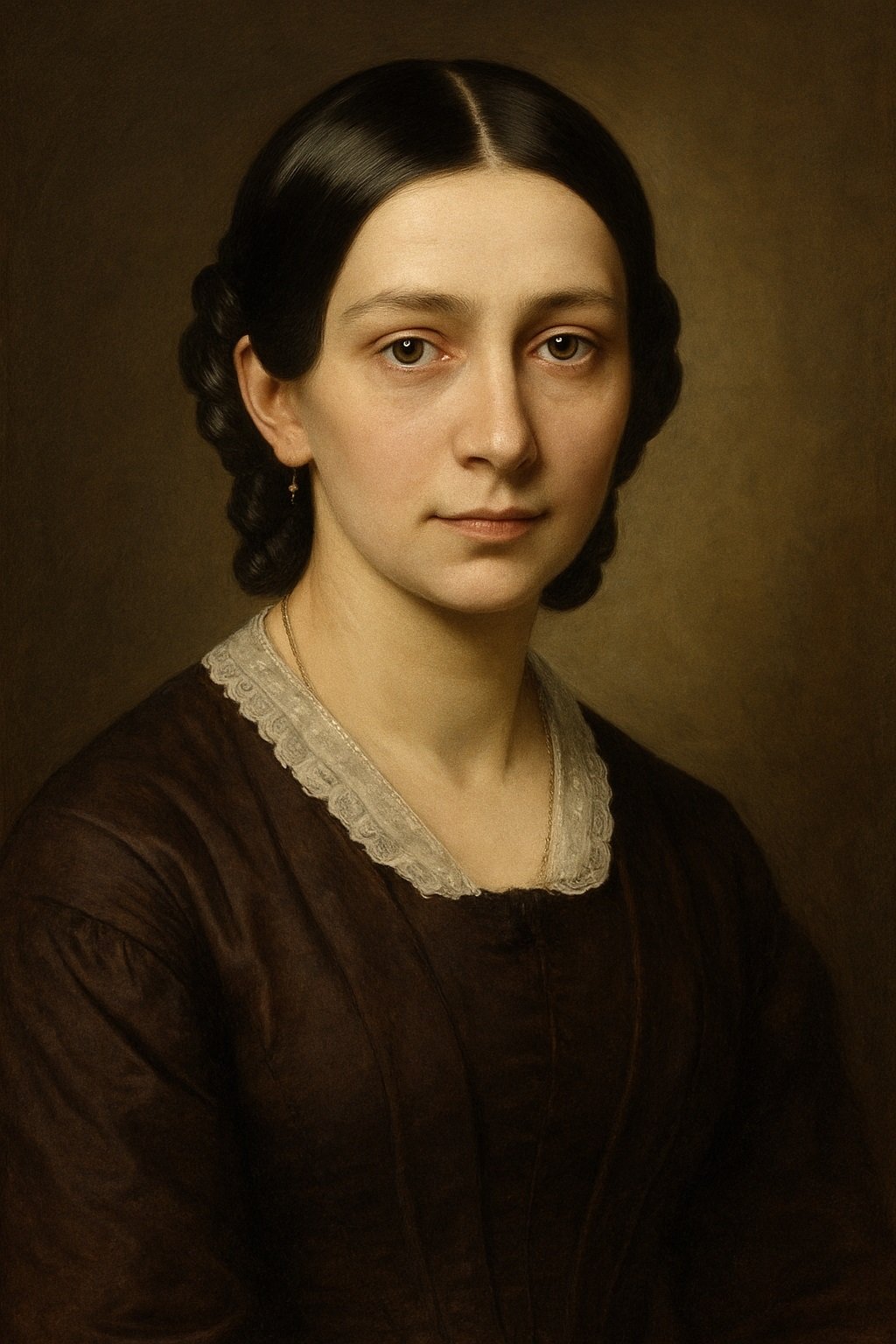
CLARA SCHUMANN (English)
Clara Schumann was born on September 13, 1819, in Leipzig, within the Kingdom of Saxony, into a disciplined musical environment. Her father, Friedrich Wieck, a renowned piano pedagogue, directed her rigorous education in piano, theory, counterpoint, and composition. As a result, she developed exceptional technical control, musical intelligence, and expressive balance from early childhood, shaping a distinctive artistic identity grounded in precision and depth.
By the age of nine, she appeared publicly as a pianist in Leipzig, astonishing audiences with maturity beyond her years. Soon afterward, she toured major cultural centers in Germany, France, and Austria, earning widespread critical acclaim. Therefore, early success established her reputation as one of Europe’s most promising young pianists, admired for virtuosic technique, clarity, and emotional restraint.
Clara Schumann and Marriage, Career, and Artistic Resilience
In 1840, Clara Schumann married composer Robert Schumann after a prolonged legal struggle against her father’s opposition. Their marriage formed a deep artistic partnership based on mutual respect and shared musical values. However, prevailing social expectations challenged her independence as a professional woman within nineteenth-century Europe.
Despite these constraints, she maintained an active international concert career. Moreover, she premiered, edited, and promoted many of Robert Schumann’s compositions across European stages. While raising eight children, she balanced family responsibilities with intense artistic demands. After Robert’s mental collapse in 1854 and his death in 1856, Clara became the family’s sole provider, reinforcing her resilience and professional authority.
Clara Schumann: Composer and Voice of Romantic Expression
Beyond performance, Clara Schumann pursued composition with seriousness and artistic ambition. Her output includes piano works, lieder, chamber music, and pedagogical compositions reflecting lyrical refinement and formal clarity. Among her most significant works is the Piano Concerto in A minor, Op. 7, composed during her teenage years and premiered by herself.
Nevertheless, restrictive gender norms limited her compositional confidence and productivity. She openly questioned whether women were encouraged to compose professionally. Yet, her music demonstrates emotional depth, balanced structures, and a refined harmonic voice. Modern scholarship increasingly recognizes her as a creative contributor to Romantic-era music, rather than a secondary historical figure.
Clara Schumann: Pedagogy, Legacy, and Final Years
In 1878, Clara Schumann accepted a teaching position at the Hoch Conservatory in Frankfurt, one of Europe’s leading musical institutions. There, she shaped generations of pianists through disciplined instruction emphasizing fidelity to the score, expressive restraint, and technical integrity. Consequently, her pedagogical influence extended well beyond her lifetime.
Simultaneously, she maintained a close artistic friendship with Johannes Brahms, grounded in shared aesthetic principles and mutual respect. Clara continued performing publicly until 1891, despite declining health. She died on May 20, 1896, in Frankfurt am Main, aged seventy-six. Ultimately, her legacy unites performance excellence, pedagogical authority, and creative achievement, securing her place in Western music history.
