




THE APPROPIATE HEIGHT OF THE PIANO BENCH
The analysis of the appropriate height of the piano bench has been a subject of constant reflection since the emergence of the instrument. A central objective has always been to optimize bodily control, avoiding unnecessary tension and promoting motor efficiency.
Historical context of the appropriate height of the piano bench
The piano emerged at the beginning of the eighteenth century, when in 1700 Bartolomeo Cristofori developed the gravicembalo col piano e forte in Florence. The earliest piano methods did not establish universal measurements for the bench, although they described proportional bodily relationships among the keyboard, the arms, and the torso. During the Classical period, between 1750 and 1820, authors such as Carl Philipp Emanuel Bach offered fundamental observations; in his treatise Versuch über die wahre Art das Clavier zu spielen (1753–1762), Bach emphasized the natural freedom of the arm, indirectly linking seat height with efficient mobility. Subsequently, in the nineteenth century, the development of the concert piano transformed pianistic posture, as the instrument’s greater mechanical resistance required a stable and functional position. Methods by Czerny and Leschetizky, active between 1820 and 1900, reinforced the idea that correct height allows the forearm to be positioned approximately parallel to the keyboard.
Biomechanical principles of the appropriate height of the piano bench
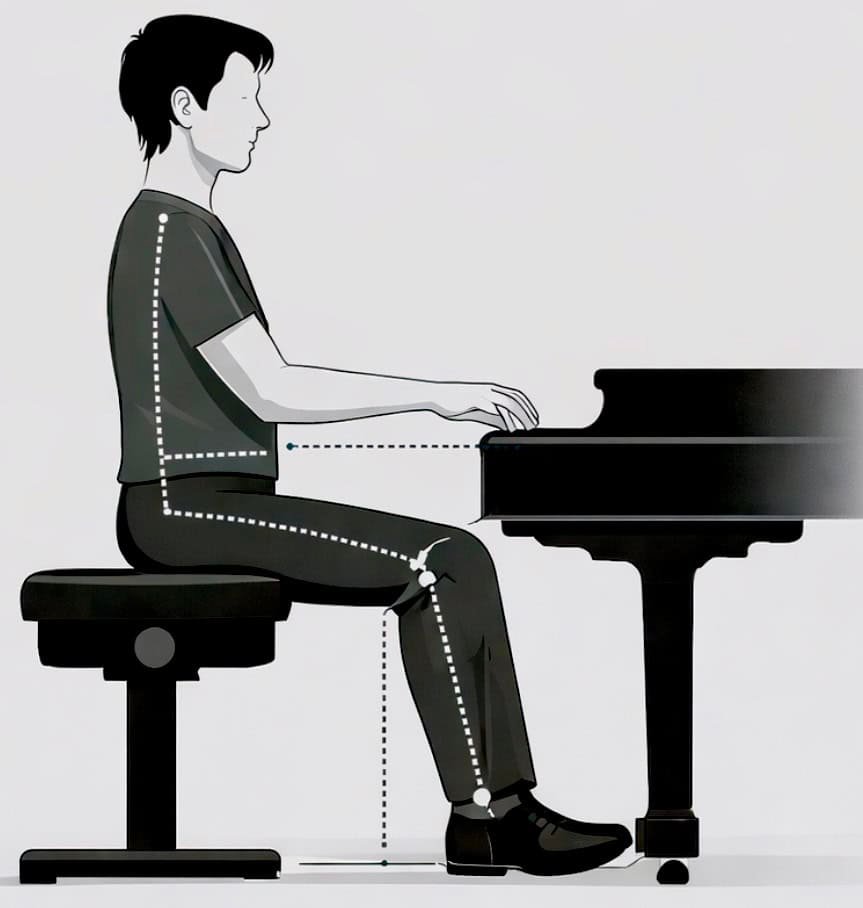
From a biomechanical perspective, the appropriate height of the piano bench is defined by precise and observable joint relationships. Pedagogical tradition agrees on a central principle: the elbow should be positioned slightly above the level of the keys. This relationship facilitates efficient transmission of arm weight, reduces wrist hyperflexion, and preserves the stability of the metacarpophalangeal joint. Likewise, trunk balance depends directly on this postural adjustment. Pedagogical research in the twentieth century consolidated these principles; in 1932, Otto Ortmann published The Physiological Mechanics of Piano Technique, in which he analyzed pianistic movement using measuring instruments, confirming the relevance of an adjustable bench height.
Individual factors in the appropriate height of the piano bench
There is no fixed universal measurement; therefore, the appropriate height of the piano bench depends on clearly identifiable individual factors. Among them are height, torso length, and the proportion between the arm and forearm. In addition, the type of repertoire influences postural choice: late Romantic repertoire requires greater use of body weight, whereas Baroque repertoire demands fine control and economy of gesture. Despite these stylistic differences, the basic postural principles remain constant. The use of adjustable benches became widespread at the end of the nineteenth century in response to verifiable pedagogical needs, allowing height to be adapted without altering the instrument’s mechanics, a practice that is now considered standard in professional training.
Pedagogical consequences of the appropriate height of the piano bench
The consequences of incorrect height are documented in pianistic pedagogy. A bench that is too low increases tension in the shoulders and neck, while one that is excessively high compromises pelvic balance and overall stability. In both cases, technical precision is affected. By contrast, the appropriate height of the piano bench promotes physical endurance, improves sound quality, and stabilizes dynamic control, becoming a key factor in injury prevention. Since the twentieth century, European and American conservatories have formally incorporated these criteria, consolidating an academic consensus that remains in force.
In summary, the appropriate height of the piano bench is not a recent trend but the result of more than three centuries of instrumental and pedagogical evolution. From 1700 to the present, historical evidence shows remarkable coherence. The essential criterion remains stable: the pianist must sit in such a way that the body cooperates with technique, turning posture into a silent ally of musical performance.
