




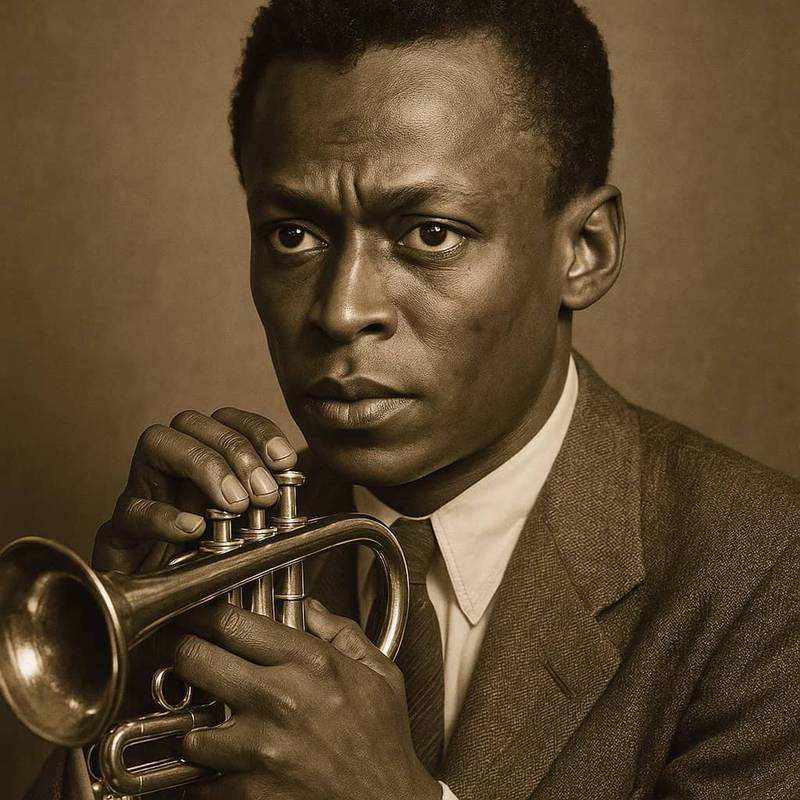
MILES DAVIS (English)
Miles Davis transformed modern jazz through innovative styles and groundbreaking artistic choices. His influence shaped global music culture and inspired generations.
Early Years of Miles Davis
Miles Davis was born on May 26, 1926, in Alton, Illinois. He grew up in East St. Louis, where he developed disciplineand early musical focus. He began trumpet studies at thirteen and quickly displayed exceptional control. Additionally, his collaboration with Elwood Buchanan emphasized a clean tone, which later defined his unique sound.
At seventeen, Miles Davis joined bands led by influential musicians. These experiences boosted his technical maturityand broadened his exposure to diverse styles. Moreover, in 1944, he entered the Juilliard School while performing in New York jazz clubs, strengthening his artistic foundation.
Rise of Miles Davis in Bebop and Cool Jazz
By 1945, Miles Davis performed with Charlie Parker, shaping his understanding of bebop phrasing. His subtle approach contrasted Parker’s intensity, creating a distinct signature.
In 1949, he recorded the iconic sessions later released as “Birth of the Cool”, which introduced underlined innovative arrangements that redefined ensemble sound. These recordings marked a turning point because they demonstrated his commitment to collaborative experimentation. Consequently, Miles Davis became a main architect of the cool jazzmovement.
Miles Davis and the Era of Modal Innovation
In 1959, Miles Davis released “Kind of Blue”, a revolutionary modal album that shaped contemporary jazz. Its tracks used minimal harmonic shifts to encourage creative improvisation. This album became a landmark because it illustrated a new way of organizing melody and harmony.
Furthermore, Davis’s ensemble included John Coltrane, Bill Evans, and other notable innovators. Their unified sound elevated the album’s emotional clarity. As a result, “Kind of Blue” remains one of the best-selling jazz recordings in history.
Electric Transformation and Lasting Legacy of Miles Davis
During the late 1960s, Miles Davis embraced electric instruments and integrated rock, funk, and global rhythms. In 1969, he released “In a Silent Way”. In 1970, he launched “Bitches Brew”, which expanded jazz fusion with bold textures and complex layers. These albums changed expectations about jazz’s boundaries and opened paths for cross-genre exploration.
After a brief retirement starting in 1975, Davis returned in 1981 with renewed energy. He continued exploring new soundscapes and maintained strong relevance in global music culture.
Miles Davis died on September 28, 1991, in Santa Monica, California. His artistic legacy remains underlined profound, because it permanently influenced jazz interpretation, composition, and global performance practice. Today, musicians worldwide study his recordings to understand clarity, innovation, and emotional depth.
