




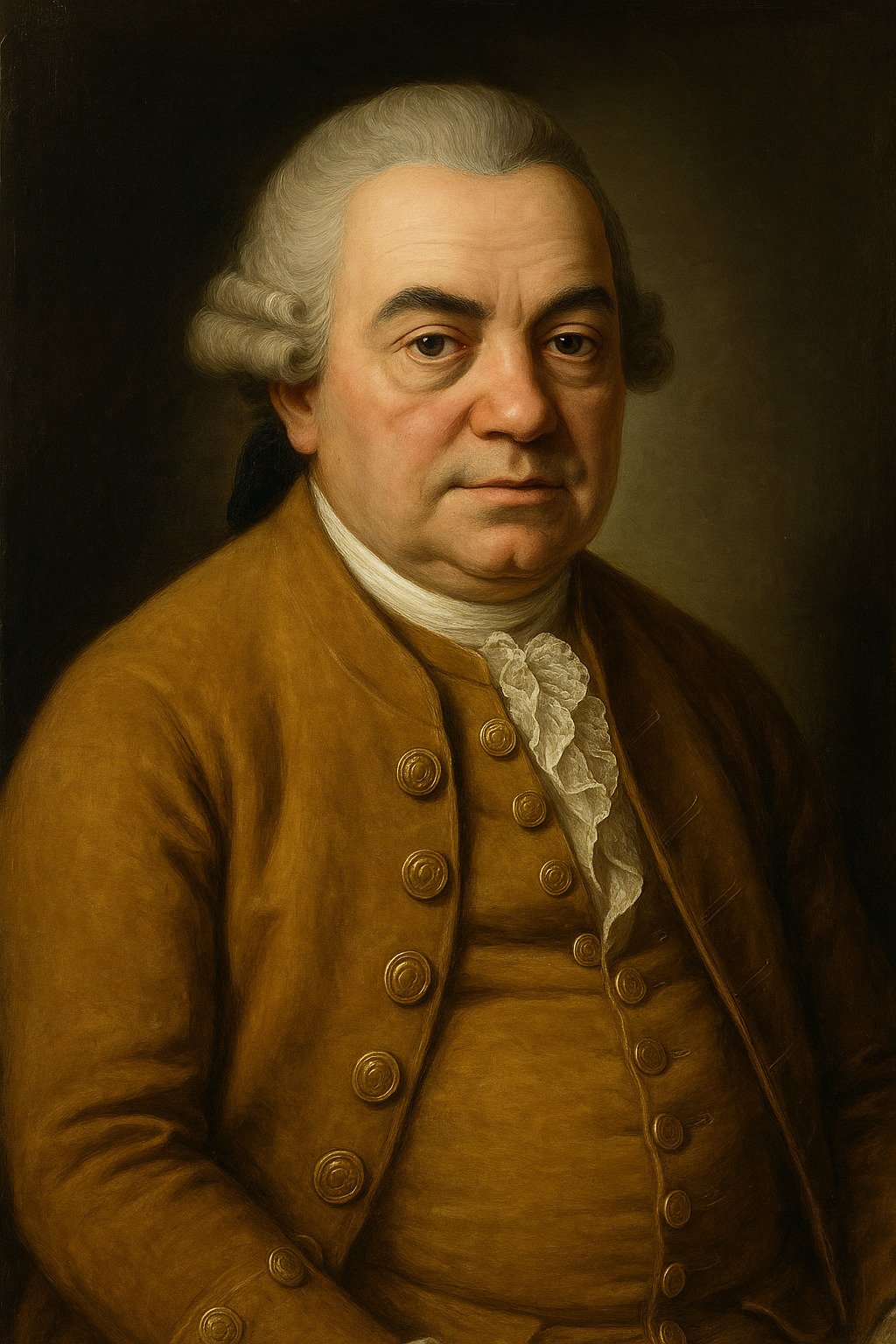
CARL PHILIPP EMANUEL BACH (English)
Carl Philipp Emanuel Bach was born on March 8, 1714, in Weimar. He grew up in a household defined by discipline, creativity, and continuous musical study. As the son of Johann Sebastian Bach, he learned advanced compositional techniques from childhood. Moreover, he developed skills that shaped the transition from the Baroque era to the early Classical period.
During his youth, he studied law in Leipzig and Frankfurt an der Oder; yet he maintained rigorous musical training. Consequently, this dual background enriched his expressive voice. His early exposure to complex counterpoint and emotional nuance helped form his connection with the emerging Empfindsamer Stil, a movement focused on heightened expression and sensitive phrasing.
Professional Rise of Carl Philipp Emanuel Bach in Berlin
In 1738, Carl Philipp Emanuel Bach joined the court of the future Frederick the Great as a harpsichordist. He served there for nearly thirty years. During this period, he produced numerous keyboard works, symphonies, and chamber pieces. Additionally, he shaped the sound of the mid-18th century through his innovative sense of contrast and expressive detail.
His influential treatise, “Essay on the True Art of Playing Keyboard Instruments” (published in 1753 and 1762), became a cornerstone of keyboard pedagogy. It introduced essential techniques, emphasized expressive articulation, and provided strategies for emotional performance. Therefore, the treatise inspired later composers, including Haydn, Mozart, and Beethoven.
His Berlin years also revealed his mastery of musical tension. He used daring harmonic choices and unexpected shifts to portray inner emotional landscapes, which distinguished him from traditional Baroque composers.
Creative Maturity in Hamburg
In 1768, Carl Philipp Emanuel Bach succeeded his godfather Georg Philipp Telemann as music director in Hamburg. This prestigious role granted him greater artistic independence. As a result, he produced expressive sacred works, bold symphonies, and notable vocal compositions.
In Hamburg, he wrote the celebrated “Hamburg Symphonies” and a series of intense choral pieces. These works demonstrated striking emotional contrasts and reinforced his connection to the sensitive style. His compositions often highlighted freedom, clarity, and dramatic gestures, elements central to the early Classical aesthetic.
Legacy and Lasting Influence of Carl Philipp Emanuel Bach
Carl Philipp Emanuel Bach died on December 14, 1788, in Hamburg, leaving a vast legacy that influenced European musical evolution. His works bridged two essential eras and shaped subsequent generations. Furthermore, Mozart referred to him as “the father of us all,” acknowledging his transformative role.
Today, scholars admire his ability to blend structural innovation with emotional intensity. His music continues to inspire historically informed performance, academic research, and modern keyboard interpretation.
Ultimately, Carl Philipp Emanuel Bach remains a pioneer of expressive Classicism, whose ideas shaped Western music’s stylistic development. His contributions endure because he united tradition and experimentation with a voice that remains remarkably vivid.
