




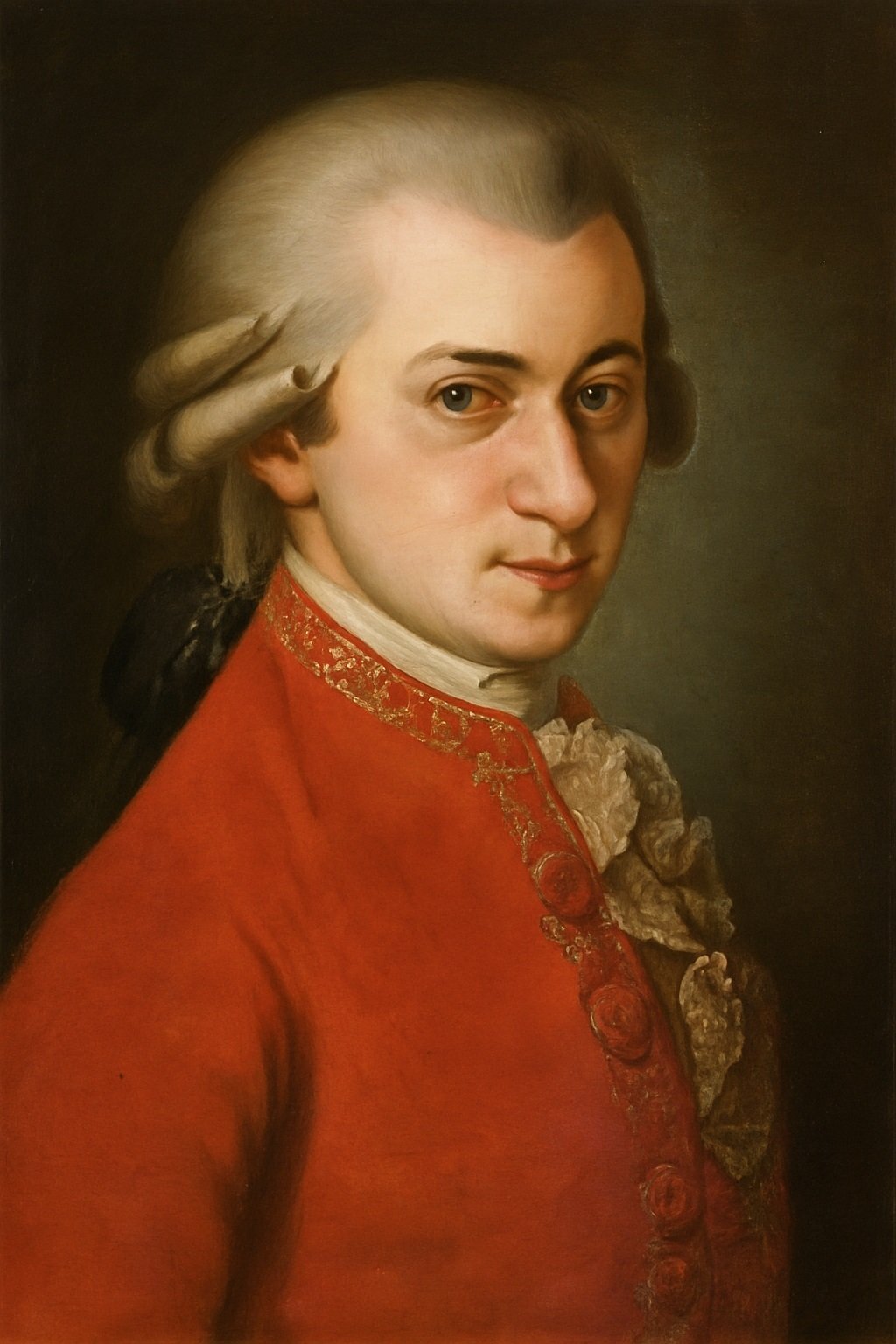
WOLFGANG AMADEUS MOZART (English)
Wolfgang Amadeus Mozart was born on January 27, 1756, in Salzburg. His father, Leopold Mozart, guided his musical training from an early age. Moreover, the child displayed extraordinary abilities before turning four.
In 1762, he performed for the Munich court, revealing his exceptional talent. Additionally, between 1763 and 1766, he toured Europe, gaining exposure to influential musical traditions.
As a result, Wolfgang Amadeus Mozart achieved a remarkable level of mastery before reaching adolescence, building a reputation that impressed European audiences.
Artistic Development of Wolfgang Amadeus Mozart
During his youth, Wolfgang Amadeus Mozart devoted himself to opera, chamber music, and symphonic writing. In 1768, he composed La finta semplice, which demonstrated his early artistic maturity.
Likewise, in 1770, he traveled to Italy and premiered Mitridate, re di Ponto, earning significant acclaim. Furthermore, in 1773, he created the Salzburg Symphonies, works that reflected his evolving style.
In 1781, his move to Vienna marked a turning point because it allowed him to refine a more expressive and balanced musical language.
Mature Works and Legacy
Between 1782 and 1786, Wolfgang Amadeus Mozart composed essential works, including The Abduction from the Seraglio (1782) and The Marriage of Figaro (1786). These pieces displayed his dramatic genius.
Then, in 1787, he wrote Don Giovanni, a landmark opera that combined psychological depth and innovative theatrical structure. Additionally, in 1790, he premiered Così fan tutte, known for its emotional refinement.
In 1791, he unveiled The Magic Flute, a work filled with symbolism, humor, and spiritual insight. That same year, he worked on his Requiem, left unfinished due to his death on December 5, 1791.
Consequently, his catalog showcases remarkable versatility and sensitivity, defining the musical ideals of the Viennese Classicism.
Historical Influence and Lasting Impact of Wolfgang Amadeus Mozart
After 1791, the music of Wolfgang Amadeus Mozart continued spreading across Europe and later the entire world. His compositions soon became essential in academic and professional training.
Moreover, 19th-century composers such as Beethoven and Schubert recognized his profound influence. Throughout the 20th century, critical editions revealed new perspectives on his artistic development.
Therefore, his work remains central in modern concert programs, conservatories, and international festivals. His creative vision still inspires conductors, pianists, and composers, underscoring his timeless relevance.
