




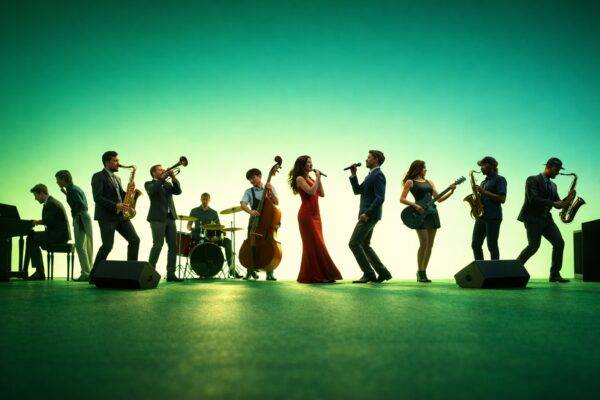
TREATISE ON COUNTERPOINT AND FUGUE (PART 15)
Dive deeper into Counterpoint in jazz and related genres. Discover how improvised polyphony emerges and how melodic Counterpoint is shaped through clear, expressive simultaneous lines. In addition, understand rhythmic interaction, collective Counterpoint, and the harmonic relationship that sustains every musical dialogue. Then, master structured improvisation—form, motives, space, and tension–resolution—to create a solid, modern, and convincing musical discourse.
PART XV – Counterpoint in jazz and related genres
- XV.1 Improvised polyphony
- XV.2 Melodic counterpoint
- XV.3 Simultaneous lines
- XV.4 Rhythmic interaction
- XV.5 Collective counterpoint
- XV.6 Harmonic relationship
- XV.7 Structured improvisation
- XV.8 Arrangements
- XV.9 Big band
- XV.10 Academic influence
- XV.11 Comparative analysis
- XV.12 Expressive function
- XV.13 Cross-genre relevance
PART XV — Counterpoint in jazz and related genres
XV.1 Improvised polyphony
What it is and how it is organized in real time
Improvised polyphony is the fabric of several independent voices that “converse” without a rigid script, yet still fit the tune’s rhythmic–harmonic framework. In jazz, it grows from active listening: each player proposes, responds, or yields. The bass defines trajectories (walking lines, pedals, ostinatos), the drums mark and comment (ride pattern, snare comping), and melodic instruments alternate leadership. The key is to avoid having every voice “shout” at once; instead, players shape layers (foreground, response, timbral fill) and control density through register and dynamics.
Listening, register, and density: keeping the texture clear
- Vertical listening (the present chord) and horizontal listening (your own line).
- Register: if the soloist rises, another voice can descend or occupy the middle register.
- Density: the 2–1–0 rule → two active voices, one minimal, one silent.
- Staggered entrances: entering after a strong accent helps prevent clashes.
XV.2 Melodic counterpoint
Motives, countermotives, and directionality (voice-leading guide)
Melodic counterpoint means independence with meaning. Start from a motive (2–4 notes) and design a countermotive that:
- contrasts in direction (ascending vs. descending),
- complements rhythmically (syncopation vs. longer values),
- respects voice leading (the chord’s 3rd–7th as pivots).
Directionality prevents “snakes” with no destination: think in target tones per bar and lead toward them.
Singable intervals and managing tensions
- Singability: 2nds and 3rds for flow; 6ths/7ths as expressive accents.
- Tensions: use 9, 11, 13 when harmony allows; avoid simultaneities that create unwanted tritones with the main melody.
XV.3 Simultaneous lines
Avoiding collisions: register, timbre, and dynamic planes
Three keys: register, timbre, and dynamic plane. If a saxophone occupies the mid–high register with legato articulation, another voice can play staccato in the mid–low register. Collisions diminish when the group agrees on “who cuts the air” (articulation and attacks) and “who sustains” (long notes, pads).
Techniques: pedal, ostinato, imitation, staggered entrances
- Pedal: a dramatic anchor so another voice can flourish.
- Ostinato: a short cyclic pattern that stabilizes; ideal in bridges.
- Imitation: repeat a motive at an interval (3rd, 6th, octave) or inverted.
- Entrances 3–2–1: voice 1 enters, then voice 2 next bar, then voice 3.
In performance, agree on minimal cues (eye contact + a bow/stick gesture) to announce entrances and cuts.
XV.4 Rhythmic interaction
Call-and-response, syncopations, and displacements
Rhythm articulates counterpoint.
Call-and-response organizes turns; syncopations shift the center and create space. Alternate even/odd phrase lengths to break the grid. Drums and piano can “ask” (short figure) and the soloist can “answer” (longer phrase).
Functional polyrhythm vs. chaos
Polyrhythm works when each pattern anchors to the pulse. Avoid overlaps that erase beat “1”. Practical rule: if two voices displace, the third keeps the pulse clear (ride or walking).
XV.5 Collective counterpoint
Models: New Orleans to bebop
From New Orleans style (simultaneous polyphony of cornet/clarinet/trombone) to swing and bebop combos, collective counterpoint evolves: it shifts from three continuous lines to momentary micro-polyphonies (fills, backgrounds, brief riffs).
Combo roles: who occupies and who leaves space
- Soloist: defines the discourse; avoid filling every silence.
- Comps (piano/guitar): between-phrase support and reactive hits.
- Rhythm section: balance between drive and air.
XV.6 Harmonic relationship
Voice leading, shells, and tensions
Counterpoint rests on voice leading. Shells (3rd and 7th) define function; add 9/11/13 depending on the chord and avoid doubling tense tones unless the color is intentional. Lines should resolve (7th → 3rd of the next chord, #11 → 5, etc.).
Reharmonization and inner motion
Inner motion adds life: chromatic passing tones, semitone links, and substitutions (tritone, secondary dominants). Keep the main melody legible; counterpoint comments, it does not usurp.
XV.7 Structured improvisation
Forms (blues, AABA, rhythm changes)
Structuring is not constraining: blues and AABA allow density arcs (simple → complex → release). Define zones by chorus: melodic, rhythmic, timbral.
Signals (hits) and pre-agreed blocks
Brief unisons, response riffs, or cuts create cohesion without killing spontaneity.
XV.8 Arrangements
Counterlines and backgrounds: writing so the music can breathe
An effective arrangement alternates the main melody with counterlines in the middle register and backgrounds at lower dynamics. Think in 2–4 bar phrases that “speak” to the melody: question–answer, echo, shadow.
From score to rehearsal: what to do and what to avoid
- Write articulation and dynamics; it saves debate.
- Leave explicit space (marked rests).
- Avoid overwriting: less ink, more music.
XV.9 Big band
Sections, “soli,” and counterpoint between blocks
In big band writing, counterpoint appears between blocks: saxes vs. trumpets, trombones as a third plane or glue. A soli can include imitation and cascading entrances.
Balance and dynamics: the art of the tutti
- Sound pyramid: solid lows, present mids, clear highs.
- The lead sets phrasing; the rest “hangs” on that articulation.
XV.10 Academic influence
From species counterpoint to jazz: what is taken and what is left
From species counterpoint we take rhythmic independence, prepared consonance, and avoiding parallel fifths/octaves when they ruin the color. We leave rigidity when swing and syncopation demand flexibility.
Third stream, modern orchestration, and teaching
Academic–jazz synthesis (third stream) shows how classical techniques enrich modern arranging: controlled clusters, polymodality, and inner counterpoints within the rhythm section.
XV.11 Comparative analysis
Swing vs. cool vs. free vs. latin: different textures
- Swing: riffs and responses; strong walking.
- Cool: long lines, airy registers.
- Free: extreme independence, timbral/gestural references.
- Latin: rhythmic layers (tumbao, clave) support melodic counterpoints.
Case studies (emblematic tunes)
Propose 3–5 tunes per style and analyze: which voice leads, how others enter, and what the drums do at crossings.
XV.12 Expressive function
Narrative, tension, and release
Counterpoint tells stories: two voices can argue, flirt, or cooperate. Raise tension with register crossings, rhythmic intensification, and harmonic tensions; release with clear resolutions and brief unisons.
Density, space, and dramatic direction
Think in a dramatic curve per section: clear beginning, conflict (controlled overlap), climax (dense texture), resolution (space).
XV.13 Cross-genre relevance
From jazz to related genres (funk, latin, film, video games)
Counterpoint travels: in funk, rhythmic guitars and bass lines; in latin, choirs vs. brass; in film and video games, motivic layers that guide emotion without overloading dialogue/FX.
Master Table: Counterpoint in Jazz — Practical Guide (Time, Guide Tones, Countermelody, and Big Band)
| Key area | What it is in jazz | How to do it (clear procedure) | Teaching recommendation | Common mistake |
|---|---|---|---|---|
| Counterpoint goal | Independent lines that create a coherent texture | Think “dialogue” and define a role: lead, counterline, or support | Start with 2 voices; add more only if the texture stays clear | Everyone “leads” at once |
| Time first | Rhythmic coordination supports everything | Secure the pulse before adding chromaticism or density | Practice with a metronome; then set the click on 2 and 4 | Good notes with bad time |
| Register and clarity (nuance) | Separation by range and timbre | Choose a range and stick to it so you don’t cover the soloist | If there’s bass in the ensemble, avoid the low register; if the soloist is mid-range, go above or below | Competing in the same register |
| Guide tones (3rd and 7th) | The most informative harmonic framework | Aim for the 3rd/7th on strong beats; connect with minimal motion | Build “guide-tone lines” before running scales | Playing scales with no function |
| Tension and resolution (nuance) | In jazz, “dissonance” is often accepted tension | Use 9/11/13 or alterations with direction: prepare, place, and stabilize | Prioritize functional clarity over “pure consonance” | Long tensions with no hierarchy |
| Voice leading | Cohesion across chords and lines | Prefer stepwise motion and semitone moves toward guide tones | Move as little as possible to sound “connected” | Leaps that break the thread |
| Rhythmic contrast (strategy, not a law) | Independence through accents and note values | Change accents, durations, and silences relative to the soloist | Useful strategy: if the texture gets dense, simplify your rhythm | Copying the soloist’s rhythm exactly |
| Motion between voices | Real melodic independence | Seek contrary motion and avoid obvious parallelism | Alternate: contrary, oblique, direct—on purpose | Constant parallels that “flatten” |
| Space and breathing | Silence organizes the texture | Insert pauses so the other voice can be heard | “Answer” more than you “talk over” | Continuous overplaying |
| Motive and development | Coherent discourse without a score | Choose 1 motive and vary it: rhythm, sequence, partial inversion | One well-worked motive beats 20 ideas | Changing idea every bar |
| Call and response | Audible conversation | Alternate short phrases: 1–2 bars | Train in duos: question–answer | Replies that are too long |
| Singable counterline (heuristic) | A real second melody | Sing your line before playing it | If you can’t sing it, simplify | A “scalar” mechanical counterline |
| Collective counterpoint | Multiple voices improvising in coordination | Agree on roles and density: who supports, who comments | Begin with minimal rules (register + space) | Saturation from lack of hierarchy |
| Big band: block counterpoint | Sections in dialogue (riffs/responses) | One section sets a pattern; another answers or contrasts | Keep a hierarchy of planes, not everything upfront | Dense writing with no clear layers |
| Linear comping (piano/guitar) | Chords as a directed voice | Make the top voice “sing” and keep rhythm independent | Fewer voicings, more linear intent | Heavy chords that cover the texture |
| Walking bass (bass) | Bass as a functional melodic line | On strong beats, secure function; use chromatics as links | Anchor the harmony and protect the time | Walking through scales with no destination |
