



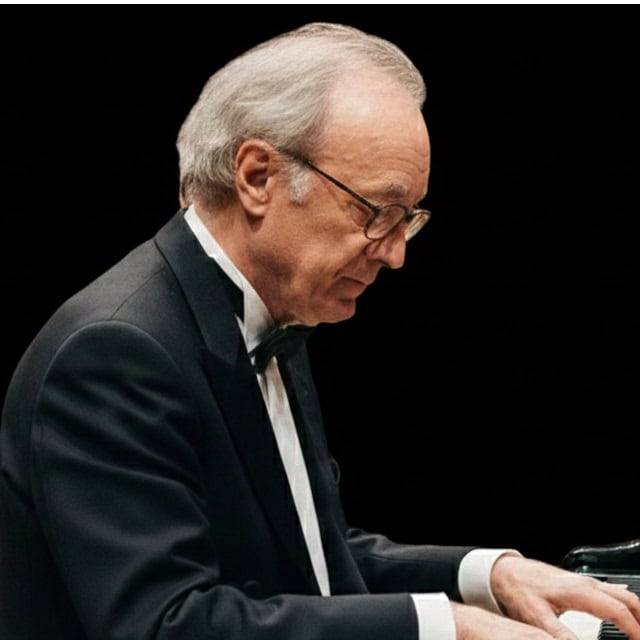
ALFRED BRENDEL (English)
He was born on January 5, 1931, in Wiesenberg, then part of Czechoslovakia, today Loučná nad Desnou, in the Czech Republic. He grew up in a family environment without a professional musical tradition, which encouraged an early and conscious form of self-directed learning. During his childhood, he lived in Zagreb and Graz, cities that proved decisive for his cultural formation. He began piano studies without completing a conventional conservatory curriculum, a circumstance that fostered an independent, analytical, and critical relationship with music. From his earliest years, he prioritized structural understanding of musical works over external brilliance. This early orientation decisively shaped his artistic identity.
Independent artistic formation and early recognition
At the age of 17, in 1948, he gave his first public recital in Graz, performing works by Johann Sebastian Bach, Franz Liszt, and his own compositions. The debut revealed a reflective personality and a deep interest in musical form. In 1949, he took part in the Ferruccio Busoni International Competition in Bolzano, where he was awarded fourth prize, a result that consolidated his international projection. From that point onward, he deepened his training through harmonic analysis, critical score reading, and comparative listening. Intellectual autonomy became the core of his method. Reflection was always an integral part of interpretation.
Alfred Brendel: international consolidation and interpretive maturity
During the 1950s and 1960s, his career gradually consolidated across Europe. He specialized in the Classical and Romantic repertoire, with particular affinity for Joseph Haydn, Wolfgang Amadeus Mozart, Ludwig van Beethoven, and Franz Schubert. In 1964, he embarked on a decisive project: a modern, complete recording of Beethoven’s piano sonatas, made for the Vox label. Although it was not the first chronologically absolute cycle, it established a contemporary interpretive standard through its aesthetic coherence. His readings stood out for formal clarity, expressive balance, and stylistic rigor. Musical architecture always prevailed over theatrical gesture.
Written musical thought and intellectual production
Alongside his pianistic activity, he developed a significant career as an essayist and musical thinker. He published fundamental books such as Music Sounded Out and A Pianist’s A–Z, in which he analyzed the relationship between the musical text, the performer, and historical tradition. His prose is marked by conceptual precision, subtle irony, and philosophical depth. He also cultivated poetry, a discipline that complemented his comprehensive artistic vision. Interpreting and thinking remained inseparable processes throughout his career.
Alfred Brendel: recordings, awards, and pedagogical work
He recorded extensively for labels such as Vox, Philips, and Decca, leaving complete cycles of Beethoven and Schubert that are regarded as canonical references. He received numerous international distinctions, including the Ernst von Siemens Music Prize in 2004, one of the most prestigious awards in academic music. In 2008, he gave his final public concert, bringing to a close a career spanning more than six decades. From then on, he devoted himself to teaching, lecturing, and writing, exerting a decisive influence on new generations through masterclasses. His legacy combines intellectual rigor with expressive humanity.
Alfred Brendel in the history of pianistic interpretation
He died on October 17, 2023, in London, at the age of 92. In the history of pianistic interpretation, he occupies a central place as one of the most influential interpreters of the twentieth century. His approach redefined the relationship between analysis, emotion, and stylistic fidelity. He avoided media protagonism and favored lasting artistic coherence. Through recordings, writings, and teaching, he established a solid interpretive model, now studied in conservatories and universities. Clarity, critical thought, and musical ethics summarize his enduring legacy.