




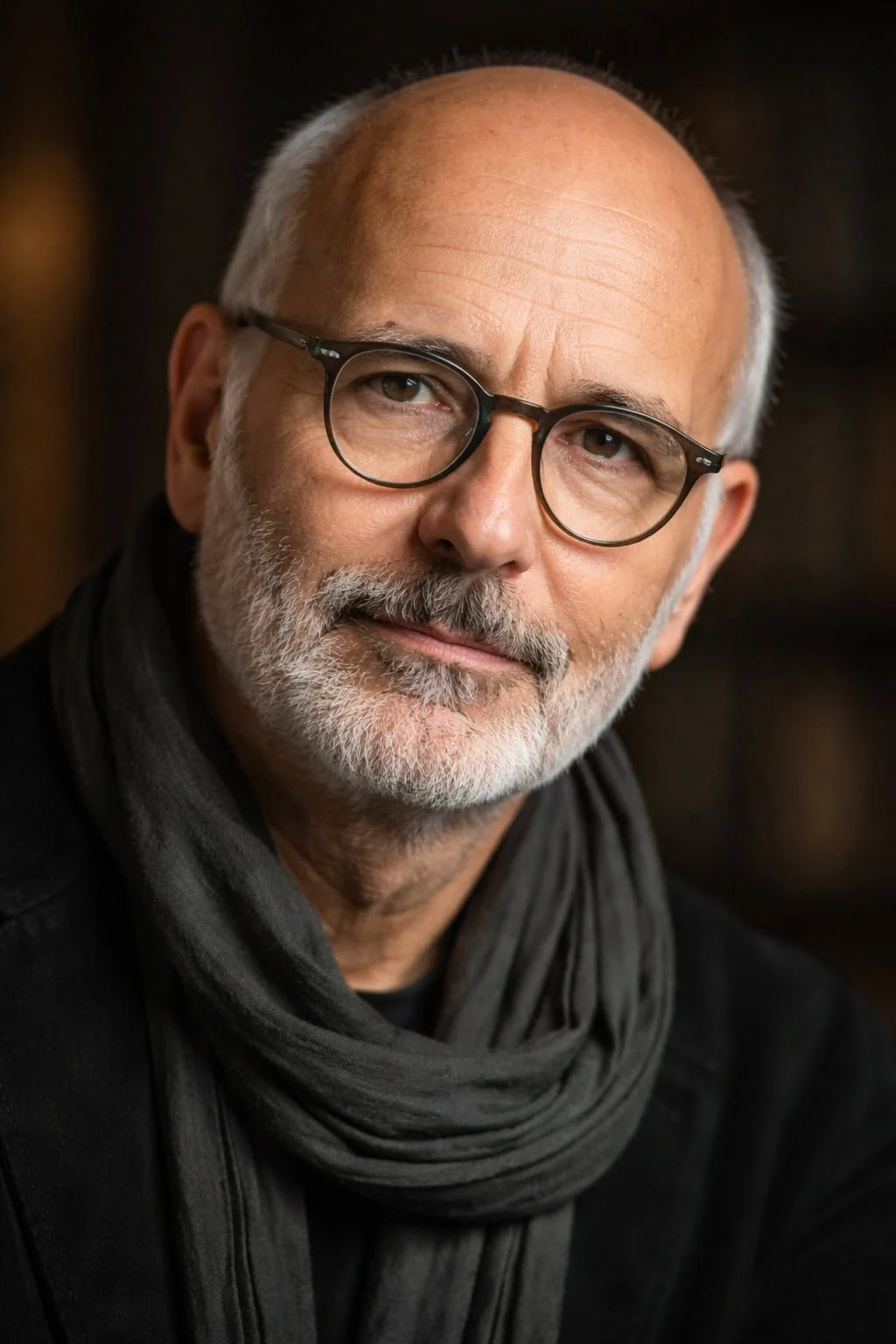
LUDOVICO EINAUDI (English)
Ludovico Einaudi was born on November 23, 1955, in Turin, Italy. He is a contemporary composer and pianist with international reach, recognized for integrating elements of classical music, minimalism, and music for audiovisual media. From his earliest works, he developed a clear, repetitive, and emotionally direct musical language, grounded in verifiable musical structures and conscious aesthetic choices. He grew up in a documented intellectual environment; he was the grandson of Luigi Einaudi, President of Italy from 1948 to 1955, although his musical career is explained by rigorous academic training rather than political influence.
Academic Training
Ludovico Einaudi pursued formal studies in composition at the Giuseppe Verdi Conservatory in Milan during the 1970s, a central institution in Italian musical education. He later expanded his training under the guidance of Luciano Berio, one of the most influential figures in contemporary European music. During this period, Ludovico Einaudi explored experimental, serial, and avant-garde techniques, widely documented in academic records and in the composer’s own testimonies. However, he gradually oriented his language toward an expanded tonal writing, seeking perceptual clarity and direct communication—an aesthetic decision that decisively shaped his later output.
Ludovico Einaudi and the Development of a Personal Style
From the late 1980s onward, Ludovico Einaudi consolidated a recognizable personal style based on modular structures, rhythmic ostinati, simplified functional harmonies, and transparent textures. These characteristics appear in works for solo piano as well as in chamber and orchestral music. The release of the album Le Onde (1996) marked a documented turning point in his career, inspired by Virginia Woolf’s novel The Waves and widely disseminated internationally. Later, Divenire(2006) reinforced his global recognition, establishing Ludovico Einaudi as a central figure in contemporary European piano music.
Ludovico Einaudi in Film and Audiovisual Media
In parallel, Ludovico Einaudi developed a sustained relationship with film, television, and documentary, particularly from the 1990s onward. His music has been officially incorporated into international film productions such as This Is England(2006) and Nomadland (2020), through the licensing of previously composed works. These properly credited uses expanded Ludovico Einaudi’s reach to non-specialist audiences, contributing to the global dissemination of contemporary piano music beyond traditional academic circuits.
International Recognition
Since the beginning of the twenty-first century, Ludovico Einaudi has maintained an intense schedule of international tours, with regular performances across Europe, the Americas, Asia, and Oceania, often in highly prestigious venues. His recognition rests less on institutional awards and more on sustained public reception, as well as on the continuous circulation of his work across cultural and educational platforms. Today, Ludovico Einaudi is regarded as a world-reference pianist and composer, having established a solid bridge between European classical tradition, contemporary minimalism, and current cultural sensibilities.
In conclusion, Ludovico Einaudi has built a coherent, verifiable career with broad international impact. His musical language reflects documented aesthetic choices aimed at formal clarity and direct listening experience. On a global scale, Ludovico Einaudi occupies a prominent place as an influential contemporary pianist, whose work has redefined the relationship between academic music, audiovisual culture, and a global audience, consolidating his position as a key figure in twenty-first-century music.
