




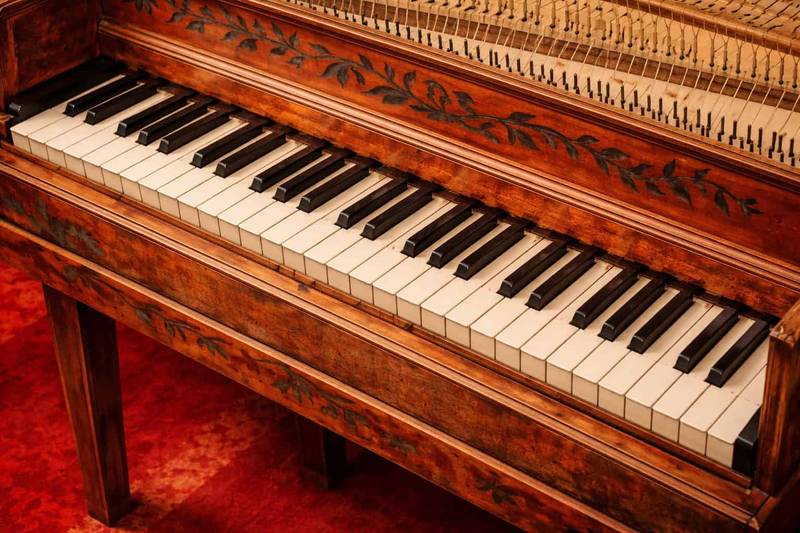
PREDECESSORS OF THE PIANO
Since Antiquity, musicians sought sound control, stable tuning, and dynamic expressiveness, although these goals were achieved gradually. For this reason, the piano did not emerge in isolation, but rather as the result of a documented chain of organological developments. Each preceding instrument provided partial solutions to specific technical and musical problems. Thus, the predecessors of the piano reflect a constant evolution between instrumental mechanics and sonic aesthetics, linked to verifiable expressive needs.
Antiquity and the Middle Ages
The monochord occupies a fundamental place. This instrument is documented in ancient Greece around the sixth century BCE and is traditionally associated with Pythagoras of Samos within ancient musical theory. The monochord consisted of a single string stretched over a resonating box with movable divisions. Its function was theoretical and acoustic rather than performative. It allowed the demonstration of mathematical ratios such as 2:1, 3:2, and 4:3, which are essential for understanding tuning systems. Although it lacked a keyboard, it established lasting scientific foundations for the organization of sound. During the Middle Ages, the monochord remained a central pedagogical tool in musical treatises. Therefore, it represents a conceptual predecessor of the piano, though not a direct mechanical antecedent.
Predecessors of the piano in the Renaissance: clavichord and harpsichord
Among the predecessors of the piano, the clavichord played a decisive role. This instrument has been documented in Europe since the fourteenth century. The clavichord produces sound through metal tangents that strike the string and remain in contact with it while the key is depressed. Thanks to this mechanism, it allowed limited dynamic control and expressive effects such as bebung. However, its low volume restricted its use to domestic and pedagogical contexts. In contrast, the harpsichord, documented since the fifteenth century, offered greater sound projection. In this instrument, the strings are plucked by jacks, typically fitted with quills. The harpsichord lacked dynamic control through finger pressure, yet it was essential to the development of Baroque music. Both instruments addressed different problems, but neither integrated powerful projection and full dynamic control simultaneously. In this way, the predecessors of the piano offered partial solutions to emerging expressive demands.
The transition toward the eighteenth century
By the late seventeenth century, the technical limitations of both the clavichord and the harpsichord had become evident to performers and composers. Greater expressiveness, dynamic contrast, and precise control of attack were increasingly demanded. Within this historical context, the predecessors of the piano reached a point of technical saturation. The need for an instrument capable of combining sound volume, mechanical precision, and dynamic responsiveness became a priority. This process is widely documented in organological and musicological sources. Consequently, the invention of the piano responded to an accumulated necessity rather than a sudden rupture in the history of keyboard instruments.
Predecessors of the piano: a verifiable historical synthesis
In summary, the predecessors of the piano constitute a logical and verifiable sequence of musical developments. The monochord provided acoustic and theoretical foundations. The clavichord introduced expressive control through touch. The harpsichord consolidated the keyboard as a central instrument in European musical practice. None of these instruments fully resolved emerging expressive demands. Nevertheless, each contributed essential elements to subsequent development. Through this progressive evolution, the piano was able to emerge in the early eighteenth century as a technical and aesthetic synthesis.
