




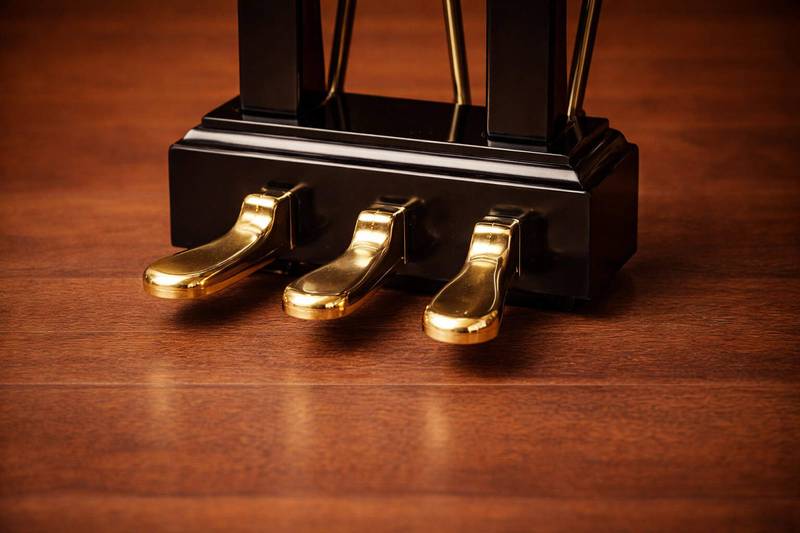
THE USE OF PIANO PEDALS
The use of piano pedals in different historical periods reflects the parallel evolution of the instrument, aesthetic thought, and interpretative technique. It did not emerge as an autonomous expressive resource, but rather as a direct consequence of the mechanical development of the pianoforte at the beginning of the eighteenth century. Understanding its historical transformation allows for stylistically coherent and sonically precise interpretation. Over time, the pedal evolved from serving an auxiliary function to becoming a structural element of musical discourse.
The use of piano pedals in different historical periods: pre-Classical antecedents (before 1750)
Before 1700, pedals did not exist in the proper sense. The predominant keyboard instruments were the harpsichord and the clavichord, both lacking mechanisms for sustained resonance. In the clavichord, sound could be prolonged minimally through finger pressure (Bebung), a practice documented in eighteenth-century German treatises. However, there was no mechanical control of sustain, so resonance depended exclusively on finger contact. For this reason, the use of piano pedals in different historical periods cannot be projected retrospectively onto the Baroque era, and any modern application of the pedal in Bach reflects later interpretative decisions rather than documented historical practice.
The use of piano pedals in different historical periods: Early Classicism (1700–1780)
Bartolomeo Cristofori developed the pianoforte around 1700, incorporating a system of manually liftable dampers. The earliest devices equivalent to pedals operated via knee levers. During this period, pedal use was sporadic and functional, intended to reinforce cadences or prolong final chords. It did not serve an independent expressive function nor replace digital articulation. Composers such as C. P. E. Bach and early Haydn wrote music that required clarity, precise articulation, and transparency, principles that defined the sonic ideal of early Classicism.
The use of piano pedals in different historical periods: Mozart and the mature Classical style (1780–1791)
Wolfgang Amadeus Mozart was familiar with instruments equipped with pedals, yet he left no written pedal indicationsin his piano works, a fact confirmed by critical editions and contemporary historical studies. In his aesthetic, formal and harmonic clarity was paramount. Consequently, the use of piano pedals in different historical periods, when applied to Mozart, must be understood as exceptional, brief, and structural, never as a continuous resource. Legato was to be produced by the fingers, and the pedal could only reinforce specific formal moments without compromising the clarity of musical discourse.
The use of piano pedals in different historical periods: Beethoven (1795–1827)
Ludwig van Beethoven represents the decisive turning point in the history of the pedal. From the late eighteenth century onward, the pedal became a structural expressive element, integrated into compositional thinking. Beethoven wrote explicit indications for prolonged pedaling, even over harmonic dissonances, as seen in the Sonata op. 27 no. 2 and the Sonata op. 53. These practices, verified in autograph manuscripts, demonstrate that the composer conceived the pedal as a generator of atmosphere, depth, and formal expansion. In this context, the use of piano pedals in different historical periods ceases to be ornamental and assumes an architectural function.
The use of piano pedals in different historical periods: Early Romanticism (1830–1850)
During early Romanticism, with Chopin, Schumann, and Mendelssohn, the pedal acquired a poetic and vocal character. Chopin employed rapid pedal changes and implicit half-pedaling, as documented by student testimonies and urtext editions. The pedal accompanies legato cantabile, inspired by the bel canto ideal, yet never obscures harmonic clarity. In this period, the use of piano pedals in different historical periods becomes organically integrated into the musical phrase, functioning as sonic breathing and an expressive extension of melodic discourse.
The use of piano pedals in different historical periods: High Romanticism (1850–1890)
In High Romanticism, Franz Liszt expanded the pedal toward an orchestral concept, employing prolonged resonances and layered sonic planes. Johannes Brahms, by contrast, developed a harmonic and structural use of the pedal, frequently applying half-pedaling to control density and clarity. Nineteenth-century piano pedagogy, reflected in methods such as Albert F. Venino (1894), systematized pedal synchronization, establishing technical principles that remain valid today. Thus, the use of piano pedals in different historical periods became firmly established as an inseparable component of advanced technique.
The use of piano pedals in different historical periods: Impressionism (1890–1920)
With Claude Debussy and Maurice Ravel, the pedal was redefined as color, atmosphere, and acoustic phenomenon. Debussy employed prolonged pedaling over non-functional harmonies and static structures, while Ravel demanded greater rhythmic precision and timbral control. In both cases, the ear becomes the supreme authority. Here, the use of piano pedals in different historical periods emancipates itself from traditional tonality and turns toward the creation of sonic spaces.
The use of piano pedals in different historical periods: the twentieth century and contemporaneity
During the twentieth century, composers such as Bartók, Prokofiev, and Messiaen explored the pedal as texture, resonance, and temporal structure. Ferruccio Busoni radically expanded the use of the sostenuto pedal, as documented by recent university research. In contemporary music, the pedal becomes conscious compositional material, combining sustain pedal, una corda, and sostenuto for specific expressive purposes. In this way, the use of piano pedals in different historical periods reaches its highest level of technical and conceptual complexity.
The use of piano pedals in different historical periods evolved from a basic mechanical function into an autonomous expressive language. Mastery of pedaling requires historical knowledge, critical listening, and informed stylistic judgment. The pedal is not a technical accessory: it is sonic thought in motion.
The right pedal (sustain pedal)
The right pedal functions by lifting all the piano dampers, allowing the strings to vibrate freely and generate sympathetic resonance. Its function is documented from the late eighteenth century in early pianofortes, although its expressive use was consolidated with Beethoven (1795–1827). Autograph manuscripts and critical editions show indications for prolonged pedaling, even over harmonic changes, confirming its conception as a structural element of sound rather than a mere dynamic reinforcement.
From a technical standpoint, the right pedal is generally depressed after the attack of the note or chord, a procedure historically known as syncopated pedaling, systematically described in nineteenth-century methods such as Albert F. Venino (1894). Pedal changes respond to harmonic logic rather than individual notes. The practice of half-pedaling, although not always explicitly notated, is documented in nineteenth-century pedagogical testimonies and allows control of resonance without fully eliminating overtones.
Aesthetically, the right pedal fulfills differentiated functions according to style. In Classicism it is used briefly and structurally; in Beethoven it acquires architectural value; in early Romanticism, especially with Chopin, it integrates into the legato cantabile ideal; in Impressionism, with Debussy, it creates sonic atmospheres; and in the twentieth century it becomes a textural and acoustic resource. In all documented cases, the right pedal expands and shapes sonic space without replacing digital articulation.
The left pedal (una corda)
The una corda pedal is documented in late eighteenth-century pianofortes. In grand pianos, its mechanism shifts the keyboard, reducing the number of strings struck by the hammer; in upright pianos, it alters the hammer’s contact point. This mechanism is described in nineteenth-century organological treatises and confirmed by the historical construction of the instrument.
Technically, the use of una corda reduces sound intensity and, more significantly, alters timbre by modifying the harmonic spectrum. Its use is clearly documented in the music of Beethoven, Chopin, and later composers, always serving a specific expressive function. It does not replace digital dynamic control but adds a controlled timbral nuance.
Aesthetically, una corda is associated with effects of intimacy, distance, or softened color. In Romanticism it reinforces lyrical character; in Impressionism it contributes to timbral diffusion; and in later repertoires it creates contrasts of sonic perspective. In all documented periods, its function is qualitative rather than quantitative.
The middle pedal (sostenuto)
The sostenuto pedal was developed technically during the nineteenth century and became standardized on concert pianos toward the end of that century. Unlike the right pedal, the sostenuto sustains only previously depressed notes, allowing the remainder of the keyboard to function without additional resonance. Its explicit use is rare in early nineteenth-century repertoire but is documented in Liszt and, systematically and consciously, in Ferruccio Busoni.
Recent academic research has demonstrated that Busoni, from 1894 onward, especially in later works and editions, expanded the use of the sostenuto pedal to create independent polyphonic layers, prolong harmonic points, and form complex sonic superpositions. These practices are documented in scores, explicit annotations, and contemporary scholarly analyses.
From an aesthetic perspective, the sostenuto pedal allows the separation of structure and motion. It sustains fundamental harmonic elements while freeing other voices, a function that becomes essential in twentieth-century and contemporary repertoire.
The combination of the right pedal with una corda is documented in Romantic and later practice, producing controlled resonance with softened timbre. Also, the combination of sostenuto with the right pedal appears in advanced twentieth-century repertoire, allowing a stable harmonic foundation while coloring upper planes. Besides, the combination of sostenuto with una corda, though less frequent, is documented in modern music to generate distant and suspended sonorities. The simultaneous use of all three pedals is restricted to specific twentieth- and twenty-first-century repertoires, where it is explicitly indicated by the composer.
The use of the right pedal, una corda, and sostenuto is grounded in a documented historical evolution of the piano and its repertoire. Each pedal corresponds to a precise mechanical function, a specific technique, and a contextual aesthetic purpose. Proper application requires historical knowledge, technical control, and informed critical listening. From an academic perspective, piano pedals constitute a conscious extension of musical thought rather than an accessory or arbitrary resource.
