




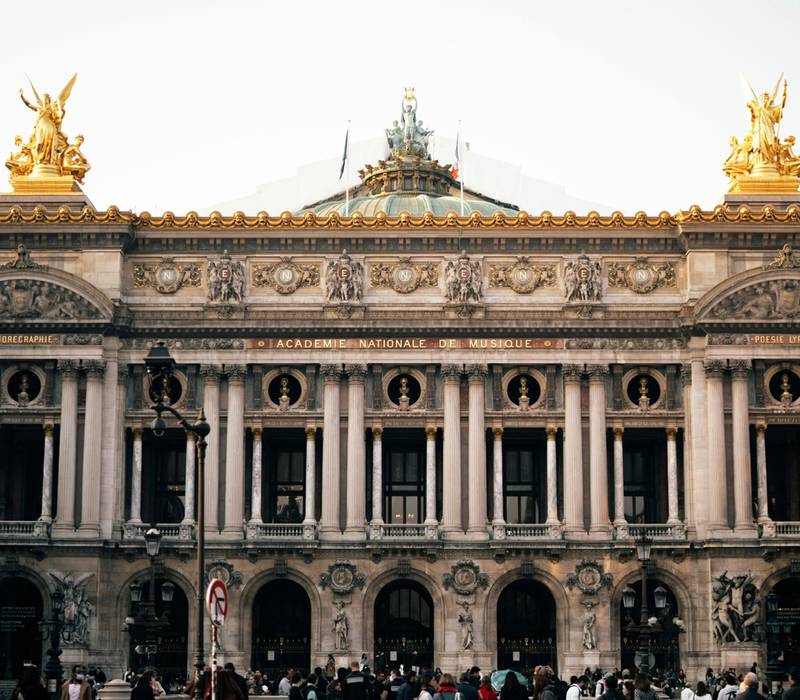
OPERA GARNIER (English)
The Opera Garnier emerged from a political and urban decision of the French Second Empire. On January 14, 1858, an attack outside the Théâtre Le Peletier exposed serious security failures. As a result, the State decided to replace that venue with a safer and more monumental building. Moreover, the new project was integrated into the Paris modernization plan directed by Georges-Eugène Haussmann. In December 1860, the imperial government announced an international competition to build a new opera house. Subsequently, in 1861, the jury selected the project by architect Charles Garnier, who stood out for its functional clarity and formal richness. From that moment, the Opera Garnier became associated with the symbolic power of the State and the urban transformation of the nineteenth century.
Competition and architectural design
The design of the Opera Garnier reflects a comprehensive theatrical conception. Charles Garnier organized the building through a strict hierarchy of spaces, clearly separating public, technical, and stage areas. First, he conceived expansive foyers and staircases to facilitate social circulation. Then, he structured the auditorium and stage according to advanced acoustic and visual criteria for his time. Likewise, the architect employed an eclectic nineteenth-century language, combining Baroque, Classical, and Renaissance elements. This synthesis made it possible to integrate architecture, sculpture, and painting into a single visual discourse. For this reason, the Opera Garnier became established as an architectural manifesto of French academicism.
Construction of the Opera Garnier: engineering, crises, and interruptions (1861–1874)
Construction of the Opera Garnier began in 1861 and presented significant technical challenges. The site, saturated with groundwater, required the design of complex foundations with retaining structures. This technical solution was thoroughly documented in construction archives. However, the building process experienced prolonged interruptions. In 1870, the Franco-Prussian War halted the works and led to the fall of the Second Empire. Despite this, construction continued under the Third Republic, demonstrating the project’s administrative continuity. Finally, by 1874, the building was structurally complete and ready for acoustic testing. Thus, the Opera Garnier overcame political crises without altering its original conception.
Inauguration and public reception (1875)
The official inauguration of the Opera Garnier took place on January 5, 1875, with a solemn gala. From that moment on, the building was perceived as a national symbol beyond its artistic function. Contemporary critics emphasized the monumentality of the complex and the sophistication of its interior spaces. Furthermore, the opening confirmed the ability of the French State to complete a project initiated under a previous regime. Consequently, the Opera Garnier became an example of cultural and administrative continuity. Its impact extended beyond music and reinforced Paris’s image as a European artistic capital.
Heritage status, renovations, and current uses of the Opera Garnier (1923–1964)
The historical value of the Opera Garnier was officially recognized in 1923, when it was classified as a historic monument. This legal protection ensured its preservation and regulated future interventions. During the twentieth century, the building underwent documented and respectful modifications. A major milestone occurred on September 23, 1964, when the new ceiling of the main auditorium, painted by Marc Chagall, was unveiled. This artwork was installed on a reversible structure, preserving the original nineteenth-century decoration. In this way, the Opera Garnier successfully integrated modern art without losing its historical identity.
Documented myths and cultural projection
The cultural projection of the Opera Garnier generated literary narratives and popular myths. In 1910, writer Gaston Leroux published The Phantom of the Opera, a novel set within the building. Although the work is fictional, it draws on real spaces and partial documents. Therefore, it is essential to distinguish between literary narrative and historical evidence. Today, the Opera Garnier functions both as an active theater and a visitable monument. Moreover, it forms a central part of the cultural identity of the Paris National Opera.
