




The study of the Diatonic Scale and Chromatic Scale has formed a central axis of Western music theory since Antiquity. Its understanding rests on verifiable acoustical principles, especially the monochord and the circle of fifths. These tools made it possible to explain sonic relationships through stable mathematical proportions. Moreover, they established enduring theoretical foundations for tuning, tonal organization, and historical musical perception.
DIATONIC SCALE and CHROMATIC SCALE
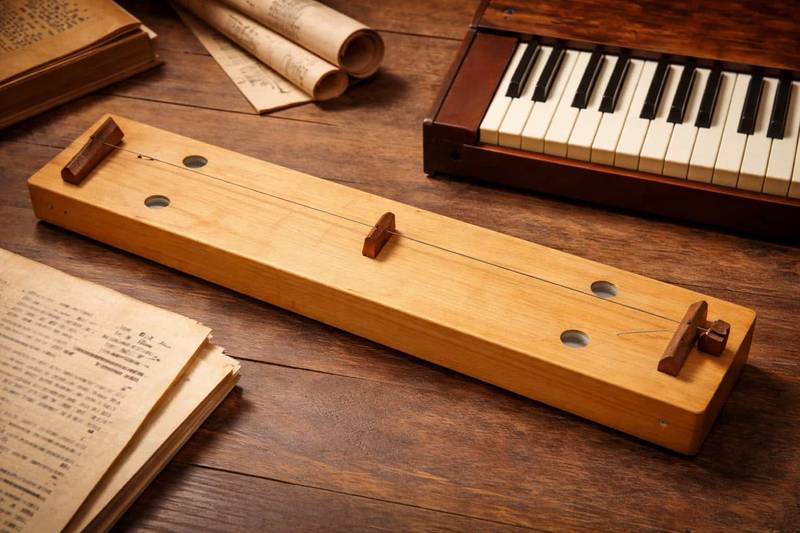
The monochord is documented in the Greek tradition of the 6th century BCE, associated with Pythagoras of Samos. This experimental instrument consisted of a stretched string with movable divisions. Through it, simple ratios such as 2:1, 3:2, and 4:3 were demonstrated, corresponding to the octave, perfect fifth, and perfect fourth. These verifiable proportions support the formation of the Diatonic Scale and Chromatic Scale from an early scientific perspective.
Diatonic Scale and Chromatic Scale in the Greek Monochord
The Diatonic Scale and Chromatic Scale originated as a classification of musical genera in ancient Greek theory. Authors such as Aristoxenus (4th century BCE) described diatonic and chromatic systems from an auditory perception standpoint, without abandoning the mathematical tradition. The monochord allowed stable and reproducible intervals to be tested. For this reason, it became a pedagogical and scientific tool for centuries.
In the ancient diatonic system, intervals were organized through regular tones and semitones. This order generated scales of seven sounds within the octave. In contrast, the chromatic genus introduced smaller divisions, emphasizing consecutive semitones. Thus, the Diatonic Scale and Chromatic Scale reflected two distinct ways of organizing sonic space, both experimentally verified.
During the Middle Ages, the monochord was preserved and adapted by theorists such as Boethius (c. 480–524 CE). His treatises transmitted Greek thought to Latin Europe. Thanks to this documentary continuity, the Diatonic Scale and Chromatic Scale maintained conceptual coherence within ecclesiastical and academic musical systems.
The Circle of Fifths
The circle of fifths emerged as a systematic representation of tonal relationships based on the perfect fifth (3:2). Although circular relationships existed implicitly earlier, their clear formulation appeared in the 18th century. The German theorist Johann David Heinichen described it explicitly in Der General-Bass in der Composition (1728). This date is key to the modern development of the Diatonic Scale and Chromatic Scale.
The circle of fifths organizes the twelve chromatic pitch classes through successive fifths. This order makes it possible to visualize key signatures, modulations, and tonal relationships. The diatonic scale emerges as a functional subset within this system. Consequently, the Diatonic Scale and Chromatic Scale acquire a coherent and pedagogical graphic representation.
Furthermore, the circle of fifths revealed limitations of the Pythagorean system. The so-called Pythagorean commashowed small cumulative discrepancies. These observations led, over time, to systems of temperament, documented between the 16th and 18th centuries. Thus, the Diatonic Scale and Chromatic Scale evolved without losing their verifiable historical foundations.
Diatonic Scale and Chromatic Scale in Modern Tonal Theory
In tonal practice consolidated between 1600 and 1900, the Diatonic Scale and Chromatic Scale fulfilled differentiated functions. The diatonic scale structured melody, harmony, and form. By contrast, the chromatic scale expanded expressive resources, especially in modulation and harmonic tension. Both systems coexisted in a documented manner in treatises and repertoires.
Theorists such as Jean-Philippe Rameau (1683–1764) integrated these scales into a harmonic theory based on acoustical principles. Rameau linked musical practice with natural laws of sound. In this way, he reinforced the scientific legitimacy of the Diatonic Scale and Chromatic Scale within Enlightenment thought.
In summary, the Diatonic Scale and Chromatic Scale represent a solid historical construction, supported by the ancient monochord and the modern circle of fifths. Both models are based on verifiable data and documented sources.
