




JAZZ
Jazz is a musical genre that emerged in the United States in the late nineteenth century, approximately between 1895 and 1915, within a deeply diverse social environment such as New Orleans. In this city, African traditions, African American music, spiritual songs, and European elements coexisted. After the abolition of slavery in 1865, African American communities promoted new forms of artistic expression. Therefore, this musical language integrated historical memory, cultural resistance, and collective creativity, becoming a manifestation associated with identity, freedom, and social transformation.
Historical Roots and the Formation
The early development of jazz relied on previous expressions such as the blues, ragtime, and spirituals, which emerged in complex social contexts. These influences blended with the practice of street bands, facilitating its initial spread. In addition, African American musicians transformed traditional rhythms into new musical structures, integrating improvisation, flexible rhythm, and innovative formal organization. In this way, the genre evolved as an open system, capable of absorbing multiple cultural influences without losing aesthetic coherence.
Essential Musical Characteristics of Jazz
The sonic identity of the genre is defined by improvisation, swing, and complex harmonic language. Improvisation allows the creation of spontaneous melodies in real time and encourages musical dialogue among performers. <u>Swing</u> generates a fluid and dynamic rhythmic feeling, distinct from traditional European meter, balancing stability and movement. Likewise, the harmonic language employs extended chords, modulations, and sophisticated progressions, contributing fundamental expressive richness to modern music.
Stylistic Evolution of Jazz in the Twentieth Century
The history of jazz presents clearly differentiated stylistic stages. Between 1917 and 1929, Dixieland consolidated collective improvisation. Later, between 1930 and 1945, the swing era promoted big bands and wide popular dissemination. Around 1945, bebop introduced fast tempos and advanced harmonic complexity. During the 1950s, cool jazz and hard bop offered contrasting approaches, while in 1959 modal jazz expanded improvisational freedom. Finally, free jazz in the 1960s challenged established tonal and formal norms.
Instrumentation and Representative Jazz Styles
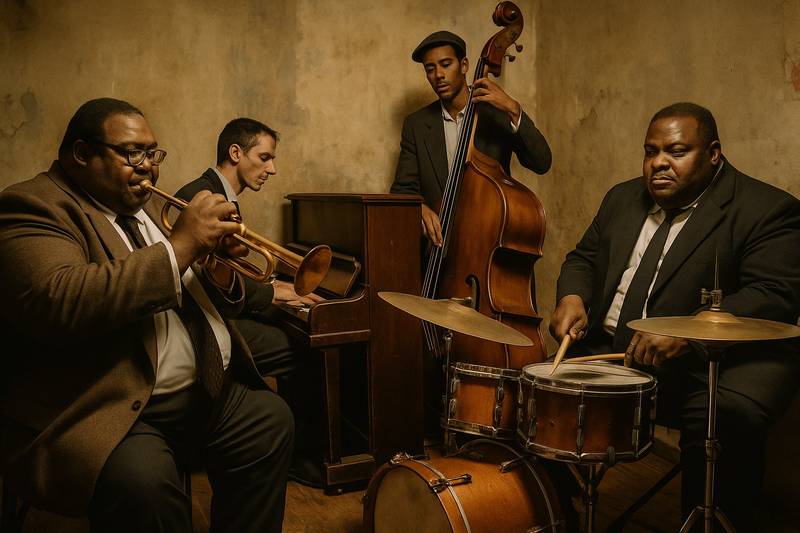
This genre employs instruments such as saxophone, trumpet, piano, double bass, and drums, as well as guitar, clarinet, and solo voices. Over time, styles such as Dixieland, Swing, Bebop, Cool jazz, Hard bop, and Jazz fusion emerged. Each presents distinctive sonorities and reflects social changes and cultural transformations of its era, confirming the structural flexibility of the jazz language.
Improvisation as the Creative Core
Improvisation constitutes a fundamental pillar within jazz. The musician creates variations from scales, melodic motifs, and harmonic progressions, constantly dialoguing with the rhythmic foundation. <u>Interaction</u> among performers strengthens collective musical communication, while flexible rhythmic patterns allow interpretive freedom. This practice transformed the jazz musician into an active creator, not merely a technical performer.
Historical Impact and Cultural Legacy of Jazz
During the twentieth century, jazz profoundly influenced classical music, rock, and popular music. It established historic figures such as Louis Armstrong, Duke Ellington, Charlie Parker, Miles Davis, and John Coltrane. Moreover, it accompanied movements of cultural freedom and African American affirmation, transcending music to become a symbol of modernity and artistic innovation with lasting social and political impact.
Jazz Today and Its Global Relevance
Today, jazz maintains a global presence and artistic relevance. International festivals celebrate its stylistic diversity, while conservatories and universities study it as a formal language. Likewise, new fusions integrate electronic music, Latin music, and pop elements, demonstrating its capacity for adaptation. In summary, the genre represents a living tradition, historically grounded and culturally influential.
