




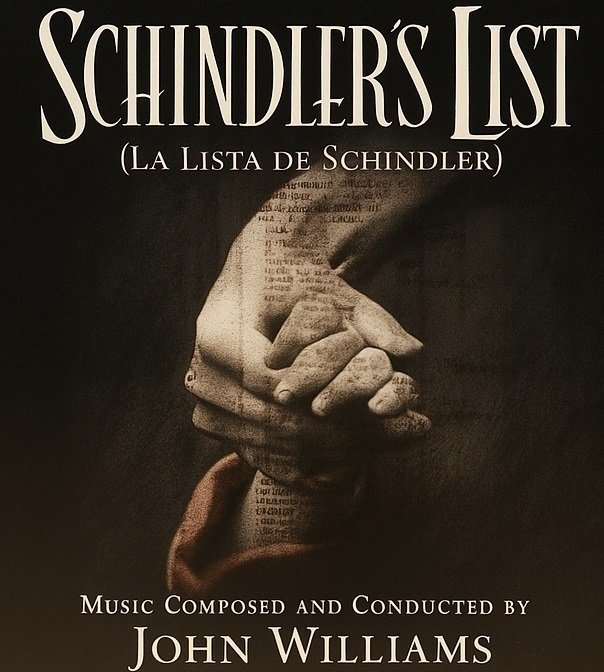
SCHINDLER´S LIST SOUNDTRACK
The Schindler’s List Soundtrack was composed in 1993 by John Williams for Steven Spielberg’s historical film Schindler’s List. The soundtrack reflects the tragic reality of the Holocaust during World War II (1939–1945), focusing on the moral transformation of Oskar Schindler. From its first release in December 1993, the Schindler’s List Soundtrack became a defining work in twentieth-century film music, combining restraint, emotional depth, and historical awareness.
The Schindler’s List Soundtrack avoids excessive orchestration. Instead, it uses minimalist textures and sparse instrumentation to reflect suffering and remembrance. This approach aligns with Spielberg’s black-and-white cinematography, reinforcing historical authenticity. As a result, the Schindler’s List Soundtrack functions as an emotional narrative rather than background music.
Schindler’s List Soundtrack and Musical Language
The musical language of the Schindler’s List Soundtrack is rooted in modal harmony, slow tempos, and lyrical phrasing. John Williams deliberately rejected grand symphonic gestures, choosing intimacy over spectacle. Consequently, the Schindler’s List Soundtrack emphasizes silence and space, allowing reflection and emotional weight.
A central feature of the Schindler’s List Soundtrack is the solo violin theme, performed by Itzhak Perlman. The violin’s timbre evokes Jewish musical traditions without direct quotation. This stylistic choice strengthens cultural resonance while maintaining universality. Therefore, the Schindler’s List Soundtrack communicates grief and dignity simultaneously.
Themes and Emotional Impact
The primary theme of the Schindler’s List Soundtrack represents mourning, memory, and compassion. Williams crafted melodies that unfold gradually, mirroring the slow realization of human loss. Because of this, the Schindler’s List Soundtrack supports emotional immersion without manipulation.
Secondary themes in the Schindler’s List Soundtrack underscore fear, displacement, and fragile hope. These motifs recur subtly, reinforcing narrative continuity. Moreover, the restrained dynamics prevent emotional excess. Thus, the Schindler’s List Soundtrack maintains respect for historical trauma.
Schindler’s List Soundtrack and Historical Authenticity
Historical authenticity defines the Schindler’s List Soundtrack. Williams studied Jewish musical idioms and Eastern European tonal colors to ensure credibility. However, he avoided pastiche. Instead, the Schindler’s List Soundtrack conveys history through emotional truth rather than imitation.
The soundtrack reflects the Nazi occupation of Poland (1939–1945) and the liquidation of the Kraków Ghetto in 1943. Musical cues align with these events, enhancing narrative clarity. Consequently, the Schindler’s List Soundtrack serves both artistic and educational purposes.
Collaboration and Performance
The collaboration between John Williams and Steven Spielberg, established since 1974, reached emotional maturity with the Schindler’s List Soundtrack. Spielberg reportedly questioned whether Williams was the right composer, given the film’s gravity. Williams responded that the project required a better composer, yet ultimately delivered one of his most restrained works.
The performance by Itzhak Perlman elevated the Schindler’s List Soundtrack. His expressive control and tonal purity reinforced the soundtrack’s emotional sincerity. As a result, the Schindler’s List Soundtrack transcended cinema and entered concert repertoire worldwide.
Schindler’s List Soundtrack and Critical Reception
Upon release in 1993, the Schindler’s List Soundtrack received universal acclaim. Critics praised its emotional honesty and ethical sensitivity. In 1994, the soundtrack won the Academy Award for Best Original Score, confirming its cultural impact.
Beyond awards, the Schindler’s List Soundtrack influenced later film scores addressing historical trauma. Composers adopted similar restraint when depicting sensitive subjects. Therefore, the Schindler’s List Soundtrack reshaped expectations of cinematic music.
Legacy and Cultural Significance
The enduring legacy of the Schindler’s List Soundtrack lies in its ability to memorialize history through sound. It remains frequently performed at commemorative events and educational programs. This continued relevance demonstrates its moral and artistic authority.
Ultimately, the Schindler’s List Soundtrack stands as a testament to music’s capacity for remembrance. Through simplicity, emotional clarity, and historical respect, it preserves memory for future generations. Thus, the Schindler’s List Soundtrack remains one of the most important film scores of the modern era.
