




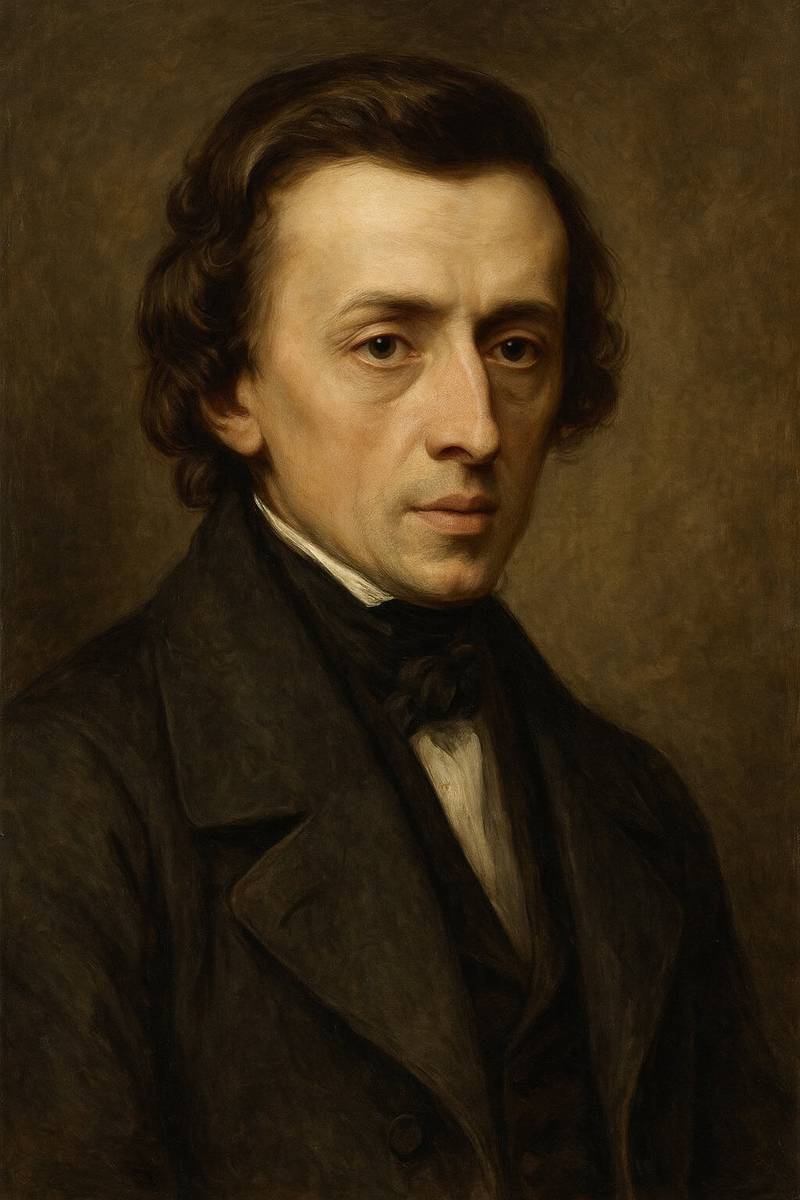
FREDERIC CHOPIN (English)
Frédéric Chopin was born on March 1, 1810, in Żelazowa Wola, near Warsaw, then part of the Duchy of Warsaw. He was a Polish composer and pianist whose work permanently transformed piano music. From early childhood, Frédéric Chopin displayed extraordinary musical sensitivity and intellectual refinement. His father, Nicolas Chopin, was a French-born educator, while his mother, Justyna Krzyżanowska, nurtured his first musical experiences. This cultivated family environment strongly shaped his artistic identity.
By the age of seven, Chopin was already composing polonaises, and at eight, he appeared in public concerts. He studied composition with Józef Elsner at the Warsaw Conservatory, where his teacher described him as a musical genius. These formative years established Frédéric Chopin as a prodigious talent within Polish musical circles.
Frédéric Chopin and the Political Climate of Poland
The youth of Frédéric Chopin unfolded during political unrest in Poland under Russian control. In 1830, shortly before the November Uprising, Chopin left Warsaw. Although intended as a temporary journey, exile became permanent. This separation from his homeland deeply influenced his emotional world. Polish identity, nostalgia, and longing became defining elements of his music.
In 1831, Frédéric Chopin settled in Paris, Europe’s cultural capital. There, he entered artistic circles that included Franz Liszt, Hector Berlioz, and Eugène Delacroix. However, Chopin avoided public virtuosity and cultivated a refined, introspective musical voice. His works reflected emotional depth rather than technical spectacle, aligning him with the core ideals of Romanticism.
Frédéric Chopin: Musical Style and Piano Innovation
The artistic language of Frédéric Chopin revolutionized piano composition. He wrote almost exclusively for the piano, transforming it into a vehicle of lyrical and psychological expression. His output includes Nocturnes, Études, Preludes, Ballades, Scherzi, Mazurkas, and Polonaises, each redefining expressive and technical boundaries.
Frédéric Chopin introduced advanced harmonic language, subtle chromaticism, and innovative textures. Moreover, he developed a sophisticated use of rubato, allowing melodic freedom while preserving rhythmic structure. This approach demanded sensitivity rather than force. His pianistic writing influenced later composers, including Claude Debussy, Maurice Ravel, and Alexander Scriabin, securing his position as a cornerstone of piano literature.
Frédéric Chopin and His Parisian Life
In Paris, Frédéric Chopin earned his living primarily as a private piano teacher, composer, and salon musician. He preferred intimate performances over large concert halls, partly due to his reserved personality and fragile health. His refined manners and intellectual elegance made him highly respected among aristocratic patrons.
Between 1838 and 1847, Chopin maintained a complex relationship with the writer George Sand. Their time together was both creatively productive and emotionally challenging. During the winter of 1838–1839, Chopin stayed in Mallorca, where he composed several major works, including the Preludes, Op. 28. Unfortunately, the damp climate worsened his illness. Tuberculosis increasingly limited his physical strength, affecting his productivity in later years.
Frédéric Chopin: Final Years and Death
During the 1840s, the health of Frédéric Chopin declined steadily. Nevertheless, he continued teaching and composing select works marked by introspection and restraint. In 1848, he undertook a demanding tour of England and Scotland, giving private concerts to aristocratic audiences. This journey severely weakened him.
Frédéric Chopin died in Paris on October 17, 1849, at the age of 39. His funeral was held at the Church of the Madeleine, featuring music by Wolfgang Amadeus Mozart, as he had requested. In accordance with his wishes, his heart was transported to Warsaw, where it remains preserved as a national symbol.
Historical Legacy of Frédéric Chopin
The legacy of Frédéric Chopin remains central to Western musical history. His compositions embody the essence of Romanticism, merging poetic intimacy with technical sophistication. Every performance of his music demands emotional intelligence, stylistic awareness, and refined control.
Today, Frédéric Chopin is universally regarded as one of the most influential composers of the nineteenth century. His piano works form a foundational part of the global repertoire and continue to inspire performers and audiences worldwide. His music transcends time, expressing personal emotion while achieving universal resonance, ensuring his enduring relevance across generations.
