




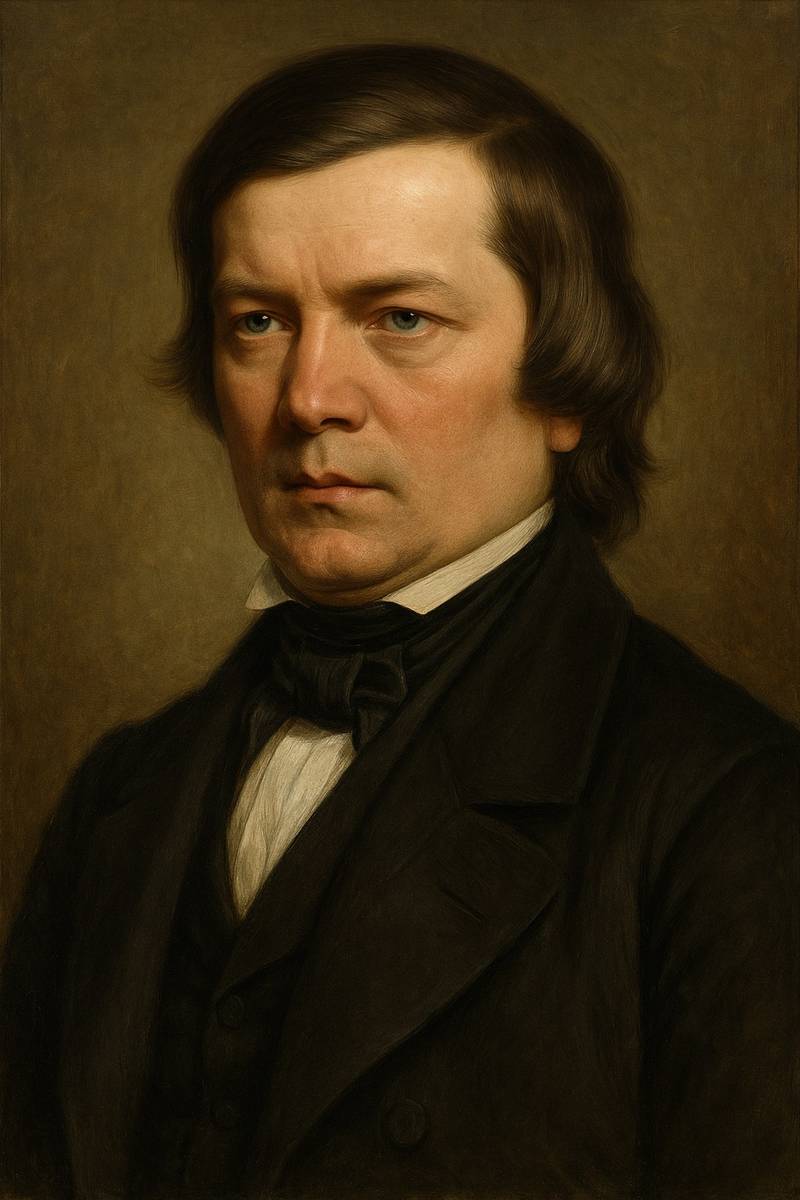
ROBERT SCHUMANN (English)
Robert Schumann was born on September 8, 1810, in Zwickau, Saxony, within a cultivated literary environment that shaped his imagination. His father, a publisher and writer, fostered a deep appreciation for books, poetry, and philosophy. Consequently, literary sensitivity and musical expression developed simultaneously in his early education. Piano studies revealed expressive depth rather than mere virtuosity, signaling an inward artistic temperament. In 1828, he entered the University of Leipzig to study law, complying with family expectations. However, music soon asserted itself as his true vocation. Therefore, he abandoned legal studies and pursued professional musical training with determination and intellectual seriousness.
Artistic Vision and Romantic Identity
During the early 1830s, Robert Schumann emerged as a central figure of musical Romanticism, guided by the belief that music should express inner poetry. After studying piano with Friedrich Wieck, a hand injury around 1831 ended his performing ambitions. Nevertheless, this limitation redirected his creative energy toward composition and criticism. In 1834, he co-founded the journal Neue Zeitschrift für Musik, promoting artistic progress and originality. Through critical essays, he championed new voices and opposed conservative aesthetics. Moreover, he invented symbolic alter egos such as Florestan and Eusebius to explore emotional duality. Thus, psychology and imagination became integral to his artistic identity.
Marriage, Maturity, and Major Works
In 1840, Robert Schumann married the renowned pianist Clara Wieck after a prolonged legal battle against her father’s opposition. This pivotal year became his celebrated Year of Song, producing over 130 Lieder. Works such as Dichterliebe and Frauenliebe und -leben display refined text interpretation and emotional nuance. As a result, the German art song reached new expressive heights. Clara’s influence encouraged discipline, clarity, and artistic confidence. Their partnership united emotional intimacy with musical collaboration, strengthening his creative output and intellectual focus during his most productive years.
Mental Struggle and Final Years
Despite professional recognition, Robert Schumann endured increasing psychological instability throughout the 1850s. Periods of depression, anxiety, and auditory hallucinations impaired his ability to work consistently. In February 1854, he suffered a severe breakdown and attempted suicide by leaping into the Rhine River. After being rescued, he requested institutional care and was admitted to an asylum in Endenich, near Bonn. There, isolation and illness dominated his final years. He died on July 29, 1856. Nevertheless, his late works still reveal moments of spiritual introspection and emotional sincerity.
Legacy and Historical Significance of Robert Schumann
Robert Schumann remains one of the most influential composers of the Romantic era, redefining musical expression through psychological depth and poetic symbolism. His innovative fusion of literature and sound transformed piano music, song, and criticism. Furthermore, his aesthetic ideals profoundly influenced later composers, including Johannes Brahms. Today, his works continue to resonate through their emotional honesty and imaginative structure. Therefore, his legacy endures as a testament to Romantic creativity, where human emotion and intellectual reflection coexist within musical form.
