




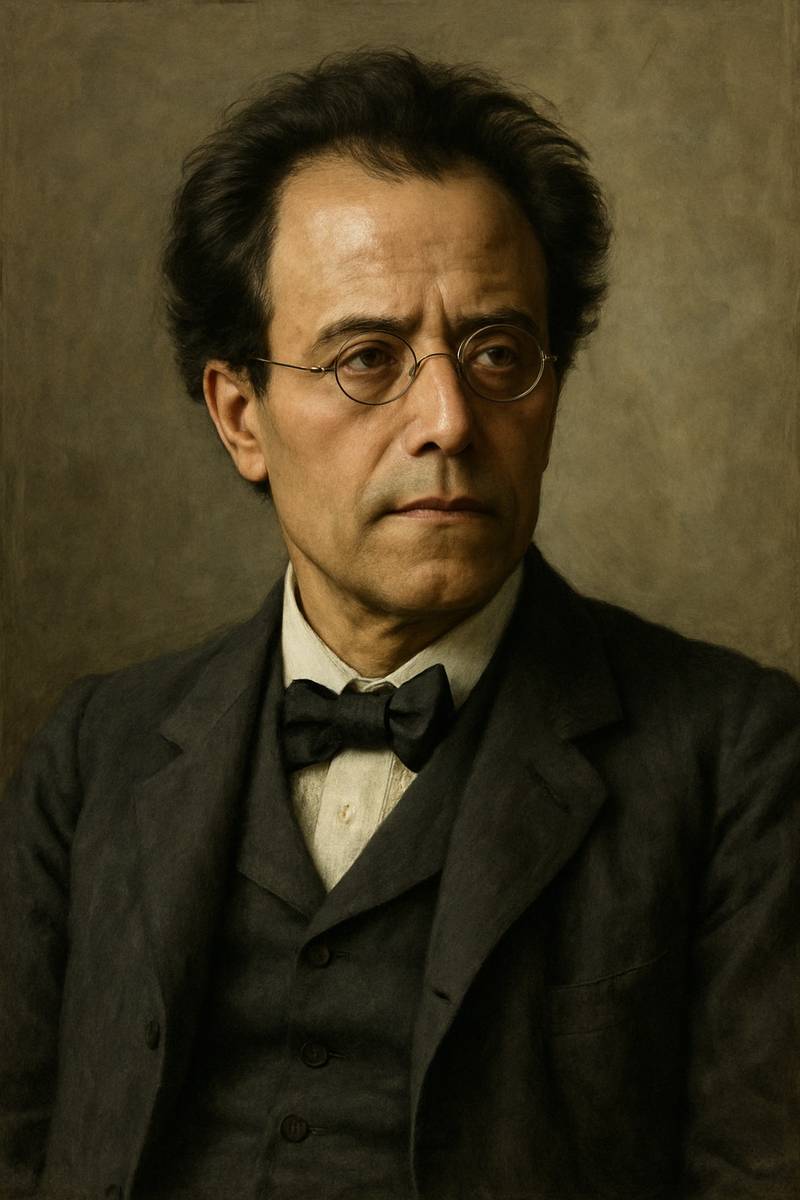
GUSTAV MAHLER (English)
Gustav Mahler was born on July 7, 1860, in Kaliště, Bohemia, then part of the Austrian Empire. He grew up in Jihlava, a multilingual town whose sounds shaped his artistic sensitivity. From early childhood, he showed remarkable musical talent, especially at the piano. Folk songs, military bands, and popular dances left lasting impressions on his musical language. Therefore, his family supported professional training, and in 1875 he entered the Vienna Conservatory. There, he studied piano, composition, and harmony, while absorbing the symphonic traditions of Beethoven, Schubert, and Bruckner. During these years, GUSTAV MAHLER began forming a personal style marked by emotional depth and large-scale ambition.
Conducting Career and Artistic Discipline
After completing his studies, Mahler pursued a demanding conducting career across Europe. Between 1880 and 1891, he worked in Bad Hall, Ljubljana, Kassel, Prague, and Hamburg, refining his precision and authority. Each post strengthened his reputation for discipline, clarity, and dramatic insight. In 1897, he was appointed Director of the Vienna Court Opera, one of Europe’s most prestigious musical institutions. To obtain the position, he converted to Catholicism, reflecting the social constraints of the period. As director, GUSTAV MAHLER transformed performance standards through unified staging, strict rehearsals, and faithful interpretations. Consequently, the opera house gained international recognition under his leadership.
GUSTAV MAHLER and the Symphonic Revolution
As a composer, GUSTAV MAHLER redefined the symphony as a philosophical and emotional statement. He composed ten symphonies, including the unfinished Tenth Symphony, expanding orchestral scale and expressive range. His music blends song, nature imagery, and existential reflection, creating works of profound intensity. The Symphony No. 2 “Resurrection” addresses death and spiritual renewal, while the Symphony No. 5 introduces structural innovation and refined orchestration. In addition, “Das Lied von der Erde” unites voice and orchestra in a unique hybrid form. Through these works, he expressed the belief that a symphony should embrace the contradictions of human existence.
Final Years and Enduring Legacy
In 1907, personal tragedy reshaped Mahler’s life. His daughter Maria Anna died that year, and doctors diagnosed him with a serious heart condition. He resigned from the Vienna Opera and moved to the United States, where he conducted the Metropolitan Opera and later led the New York Philharmonic. There, GUSTAV MAHLER introduced European rigor and interpretive depth to American orchestral culture. He died on May 18, 1911, in Vienna, at the age of fifty. Although his music was initially misunderstood, later generations embraced its power. Today, his symphonies stand as monuments of emotional honesty, spiritual inquiry, and artistic courage, securing his place in music history.
