




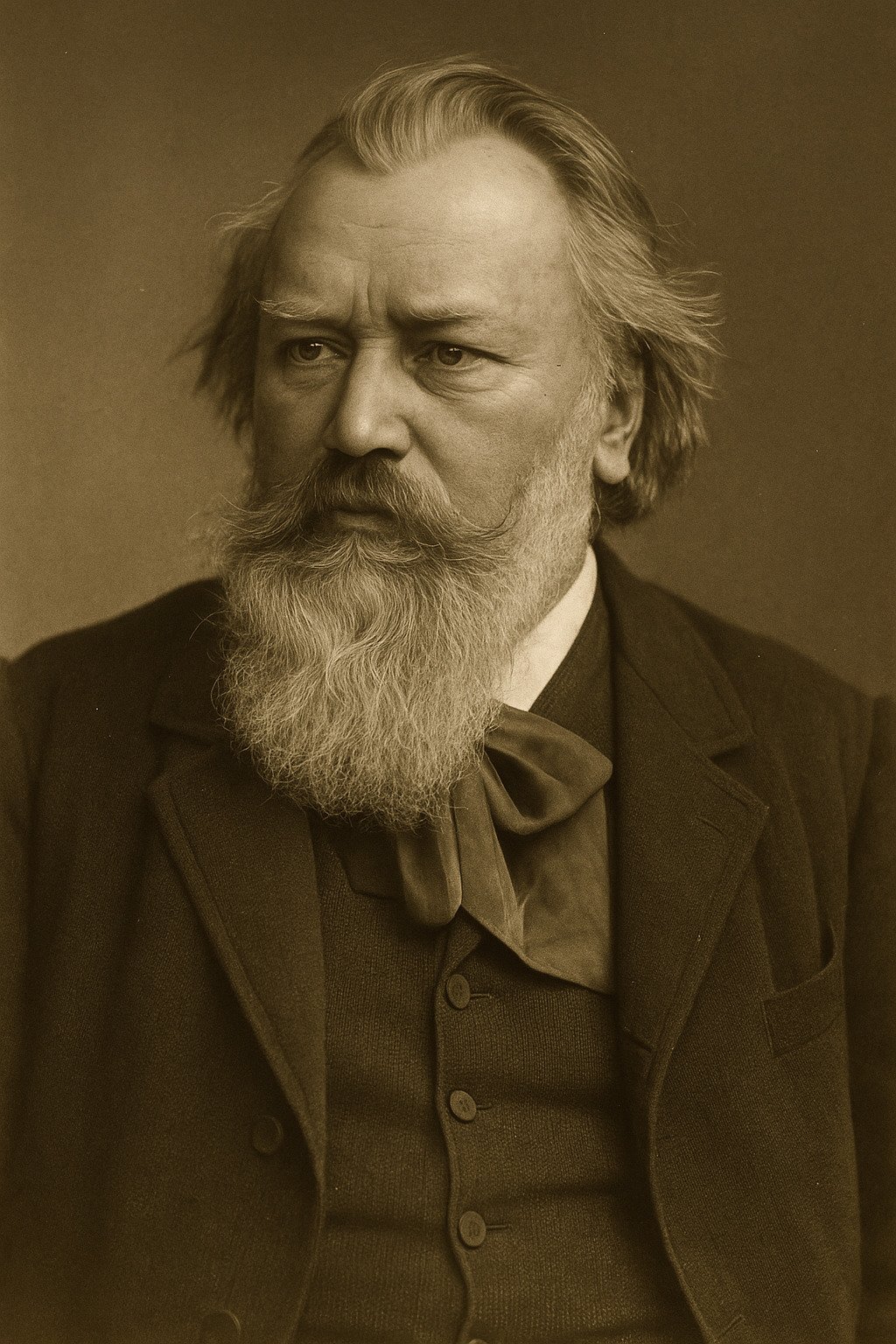
JOHANNES BRAHMS (English)
Johannes Brahms was born in Hamburg on May 7, 1833, in a modest household shaped by music and discipline. His father, a double-bass player, offered early guidance. Yet, his determination and rigorous study soon distinguished him from other young musicians. During childhood, he performed in local venues, developing remarkable technique and a refined ear. Consequently, this early exposure built the foundation for his later mastery. By 1853, he met Robert and Clara Schumann, a pivotal connection that transformed his artistic direction.
Rise to Artistic Prominence and Johannes Brahms’s Creative Maturity
As Johannes Brahms matured, he embraced classical traditions while adding a bold personal voice. His works from the 1850s to 1870s reveal disciplined craft and expressive depth. Moreover, the publication of his First Piano Concerto in 1859 demonstrated his ambition. Although its premiere received mixed reactions, its structure and contrasts displayed a confident creator.
Between 1862 and 1863, Brahms settled in Vienna, a cultural center that welcomed his artistry. There he directed choirs, refined orchestral writing, and deepened his understanding of counterpoint. His German Requiem, completed in 1868, marked a turning point. This monumental work honored his mother’s death in 1865 and explored themes of life, consolation, and mortality. Furthermore, it elevated his reputation across Europe.
Johannes Brahms and His Symphonic Achievements
The long-awaited Symphony No. 1, finally premiered in 1876, confirmed Johannes Brahms as a leading symphonic voice. Although he faced comparisons to Beethoven, he persisted with unwavering conviction. His next symphonies—completed in 1877, 1883, and 1885—combined structural clarity with lyrical warmth. Additionally, Brahms produced chamber masterpieces, including the Piano Quartets, the Violin Sonatas, and the String Quintets, which still anchor today’s repertoire. Each composition reflects intellectual balance, emotional resonance, and careful thematic development.
Legacy, Influence, and the Final Years of Johannes Brahms
During the 1880s and 1890s, Johannes Brahms enjoyed international acclaim. His friendship with violinist Joseph Joachim inspired several essential works. Likewise, his collaboration with conductor Hans von Bülow shaped the interpretation of his symphonies. In 1891, he composed the Clarinet Trio and Clarinet Quintet, both inspired by clarinetist Richard Mühlfeld. These late compositions reveal elegant restraint, shimmering textures, and profound maturity.
Brahms’s health declined after 1896, following Clara Schumann’s death. Even so, he completed significant piano pieces, maintaining artistic clarity. He died in Vienna on April 3, 1897, leaving a legacy defined by craftsmanship, emotional depth, and enduring influence. Today, Johannes Brahms remains a central figure in Western music, admired for works that combine classical structure with timeless human expression.
